Thank you for visiting SNEWPapers!
Sign up free
The Enquirer
Richmond, Henrico County, Virginia
What is this article about?
In district court, the case Bull vs. Caldwell involved a dispute over testimony admissibility regarding an erased note. Chief Justice Nicholson stated he is not bound by British decisions except for their reason and equity. The court took the matter under advisement.
Clipping
OCR Quality
Full Text
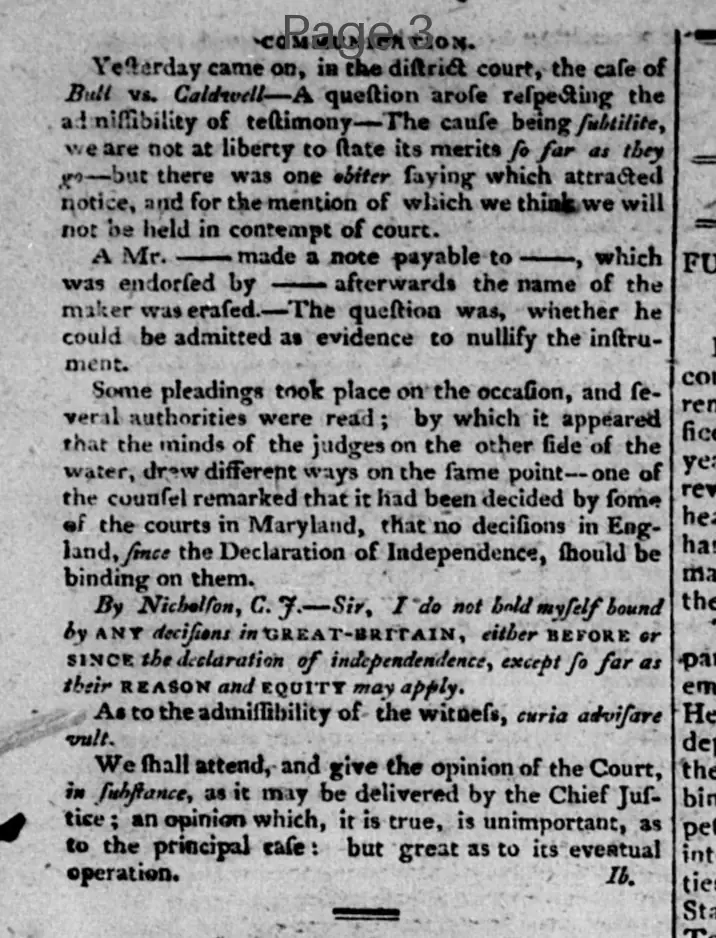
A Mr. -- made a note payable to -- which was endorsed by --- afterwards the name of the maker was erased. The question was, whether he could be admitted as evidence to nullify the instrument.
Some pleadings took place on the occasion, and several authorities were read; by which it appeared that the minds of the judges on the other side of the water, drew different ways on the same point. One of the counsel remarked that it had been decided by some of the courts in Maryland, that no decisions in England, since the Declaration of Independence, should be binding on them.
By Nicholson, C. J. -- Sir, I do not hold myself bound by ANY decisions in GREAT BRITAIN, either BEFORE or since the declaration of independence, except so far as their REASON and EQUITY may apply.
As to the admissibility of the witness, curia advisare vult.
We shall attend, and give the opinion of the Court, in substance, as it may be delivered by the Chief Justice; an opinion which, it is true, is unimportant, as to the principal case: but great as to its eventual operation.
What sub-type of article is it?
What keywords are associated?
What entities or persons were involved?
Domestic News Details
Event Date
Yesterday
Key Persons
Outcome
curia advisare vult; opinion to be delivered later.
Event Details
Case of Bull vs. Caldwell in district court raised question on admissibility of testimony for an erased note. Pleadings and authorities discussed, including Maryland courts rejecting post-Independence English decisions. Nicholson, C.J., remarked not bound by any British decisions except for reason and equity.