Thank you for visiting SNEWPapers!
Sign up free
Editorial
March 4, 1952
Atlanta Daily World
Atlanta, Fulton County, Georgia
What is this article about?
In 1952, William Gordon of the Atlanta Daily World honors the 125th anniversary of the Negro Press, praising its role since 1827 in fostering racial dignity, fighting for freedom and citizenship, overcoming barriers, and advancing social progress for African Americans.
Clipping
OCR Quality
100%
Excellent
Full Text
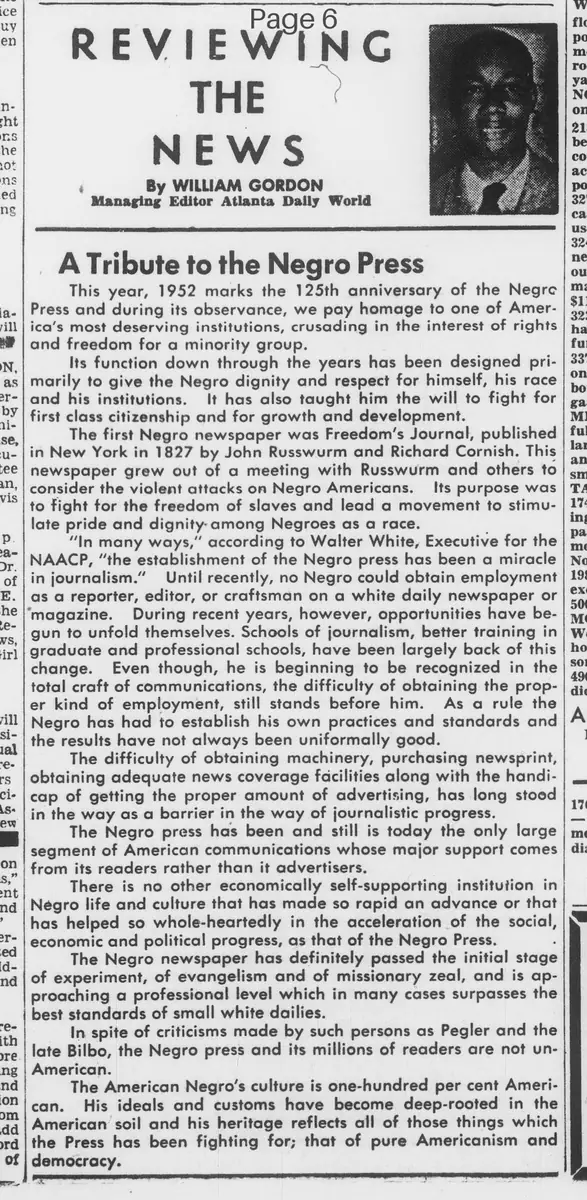
REVIEWING
THE
NEWS
By WILLIAM GORDON
Managing Editor Atlanta Daily World
A Tribute to the Negro Press
This year, 1952 marks the 125th anniversary of the Negro
Press and during its observance, we pay homage to one of America's most deserving institutions, crusading in the interest of rights
and freedom for a minority group.
Its function down through the years has been designed primarily to give the Negro dignity and respect for himself, his race
and his institutions. It has also taught him the will to fight for
first class citizenship and for growth and development.
The first Negro newspaper was Freedom's Journal, published
in New York in 1827 by John Russwurm and Richard Cornish. This
newspaper grew out of a meeting with Russwurm and others to
consider the violent attacks on Negro Americans.
Its purpose was
to fight for the freedom of slaves and lead a movement to stimulate pride and dignity among Negroes as a race.
"In many ways," according to Walter White, Executive for the
NAACP, "the establishment of the Negro press has been a miracle
in journalism." Until recently, no Negro could obtain employment
as a reporter, editor, or craftsman on a white daily newspaper or
magazine.
During recent years, however, opportunities have begun to unfold themselves. Schools of journalism, better training in
graduate and professional schools, have been largely back of this
change. Even though, he is beginning to be recognized in the
total craft of communications, the difficulty of obtaining the proper kind of employment, still stands before him. As a rule the
Negro has had to establish his own practices and standards and
the results have not always been uniformly good.
The difficulty of obtaining machinery, purchasing newsprint,
obtaining adequate news coverage facilities along with the handicap of getting the proper amount of advertising, has long stood
in the way as a barrier in the way of journalistic progress.
The Negro press has been and still is today the only large
segment of American communications whose major support comes
from its readers rather than it advertisers.
There is no other economically self-supporting institution in
Negro life and culture that has made so rapid an advance or that
has helped so whole-heartedly in the acceleration of the social,
economic and political progress, as that of the Negro Press.
The Negro newspaper has definitely passed the initial stage
of experiment, of evangelism and of missionary zeal, and is approaching a professional level which in many cases surpasses the
best standards of small white dailies.
In spite of criticisms made by such persons as Pegler and the
late Bilbo, the Negro press and its millions of readers are not un-
American.
The American Negro's culture is one-hundred per cent American.
His ideals and customs have become deep-rooted in the
American soil and his heritage reflects all of those things which
the Press has been fighting for; that of pure Americanism and
democracy.
THE
NEWS
By WILLIAM GORDON
Managing Editor Atlanta Daily World
A Tribute to the Negro Press
This year, 1952 marks the 125th anniversary of the Negro
Press and during its observance, we pay homage to one of America's most deserving institutions, crusading in the interest of rights
and freedom for a minority group.
Its function down through the years has been designed primarily to give the Negro dignity and respect for himself, his race
and his institutions. It has also taught him the will to fight for
first class citizenship and for growth and development.
The first Negro newspaper was Freedom's Journal, published
in New York in 1827 by John Russwurm and Richard Cornish. This
newspaper grew out of a meeting with Russwurm and others to
consider the violent attacks on Negro Americans.
Its purpose was
to fight for the freedom of slaves and lead a movement to stimulate pride and dignity among Negroes as a race.
"In many ways," according to Walter White, Executive for the
NAACP, "the establishment of the Negro press has been a miracle
in journalism." Until recently, no Negro could obtain employment
as a reporter, editor, or craftsman on a white daily newspaper or
magazine.
During recent years, however, opportunities have begun to unfold themselves. Schools of journalism, better training in
graduate and professional schools, have been largely back of this
change. Even though, he is beginning to be recognized in the
total craft of communications, the difficulty of obtaining the proper kind of employment, still stands before him. As a rule the
Negro has had to establish his own practices and standards and
the results have not always been uniformly good.
The difficulty of obtaining machinery, purchasing newsprint,
obtaining adequate news coverage facilities along with the handicap of getting the proper amount of advertising, has long stood
in the way as a barrier in the way of journalistic progress.
The Negro press has been and still is today the only large
segment of American communications whose major support comes
from its readers rather than it advertisers.
There is no other economically self-supporting institution in
Negro life and culture that has made so rapid an advance or that
has helped so whole-heartedly in the acceleration of the social,
economic and political progress, as that of the Negro Press.
The Negro newspaper has definitely passed the initial stage
of experiment, of evangelism and of missionary zeal, and is approaching a professional level which in many cases surpasses the
best standards of small white dailies.
In spite of criticisms made by such persons as Pegler and the
late Bilbo, the Negro press and its millions of readers are not un-
American.
The American Negro's culture is one-hundred per cent American.
His ideals and customs have become deep-rooted in the
American soil and his heritage reflects all of those things which
the Press has been fighting for; that of pure Americanism and
democracy.
What sub-type of article is it?
Social Reform
What keywords are associated?
Negro Press
125th Anniversary
Freedom's Journal
Racial Dignity
Civil Rights
Naacp
Journalism Barriers
Americanism
What entities or persons were involved?
Negro Press
Freedom's Journal
John Russwurm
Richard Cornish
Walter White
Naacp
Pegler
Bilbo
Editorial Details
Primary Topic
Tribute To The Negro Press On Its 125th Anniversary
Stance / Tone
Homage And Praise For Contributions To Racial Dignity And Civil Rights
Key Figures
Negro Press
Freedom's Journal
John Russwurm
Richard Cornish
Walter White
Naacp
Pegler
Bilbo
Key Arguments
Negro Press Gives Dignity And Respect To The Negro Race And Institutions
Teaches The Will To Fight For First Class Citizenship And Growth
First Newspaper Freedom's Journal Published In New York In 1827 To Fight For Slaves' Freedom And Racial Pride
Establishment Of Negro Press A Miracle In Journalism Due To Exclusion From White Media
Recent Opportunities In Journalism From Better Training But Employment Barriers Remain
Challenges Include Obtaining Machinery, Newsprint, Coverage, And Advertising
Major Support From Readers Rather Than Advertisers
Rapid Advance Aiding Social, Economic, And Political Progress
Approaching Professional Level Surpassing Some White Dailies
Negro Press And Readers Are Fully American Despite Criticisms