Thank you for visiting SNEWPapers!
Sign up free
The Daily Worker
Chicago, Cook County, Illinois
What is this article about?
William Z. Foster analyzes the expulsion of Trotsky, Zinoviev, and other Opposition leaders from the Russian Communist Party due to their deviation from Leninist policies, particularly on building socialism without European revolution aid and peasant alliances. Stalin's majority upholds worker-peasant cooperation amid internal factional struggles.
Clipping
OCR Quality
Full Text
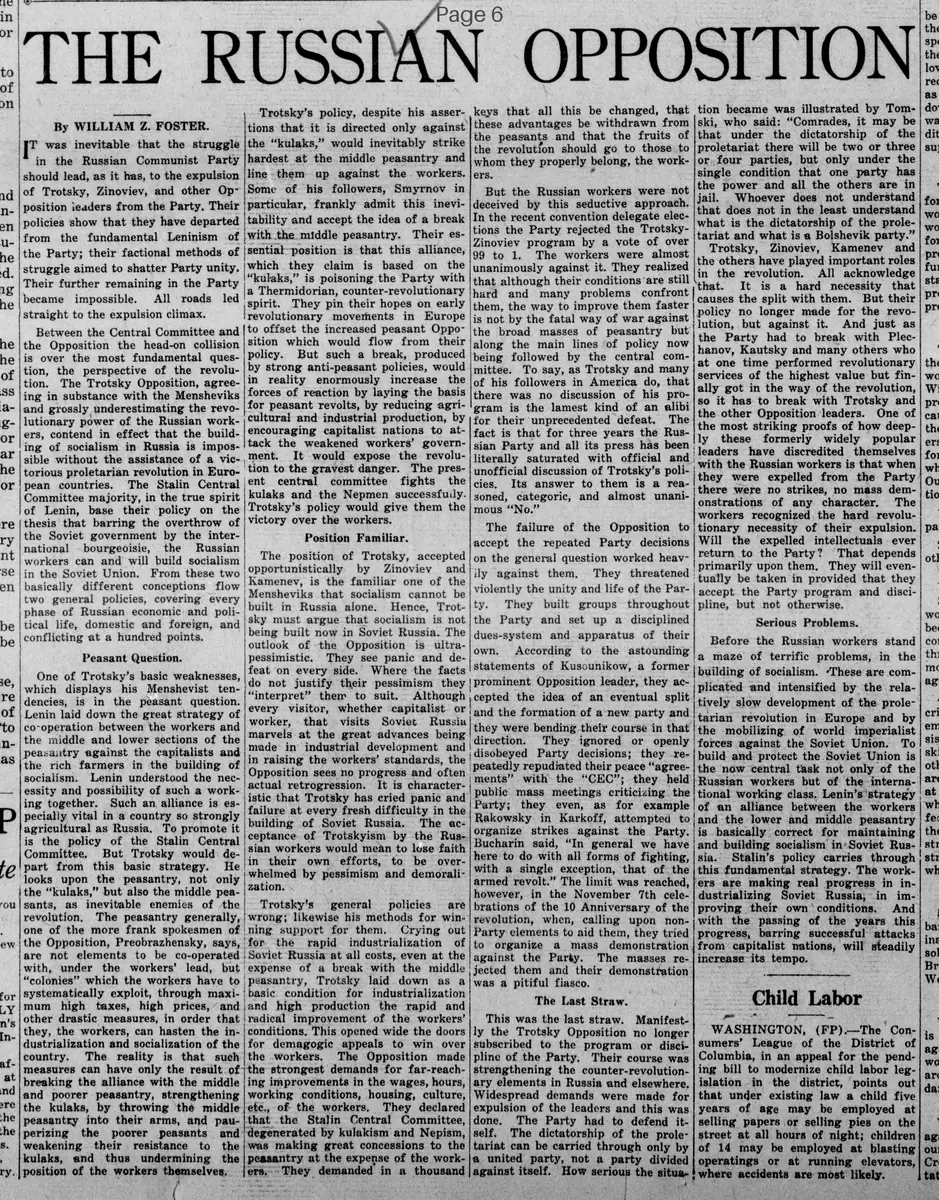
By WILLIAM Z. FOSTER.
IT was inevitable that the struggle in the Russian Communist Party should lead, as it has, to the expulsion of Trotsky, Zinoviev, and other Opposition leaders from the Party. Their policies show that they have departed from the fundamental Leninism of the Party; their factional methods of struggle aimed to shatter Party unity. Their further remaining in the Party became impossible. All roads led straight to the expulsion climax.
Between the Central Committee and the Opposition the head-on collision is over the most fundamental question, the perspective of the revolution. The Trotsky Opposition, agreeing in substance with the Mensheviks and grossly underestimating the revolutionary power of the Russian workers, contend in effect that the building of socialism in Russia is impossible without the assistance of a victorious proletarian revolution in European countries. The Stalin Central Committee majority, in the true spirit of Lenin, base their policy on the thesis that barring the overthrow of the Soviet government by the international bourgeoisie, the Russian workers can and will build socialism in the Soviet Union. From these two basically different conceptions flow two general policies, covering every phase of Russian economic and political life, domestic and foreign, and conflicting at a hundred points.
Peasant Question.
One of Trotsky's basic weaknesses, which displays his Menshevist tendencies, is in the peasant question. Lenin laid down the great strategy of co-operation between the workers and the middle and lower sections of the peasantry against the capitalists and the rich farmers in the building of socialism. Lenin understood the necessity and possibility of such a working together. Such an alliance is especially vital in a country so strongly agricultural as Russia. To promote it is the policy of the Stalin Central Committee. But Trotsky would depart from this basic strategy. He looks upon the peasantry, not only the "kulaks," but also the middle peasants, as inevitable enemies of the revolution. The peasantry generally, one of the more frank spokesmen of the Opposition, Preobrazhensky, says, are not elements to be co-operated with, under the workers' lead, but "colonies" which the workers have to systematically exploit, through maximum high taxes, high prices, and other drastic measures, in order that they, the workers, can hasten the industrialization and socialization of the country. The reality is that such measures can have only the result of breaking the alliance with the middle and poorer peasantry, strengthening the kulaks, by throwing the middle peasantry into their arms, and pauperizing the poorer peasants and weakening their resistance to the kulaks, and thus undermining the position of the workers themselves.
Trotsky's policy, despite his assertions that it is directed only against the "kulaks," would inevitably strike hardest at the middle peasantry and line them up against the workers. Some of his followers, Smyrnov in particular, frankly admit this inevitability and accept the idea of a break with the middle peasantry. Their essential position is that this alliance, which they claim is based on the "kulaks," is poisoning the Party with a Thermidorian, counter-revolutionary spirit. They pin their hopes on early revolutionary movements in Europe to offset the increased peasant Opposition which would flow from their policy. But such a break, produced by strong anti-peasant policies, would in reality enormously increase the forces of reaction by laving the basis for peasant revolts, by reducing agricultural and industrial production, by encouraging capitalist nations to attack the weakened workers' government. It would expose the revolution to the gravest danger. The present central committee fights the kulaks and the Nepmen successfully. Trotsky's policy would give them the victory over the workers.
Position Familiar.
The position of Trotsky, accepted opportunistically by Zinoviev and Kamenev, is the familiar one of the Mensheviks that socialism cannot be built in Russia alone. Hence, Trotsky must argue that socialism is not being built now in Soviet Russia. The outlook of the Opposition is ultra-pessimistic. They see panic and defeat on every side. Where the facts do not justify their pessimism they "interpret" them to suit. Although every visitor, whether capitalist or worker, that visits Soviet Russia marvels at the great advances being made in industrial development and in raising the workers' standards, the Opposition sees no progress and often actual retrogression. It is characteristic that Trotsky has cried panic and failure at every fresh difficulty in the building of Soviet Russia. The acceptance of Trotskyism by the Russian workers would mean to lose faith in their own efforts, to be overwhelmed by pessimism and demoralization.
Trotsky's general policies are wrong; likewise his methods for winning support for them. Crying out for the rapid industrialization of Soviet Russia at all costs, even at the expense of a break with the middle peasantry, Trotsky laid down as a basic condition for industrialization and high production the rapid and radical improvement of the workers conditions. This opened wide the doors for demagogic appeals to win over the workers. The Opposition made the strongest demands for far-reaching improvements in the wages, hours, working conditions, housing, culture, etc., of the workers. They declared that the Stalin Central Committee, degenerated by kulakism and Nepism, was making great concessions to the peasantry at the expense of the workers. They demanded in a thousand keys that all this be changed, that these advantages be withdrawn from the peasants and that the fruits of the revolution should go to those to whom they properly belong, the workers.
But the Russian workers were not deceived by this seductive approach. In the recent convention delegate elections the Party rejected the Trotsky-Zinoviev program by a vote of over 99 to 1. The workers were almost unanimously against it. They realized that although their conditions are still hard and many problems confront them, the way to improve them faster is not by the fatal way of war against the broad masses of peasantry but along the main lines of policy now being followed by the central committee. To say, as Trotsky and many of his followers in America do, that there was no discussion of his program is the lamest kind of an alibi for their unprecedented defeat. The fact is that for three years the Russian Party and all its press has been literally saturated with official and unofficial discussion of Trotsky's policies. Its answer to them is a reasoned, categoric, and almost unanimous "No."
The failure of the Opposition to accept the repeated Party decisions on the general question worked heavily against them. They threatened violently the unity and life of the Party. They built groups throughout the Party and set up a disciplined dues-system and apparatus of their own. According to the astounding statements of Kusounikow, a former prominent Opposition leader, they accepted the idea of an eventual split and the formation of a new party and they were bending their course in that direction. They ignored or openly disobeyed Party decisions; they repeatedly repudiated their peace "agreements" with the "CEC"; they held public mass meetings criticizing the Party; they even, as for example Rakowsky in Karkoff, attempted to organize strikes against the Party. Bucharin said, "In general we have here to do with all forms of fighting, with a single exception, that of the armed revolt." The limit was reached, however, in the November 7th celebrations of the 10th Anniversary of the revolution, when, calling upon non-Party elements to aid them, they tried to organize a mass demonstration against the Party. The masses rejected them and their demonstration was a pitiful fiasco.
The Last Straw.
This was the last straw. Manifestly the Trotsky Opposition no longer subscribed to the program or discipline of the Party. Their course was strengthening the counter-revolutionary elements in Russia and elsewhere. Widespread demands were made for expulsion of the leaders and this was done. The Party had to defend itself. The dictatorship of the proletariat can be carried through only by a united party, not a party divided against itself. How serious the situation became was illustrated by Tomski, who said: "Comrades, it may be that under the dictatorship of the proletariat there will be two or three or four parties, but only under the single condition that one party has the power and all the others are in jail. Whoever does not understand that does not in the least understand what is the dictatorship of the proletariat and what is a Bolshevik party."
Trotsky, Zinoviev, Kamenev and the others have played important roles in the revolution. All acknowledge that. It is a hard necessity that causes the split with them. But their policy no longer made for the revolution, but against it. And just as the Party had to break with Plekhanov, Kautsky and many others who at one time performed revolutionary services of the highest value but finally got in the way of the revolution, so it has to break with Trotsky and the other Opposition leaders. One of the most striking proofs of how deeply these formerly widely popular leaders have discredited themselves with the Russian workers is that when they were expelled from the Party there were no strikes, no mass demonstrations of any character. The workers recognized the hard revolutionary necessity of their expulsion.
Will the expelled intellectuals ever return to the Party? That depends primarily upon them. They will eventually be taken in provided that they accept the Party program and discipline, but not otherwise.
Serious Problems.
Before the Russian workers stand a maze of terrific problems, in the building of socialism. These are complicated and intensified by the relatively slow development of the proletarian revolution in Europe and by the mobilizing of world imperialist forces against the Soviet Union. To build and protect the Soviet Union is the now central task not only of the Russian workers but of the international working class. Lenin's strategy of an alliance between the workers and the lower and middle peasantry is basically correct for maintaining and building socialism in Soviet Russia. Stalin's policy carries through this fundamental strategy. The workers are making real progress in industrializing Soviet Russia, in improving their own conditions. And with the passing of the years this progress, barring successful attacks from capitalist nations, will steadily increase its tempo.
What sub-type of article is it?
What keywords are associated?
What entities or persons were involved?
Where did it happen?
Foreign News Details
Primary Location
Soviet Russia
Event Date
November 7th, 10th Anniversary Of The Revolution
Key Persons
Outcome
expulsion of trotsky, zinoviev, and other opposition leaders from the russian communist party; rejection of opposition program by over 99 to 1 vote; failed demonstration on november 7th.
Event Details
The article details the internal struggle in the Russian Communist Party leading to the expulsion of Trotsky and other Opposition leaders for deviating from Leninist policies on building socialism independently in the Soviet Union and maintaining worker-peasant alliances. The Stalin-led Central Committee upholds cooperation with middle and poorer peasantry against kulaks, contrasting Trotsky's view of exploiting peasants for rapid industrialization. Opposition's factional activities, including building parallel structures and attempting demonstrations, culminated in their expulsion to preserve Party unity.