Thank you for visiting SNEWPapers!
Sign up free
Constitutional Whig
Richmond, Virginia
What is this article about?
The writer defends his testimony before a House committee against Mr. Crawford's accusations of perjury regarding the Bank of Edwardsville's public deposits. He argues Crawford deliberately timed the attack during his absence, questions the delay and motives, and reaffirms the bank's solvency and his notifications to the Treasury Secretary.
Clipping
OCR Quality
Full Text
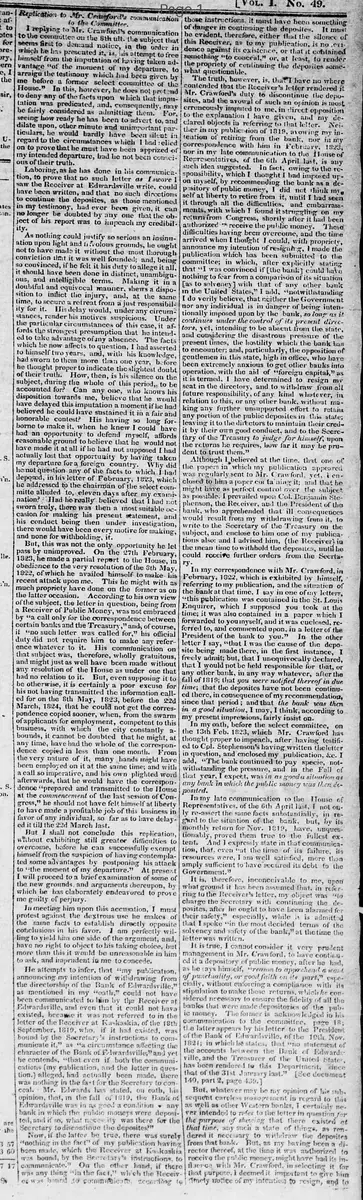
Laboring, as he has done in his communication, to prove that no such letter as I swore I saw the Receiver at Edwardsville write, could have been written, and that no such directions to continue the deposites, as those mentioned in my testimony, had ever been given, it can no longer be doubted by any one that the object of his report was to impeach my credibility.
As nothing could justify so serious an insinuation upon light and frivolous grounds, he ought not to have made it without the most thorough conviction that it was well founded; and, being so convinced, if he felt it his duty to allege it at all, it should have been done in distinct, unambiguous, and intelligible terms. Making it in a doubtful and equivocal manner, shews a disposition to inflict the injury, and, at the same time, to secure a retreat from a just responsibility for it. His delay would, under any circumstances, render his motives suspicious. Under the particular circumstances of this case, it affords the strongest presumption that he intended to take advantage of my absence. The facts which he now affects to question, I had asserted to himself two years, and, with his knowledge, had sworn to them more than one year, before he thought proper to indicate the slightest doubt of their truth. How, then, is his silence on the subject, during the whole of this period, to be accounted for? Can any one, who knows his disposition towards me, believe that he would have delayed this imputation a moment if he had believed he could have sustained it in a fair and honorable contest? His having so long forborne to make it, when he knew I could have had an opportunity to defend myself, affords reasonable ground to believe that he would not have made it at all if he had not supposed I had actually lost that opportunity by having taken my departure for a foreign country. Why did he not question any of the facts to which I had deposed, in his letter of February, 1823, which he addressed to the chairman of the select committee alluded to, eleven days after my examination? Had he really believed that I had not sworn truly, there was then a most suitable occasion for making his present statement, and his conduct being then under investigation, there would have been every motive for making, and none for withholding, it.
But, this was not the only opportunity he let pass by unimproved. On the 27th February, 1823, he made a partial report to the House, in obedience to the very resolution of the 8th May, 1822, of which he availed himself to make his recent attack upon me. This he might with as much propriety have done on the former as on the latter occasion. According to his own view of the subject, the letter in question, being from a Receiver of Public Money, was not embraced by "a call only for the correspondence between certain banks and the Treasury," and, of course, if "no such letter was called for," his official duty did not require him to make any reference whatever to it. His communication on that subject was, therefore, wholly gratuitous, and might just as well have been made without any resolution of the House as under one that had no relation to it. But, even supposing it to be otherwise, it is certainly a poor excuse for his not having transmitted the information called for on the 8th May, 1823, before the 22d March, 1824, that he could not get the correspondence copied sooner, when, from the swarm of applicants for employment, competent to this business, with which the city constantly abounds, it cannot be doubted that he might, at any time, have had the whole of the correspondence copied in less than one month. From the very nature of it, many hands might have been employed on it at the same time; and with a call so imperative, and his own plighted word afterwards, that he would have the correspondence "prepared and transmitted to the House at the commencement of the last session of Congress," he should not have felt himself at liberty to have made a profitable job of this business in favor of any individual, so far as to have delayed it till the 22d March last.
But I shall not conclude this replication, without exhibiting still greater difficulties to overcome, before he can successfully exempt himself from the suspicion of having contemplated some advantages by postponing his attack to "the moment of my departure." At present I will proceed to a brief examination of some of the new grounds, and arguments thereupon, by which he has elaborately endeavored to prove me guilty of perjury.
In meeting him upon this accusation, I must protest against the dextrous use he makes of the same facts to establish directly opposite conclusions in his favor. I am perfectly willing to yield him one side of the argument, and, have no right to object to his taking choice, but more than this it would be unreasonable in him to ask, and imprudent in me to concede.
He attempts to infer, that "my publication, announcing my intention of withdrawing from the directorship of the Bank of Edwardsville," as mentioned in my "oath," could not have been communicated to him by the Receiver at Edwardsville, and even that it could not have existed, because it was not referred to in the letter of the Receiver at Kaskaskia, of the 18th September, 1819, who, if it had existed, was bound by the Secretary's instructions to communicate it," as "a circumstance affecting the character of the Bank of Edwardsville;" and yet he contends, "that even if both the communications (my publication, and the letter in question.) alleged, had actually been made, there was nothing in the fact for the Secretary to conceal. Mr. Edwards has stated, on oath, his opinion, that, in the fall of 1819, the Bank of Edwardsville was in as good a condition as any bank in which the public moneys were deposited, and if so, what necessity was there for the Secretary to discontinue the deposites?"
Now, if the latter be true, there was surely "nothing in the fact" of my publication having been made, which the Receiver at Kaskaskia was bound, by the Secretary's instructions, to communicate." On the other hand, if there was any thing "in the act," which the Receiver was bound to communicate, according to those instructions, it must have been something of danger in continuing the deposites. It must be evident, therefore, either that the silence of this Receiver, as to my publication, is no evidence against its existence, or that it contained something "to conceal," or, at least, to render the propriety of continuing the deposites somewhat questionable.
The truth, however, is, that I have nowhere contended that the Receiver's letter rendered it Mr. Crawford's duty to discontinue the deposites, and the avowal of such an opinion is most erroneously imputed to me, in direct opposition to the explanation I have given, and my declared objects in referring to that letter. Neither in my publication of 1819, avowing my intention of retiring from the bank, nor in my correspondence with him in February, 1823, nor in my late communication to the House of Representatives, of the 6th April last, is any such idea suggested. In fact, owing to the responsibility, which I thought I had imposed on myself, by recommending the banks as a depository of public money, I did not think myself at liberty to retire from it, until I had seen it through all the difficulties, and embarrassments, with which I found it struggling on my return from Congress, shortly after it had been authorized to receive the public money. These difficulties having been overcome, and the time arrived when I thought I could, with propriety, announce my intention of resigning, I made the publication which has been submitted to the committee; in which, after explicitly stating that "I was convinced if [the bank] could have nothing to fear from a comparison of its situation [as to solvency] with that of any other bank in the United States," I add, "notwithstanding I do verily believe, that neither the Government nor any individual is in danger of being intentionally imposed upon by the bank, so long as it continues under the control of its present directors, yet, intending to be absent from this state, and considering the disastrous pressure of the present times, the hostility which the bank has to encounter; and, particularly, the opposition of gentlemen in this state, high in office, who have been extremely anxious to get other banks into operation, with the aid of "foreign capital," as it is termed, I have determined to resign my seat in the directory, and to withdraw from all future responsibility, of any kind whatever, in relation to this, or any other bank, without making any further unsupported effort to retain any portion of the public deposites in this state; leaving it to the directors to maintain their credit by their own good conduct, and to the Secretary of the Treasury to judge for himself, upon the returns he requires, how far it may be prudent to trust them."
Although I believed at the time, that one of the papers in which my publication appeared was regularly sent to Mr. Crawford, yet, I enclosed to him a paper containing it; and that he might have as perfect control over the subject as possible, I prevailed upon Col. Benjamin Stephenson, the Receiver, and the President of the bank, who apprehended that ill consequences would result from my withdrawing from it, to write to the Secretary of the Treasury on the subject, and enclose to him one of my publications also: and I advised him, (the Receiver) in the mean time to withhold the deposites, until he could receive further orders from the Secretary.
In my correspondence with Mr. Crawford, in February, 1823, which is exhibited by himself, referring to my publication, and the situation of the bank at that time, I say in one of my letters, "this publication was contained in the St. Louis Enquirer, which I supposed you took at the time; it was also contained in a paper which I forwarded to you myself, and it was enclosed, referred to, and commented upon, in a letter of the President of the bank to you." In the other letter I say, "that I was the cause of the deposit being made there, in the first instance, I freely admit; but, that I unequivocally declared, that I would not be held responsible for that, or any other bank, in any way whatever, after the fall of 1819; that you were notified thereof in due time; that the deposites have not been continued there, in consequence of my recommendation, since that period; and that the bank was then in a good situation, I may, I think, according to my present impressions, fairly insist on."
In my oath, before the select committee, on the 13th Feb. 1823, which Mr. Crawford has thought proper to impeach, after having testified to Col. Stephenson's having written the letter in question, and enclosed my publication, &c. I add, "The bank continued to pay specie, notwithstanding the pressure, and in the Fall of that year, I expect, was in as good a situation as any bank in which the public money was then deposited."
In my late communication to the House of Representatives, of the 6th April last, I not only re-assert the same facts substantially, in regard to the situation of the bank, but, by its monthly return for Nov. 1819, have, unquestionably, proved them true to the fullest extent. And I expressly state in that communication, that even "at the time of its failure, its resources were, I am well satisfied, more than amply sufficient to have secured its debt to the Government."
It is, therefore, inconceivable to me, upon what ground it has been assumed that, in referring to the Receiver's letter, my object was "to charge the Secretary with continuing the deposites, after he ought to have been alarmed for their safety," especially, while it is admitted that I spoke "in the most decided terms of the solvency and safety of the bank," at the time the letter was written.
It is true, I cannot consider it very prudent management in Mr. Crawford, to have continued it a depository of public money, after he had, as he says himself, "reason to apprehend a want of punctuality, or good faith on its part," especially, without enforcing a compliance with its stipulation to make those returns, which he considered necessary to ensure the fidelity of all the banks that were made depositories of the public money. The former is acknowledged in his communication to the committee, page 18: the latter appears by his letter to the President of the Bank of Edwardsville, of the 10th Nov. 1821; in which he states, that "no statement of the accounts between the Bank of Edwardsville, and the Treasurer of the United States, has been rendered to this Department, since that of the 31st January last." [See document 140, part 2, page 439.]
But, whatever may be my opinion of his subsequent careless management in regard to this as well as other Western banks, I certainly never intended to refer to the letter in question for the purpose of shewing that there existed at that time, any such a state of things, as rendered it necessary to withdraw the deposites from that bank. But, as my having been a director thereof, at the time it was authorized to receive the public money, might have had its influence with Mr. Crawford, in selecting it for that purpose, I deemed it important to give him ample notice of my intention to resign, and to withdraw from all future responsibility in relation to it.
What sub-type of article is it?
What themes does it cover?
What keywords are associated?
What entities or persons were involved?
Letter to Editor Details
Recipient
The Committee
Main Argument
the writer defends his credibility against mr. crawford's delayed and equivocal accusations of perjury in testimony about the bank of edwardsville, arguing the timing exploited his absence and reaffirming the accuracy of his statements on the bank's solvency and notifications to the treasury.
Notable Details