Thank you for visiting SNEWPapers!
Sign up free
Editorial
March 10, 1847
Alexandria Gazette
Alexandria, Alexandria County, District Of Columbia
What is this article about?
Daniel Webster's Senate remarks on March 3, 1847, criticize Northern Democrats and the Liberty Party for supporting Texas annexation in 1845, which expanded slavery, and warn of future conflicts over new territories from the Mexican War, urging caution to preserve constitutional stability.
Clipping
OCR Quality
98%
Excellent
Full Text
REMARKS OF MR. WEBSTER, OF MASS.
ON THE THREE MILLION BILL—[EXTRACT.
In Senate of the U. S. March 3, 1847.
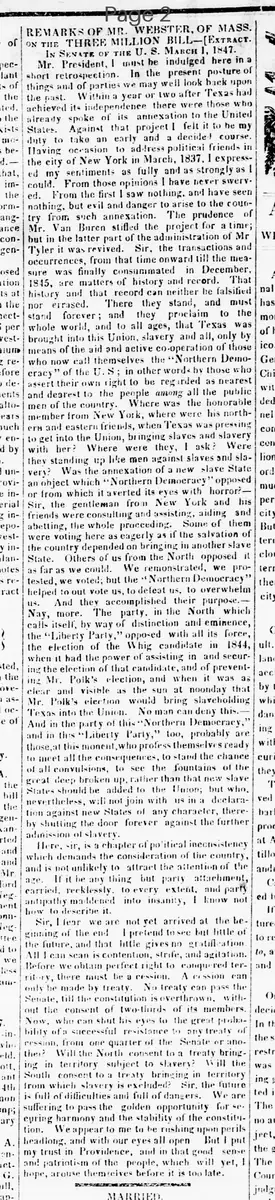
Mr. President, I must be indulged here in a short retrospection. In the present posture of things and of parties we may well look back upon the past. Within a year or two after Texas had achieved its independence there were those who already spoke of its annexation to the United States. Against that project I felt it to be my duty to take an early and a decided course. Having occasion to address political friends in the city of New York in March, 1837, I expressed my sentiments as fully and as strongly as I could. From those opinions I have never swerved. From the first I saw nothing, and have seen nothing, but evil and danger to arise to the country from such annexation. The prudence of Mr. Van Buren stifled the project for a time; but in the latter part of the administration of Mr. Tyler it was revived. Sir, the transactions and occurrences, from that time onward till the measure was finally consummated in December, 1845, are matters of history and record. That history and that record can neither be falsified nor erased. There they stand, and must stand forever; and they proclaim to the whole world, and to all ages, that Texas was brought into this Union, slavery and all, only by means of the aid and active co-operation of those who now call themselves the "Northern Democracy" of the U.S; in other words by those who assert their own right to be regarded as nearest and dearest to the people among all the public men of the country. Where was the honorable member from New York, where were his northern and eastern friends, when Texas was pressing to get into the Union, bringing slaves and slavery with her? Where were they, I ask? Were they standing up like men against slaves and slavery? Was the annexation of a new slave State an object which "Northern Democracy" opposed or from which it averted its eyes with horror?—Sir, the gentleman from New York and his friends were consulting and assisting, aiding and abetting, the whole proceeding. Some of them were voting here as eagerly as if the salvation of the country depended on bringing in another slave State. Others of us from the North opposed it as far as we could. We remonstrated, we protested, we voted; but the "Northern Democracy" helped to out vote us, to defeat us, to overwhelm us.
And they accomplished their purpose.—Nay, more. The party, in the North which calls itself, by way of distinction and eminence, the "Liberty Party," opposed with all its force, the election of the Whig candidate in 1844, when it had the power of assisting in and securing the election of that candidate, and of preventing Mr. Polk's election, and when it was as clear and visible as the sun at noonday that Mr. Polk's election would bring slaveholding Texas into the Union. No man can deny this. And in the party of this "Northern Democracy," and in this "Liberty Party," too, probably are those, at this moment, who profess themselves ready to meet all the consequences, to stand the chance of all convulsions, to see the fountains of the great deep broken up, rather than that new slave States should be added to the Union; but who, nevertheless, will not join with us in a declaration against new States of any character, thereby shutting the door forever against the further admission of slavery.
Here, sir, is a chapter of political inconsistency which demands the consideration of the country, and is not unlikely to attract the attention of the age. If it be any thing but party attachment, carried, recklessly, to every extent, and party antipathy maddened into insanity, I know not how to describe it.
Sir, I fear we are not yet arrived at the beginning of the end. I pretend to see but little of the future, and that little gives no gratification. All I can see is contention, strife, and agitation. Before we obtain perfect right to conquered territory, there must be a cession. A cession can only be made by treaty. No treaty can pass the Senate, till the constitution is overthrown, without the consent of two-thirds of its members. Now, who can shut his eyes to the great probability of a successful resistance to any treaty of cession, from one quarter of the Senate or another? Will the North consent to a treaty bringing in territory subject to slavery? Will the South consent to a treaty bringing in territory from which slavery is excluded? Sir, the future is full of difficulties and full of dangers. We are suffering to pass the golden opportunity for securing harmony and the stability of the constitution. We appear to me to be rushing upon perils headlong, and with our eyes all open. But I put my trust in Providence, and in that good sense and patriotism of the people, which will yet, I hope, arouse themselves before it is too late.
ON THE THREE MILLION BILL—[EXTRACT.
In Senate of the U. S. March 3, 1847.
Mr. President, I must be indulged here in a short retrospection. In the present posture of things and of parties we may well look back upon the past. Within a year or two after Texas had achieved its independence there were those who already spoke of its annexation to the United States. Against that project I felt it to be my duty to take an early and a decided course. Having occasion to address political friends in the city of New York in March, 1837, I expressed my sentiments as fully and as strongly as I could. From those opinions I have never swerved. From the first I saw nothing, and have seen nothing, but evil and danger to arise to the country from such annexation. The prudence of Mr. Van Buren stifled the project for a time; but in the latter part of the administration of Mr. Tyler it was revived. Sir, the transactions and occurrences, from that time onward till the measure was finally consummated in December, 1845, are matters of history and record. That history and that record can neither be falsified nor erased. There they stand, and must stand forever; and they proclaim to the whole world, and to all ages, that Texas was brought into this Union, slavery and all, only by means of the aid and active co-operation of those who now call themselves the "Northern Democracy" of the U.S; in other words by those who assert their own right to be regarded as nearest and dearest to the people among all the public men of the country. Where was the honorable member from New York, where were his northern and eastern friends, when Texas was pressing to get into the Union, bringing slaves and slavery with her? Where were they, I ask? Were they standing up like men against slaves and slavery? Was the annexation of a new slave State an object which "Northern Democracy" opposed or from which it averted its eyes with horror?—Sir, the gentleman from New York and his friends were consulting and assisting, aiding and abetting, the whole proceeding. Some of them were voting here as eagerly as if the salvation of the country depended on bringing in another slave State. Others of us from the North opposed it as far as we could. We remonstrated, we protested, we voted; but the "Northern Democracy" helped to out vote us, to defeat us, to overwhelm us.
And they accomplished their purpose.—Nay, more. The party, in the North which calls itself, by way of distinction and eminence, the "Liberty Party," opposed with all its force, the election of the Whig candidate in 1844, when it had the power of assisting in and securing the election of that candidate, and of preventing Mr. Polk's election, and when it was as clear and visible as the sun at noonday that Mr. Polk's election would bring slaveholding Texas into the Union. No man can deny this. And in the party of this "Northern Democracy," and in this "Liberty Party," too, probably are those, at this moment, who profess themselves ready to meet all the consequences, to stand the chance of all convulsions, to see the fountains of the great deep broken up, rather than that new slave States should be added to the Union; but who, nevertheless, will not join with us in a declaration against new States of any character, thereby shutting the door forever against the further admission of slavery.
Here, sir, is a chapter of political inconsistency which demands the consideration of the country, and is not unlikely to attract the attention of the age. If it be any thing but party attachment, carried, recklessly, to every extent, and party antipathy maddened into insanity, I know not how to describe it.
Sir, I fear we are not yet arrived at the beginning of the end. I pretend to see but little of the future, and that little gives no gratification. All I can see is contention, strife, and agitation. Before we obtain perfect right to conquered territory, there must be a cession. A cession can only be made by treaty. No treaty can pass the Senate, till the constitution is overthrown, without the consent of two-thirds of its members. Now, who can shut his eyes to the great probability of a successful resistance to any treaty of cession, from one quarter of the Senate or another? Will the North consent to a treaty bringing in territory subject to slavery? Will the South consent to a treaty bringing in territory from which slavery is excluded? Sir, the future is full of difficulties and full of dangers. We are suffering to pass the golden opportunity for securing harmony and the stability of the constitution. We appear to me to be rushing upon perils headlong, and with our eyes all open. But I put my trust in Providence, and in that good sense and patriotism of the people, which will yet, I hope, arouse themselves before it is too late.
What sub-type of article is it?
Slavery Abolition
Partisan Politics
Constitutional
What keywords are associated?
Texas Annexation
Slavery Expansion
Northern Democracy
Liberty Party
Political Inconsistency
Conquered Territory
Senate Treaty
What entities or persons were involved?
Mr. Webster
Texas
Mr. Van Buren
Mr. Tyler
Northern Democracy
Liberty Party
Mr. Polk
Senate
Editorial Details
Primary Topic
Criticism Of Texas Annexation And Its Expansion Of Slavery
Stance / Tone
Strong Opposition To Slavery Expansion And Political Inconsistency
Key Figures
Mr. Webster
Texas
Mr. Van Buren
Mr. Tyler
Northern Democracy
Liberty Party
Mr. Polk
Senate
Key Arguments
Texas Annexation In 1845 Brought Slavery Into The Union With Northern Democrat Support
Webster Opposed Annexation From 1837 Onward, Seeing Only Evil And Danger
Northern Democrats Aided And Voted For Annexation Despite Slavery
Liberty Party's Opposition To Whig Candidate In 1844 Enabled Polk's Election And Texas Entry
Current Opposition To New Slave States Shows Political Inconsistency
Future Treaties On Conquered Territory Will Face North South Division Over Slavery
Risk Of Constitutional Overthrow Without Compromise On Slavery In New Territories