Thank you for visiting SNEWPapers!
Sign up free
Virginia Argus
Richmond, Virginia
What is this article about?
Letter VII in a historical series to the Virginia Argus editor recounts major Greek wars: Spartan-Messenian conflicts, Persian invasions under Darius and Xerxes (battles at Marathon, Thermopylae, Salamis, Plataea), Greek counteroffensives, and the Peloponnesian War, with key events and figures from ancient sources.
Merged-components note: Merged continuation of historical letter VII on Greek wars.
Clipping
OCR Quality
Full Text
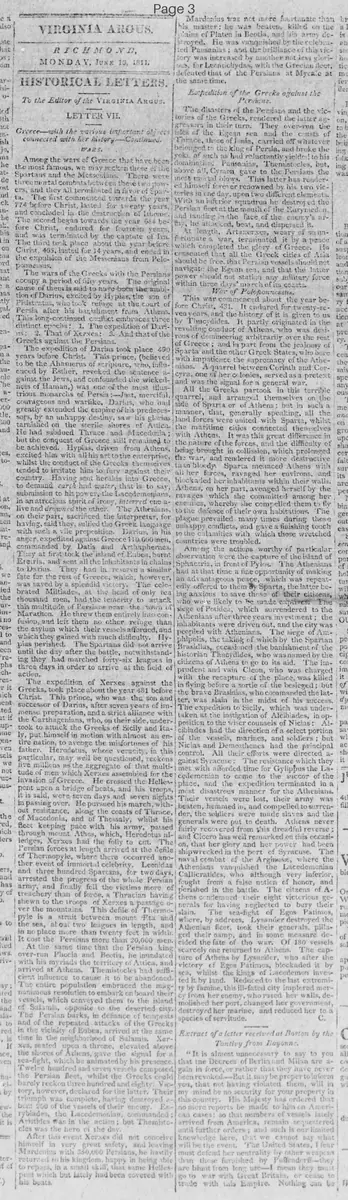
RICHMOND, MONDAY, JUNE 10, 1811.
HISTORICAL LETTERS
To the Editor of the Virginia Argus.
LETTER VII
Greece—with the various important objects connected with her history—Continued.
WARS.
Among the wars of Greece that have been the most famous, we may reckon those of the Spartans and the Messenians. There were three mortal combats between these two powers, and they all terminated in favor of Sparta. The first commenced towards the year 774 before Christ, lasted for twenty years, and concluded in the destruction of Ithome. The second began towards the year 684 before Christ, endured for fourteen years, and was terminated by the capture of Ira. The third took place about the year before Christ, 465, lasted for 14 years, and ended in the expulsion of the Messenians from Peloponnesus.
The wars of the Greeks with the Persians occupy a period of fifty years. The original cause of them is said to have been the ambition of Darius, excited by Hypias, the son of Pisistratus, who took refuge at the court of Persia after his banishment from Athens.
This long-continued conflict embraces three distinct epochs: 1. The expedition of Darius: 2. That of Xerxes: 3. And that of the Greeks against the Persians.
The expedition of Darius took place 490 years before Christ. This prince, (believed to be the Ahasuerus of scripture, who, influenced by Esther, revoked the sentence against the Jews, and confounded the wickedness of Haman,) was one of the most illustrious monarchs of Persia :—Just, merciful. courageous and warlike, Darius, who had greatly extended the empire of his predecessors, by an unhappy destiny, saw his glorious tarnished on the sterile shores of Attica.
He had subdued Thrace and Macedonia: but the conquest of Greece still remained to be achieved. Hypias, driven from Athens, excited him with all his art to the enterprise, whilst the conduct of the Greeks themselves tended to irritate him to fury against their country. Having sent heralds into Greece, to demand earth and water, that is to say, submission to his power, the Lacedemonians, in an atrocious spirit of irony, interred one alive and drowned the other. The Athenians, on their part, sacrificed the interpreter, for having, said they, sullied the Greek language with such a vile proposition. Darius, in his anger, expedited against Greece 110,000 men, commanded by Datis and Artaphernes.
They at first took the island of Eubea, burnt Eretria, and sent all the inhabitants in chains to Darius. They had in reserve a similar fate for the rest of Greece, which, however, was saved by a splendid victory. The celebrated Miltiades, at the head of only ten thousand men, had the temerity to attack this multitude of Persians near the town of Marathon. He threw them entirely into confusion, and left them no other refuge than the asylum which their vessels afforded, and which they gained with much difficulty. Hypias perished. The Spartans did not arrive until the day after the battle, notwithstanding they had marched forty-six leagues in three days in order to arrive at the field of action.
The expedition of Xerxes against the Greeks, took place about the year 481 before Christ. This prince, who was the son and successor of Darius, after seven years of immense preparation, and a strict alliance with the Carthaginians, who, on their side, undertook to attack the Greeks of Sicily and Italy, put himself in motion with almost an entire nation, to avenge the misfortunes of his father. Herodotus, whose veracity, in this particular, may well be questioned, reckons five millions as the aggregate of that multitude of men which Xerxes assembled for the invasion of Greece. He crossed the Hellespont upon a bridge of boats, and his troops, it is said, were seven days and seven nights in passing over. He pursued his march, without resistance, along the coasts of Thrace, of Macedonia, and of Thessaly, whilst his fleet keeping pace with his army, passed through mount Athos, which, Herodotus alleges, Xerxes had the folly to cut. The Persian forces at length arrived at the defile of Thermopylae, where there occurred another event of immortal celebrity. Leonidas and three hundred Spartans, for two days, arrested the progress of the whole Persian army, and finally fell the victims more of treachery than of force, a Thracian having shewn to the troops of Xerxes a passage over the mountains. This defile of Thermopylae is a strait between mount Eta and the sea, about two leagues in length, and in no place more than twenty feet in width. It cost the Persians more than 20,000 men.
At the same time that the Persian king over-run Phocia and Beotia, he inundated with his myriads the territory of Attica, and arrived at Athens. Themistocles had sufficient influence to cause it to be abandoned. The entire population embraced the magnanimous resolution to embark on board their vessels, which conveyed them to the island of Salamis, opposite to the deserted city.
The Persian barks, in defiance of tempests and of the repeated attacks of the Greeks in the vicinity of Eubea, arrived at the same time in the neighborhood of Salamis. Xerxes, seated upon a throne, elevated above the shores of Athens, gave the signal for a sea-fight, which he animated by his presence. Twelve hundred and seven vessels composed the Persian fleet, whilst the Greeks could barely reckon three hundred and eighty. Victory, however, declared for the latter. Their triumph was complete, having destroyed about 200 of the vessels of their enemy. Eurybiades, the Lacedemonian, commanded: Aristides was in the action: but Themistocles was the hero of the day.
After this event Xerxes did not conceive himself in very great safety, and leaving Mardonius with 300,000 Persians, he hastily returned to his kingdom, happy in being able to repass, in a small skiff, that same Hellespont which but lately had been covered with his boats.
Mardonius was not more fortunate than his master: he was beaten, killed on the plains of Plataea in Beotia, and his army destroyed. He was vanquished by the celebrated Pausanias; and the brilliance of this victory was increased by another not less glorious. for Leotychidas, with the Grecian fleet, defeated that of the Persians at Mycale at the same time.
Expedition of the Greeks against the Persians.
The disasters of the Persians and the victories of the Greeks, rendered the latter aggressors in their turn. They over-run the isles of the Aegean sea and the coasts of Thrace, those of Ionia, carried off whatever belonged to the king of Persia, and broke the yoke of such as had reluctantly yielded to his domination. Pausanias, Themistocles, but, above all, Cimon gave to the Persians the most mortal blows. This latter has rendered himself forever renowned by his two victories in one day, upon two different elements. With an inferior squadron he destroyed the Persian fleet at the mouth of the Eurymedon, and landing in the face of the enemy's army, he attacked, beat, and dispersed it.
At length, Artaxerxes. weary of so unfortunate a war, terminated it by a peace which completed the glory of Greece. He consented that all the Greek cities of Asia should be free, that Persian vessels should not navigate the Aegean sea, and that the latter power should not station any military force within three days' march of its coasts.
War of Peloponnesus.
This war commenced about the year before Christ, 431. It endured for twenty-seven years, and the history of it is given to us by Thucydides. It partly originated in the revolting conduct of Athens, who was desirous of domineering arbitrarily over the rest of Greece; and in part from the jealousy of Sparta and the other Greek States, who bore with impatience the supremacy of the Athenians. A quarrel between Corinth and Corcyra, one of her colonies, served as a pretext and was the signal for a general war.
All the Greeks partook in this terrible quarrel, and arranged themselves on the side of Sparta or of Athens; but in such a manner, that, generally speaking, all the land forces were united with Sparta, whilst the maritime cities connected themselves with Athens. It was this great difference in the nature of the forces, and the difficulty of being brought in collision, which prolonged the war, and rendered it more destructive than bloody. Sparta menaced Athens with all her forces. ravaged her environs, and blockaded her inhabitants within their walls. Athens, on her part, avenged herself by the ravages which she committed among her enemies, whereby she compelled them to fly to the defence of their own habitations. The plague prevailed many times during these unhappy conflicts, and gave a finishing touch to the calamities with which those wretched Countries were troubled.
Among the actions worthy of particular observation were the capture of the island of Sphacteria, in front of Pylos. The Athenians had at that time a fine opportunity of making an advantageous peace, which was repeatedly offered to them by Sparta, the latter being anxious to save those of their citizens, who were likely to be made captives? The siege of Potidea, which surrendered to the Athenians after three years investment; the inhabitants were driven out, and the city was peopled with Athenians. The siege of Amphipolis, the taking of which by the Spartan Brasidas, occasioned the banishment of the historian Thucydides, who was named by the citizens of Athens to go to its aid. The imprudent and vain Cleon, who was charged with the recapture of the place, was killed in flying before a sortie of the besieged; but the brave Brasidas, who commanded the latter, was slain in the midst of his success.
The expedition to Sicily, which was undertaken at the instigation of Alcibiades, in opposition to the wiser counsels of Nicias: Alcibiades had the direction of a select portion of the vessels, marines, and soldiers; but Nicias and Demosthenes had the principal control. All their efforts were directed against Syracuse: The resistance which they met with afforded time for Gylippus the Lacedemonian to come to the succor of the place, and the expedition terminated in a most disastrous manner for the Athenians. Their vessels were lost, their army was beaten, hemmed in, and compelled to surrender, the soldiers were made slaves and the generals were put to death. Athens never fairly recovered from this dreadful reverse; and Cicero has well remarked on this occasion, that her glory and her power had been shipwrecked in the port of Syracuse.
The naval combat of the Arginusae, where the Athenians vanquished the Lacedemonian Callicratides, who although very inferior, fought from a false notion of honor, and perished in the battle. The citizens of Athens condemned their eight victorious generals for having neglected to bury their slain. The sea-fight of Aegos Potamos, where, by address, Lysander destroyed the Athenian fleet, took their generals, pillaged their camp, and in some measure decided the fate of the war. Of 180 vessels scarcely one returned to Athens.
The capture of Athens by Lysander, who after the victory of Aegos Potamos, blockaded it by sea, whilst the kings of Lacedaemon invested it by land. Reduced to the last extremity by famine, this ill-fated city implored mercy from her enemy, who razed her walls, demolished her port, changed her government, destroyed her marine, and reduced her to a species of servitude.
C.
What sub-type of article is it?
What themes does it cover?
What keywords are associated?
What entities or persons were involved?
Letter to Editor Details
Author
C.
Recipient
The Editor Of The Virginia Argus
Main Argument
this letter provides a detailed historical account of major wars in ancient greece, including the messenian wars, persian wars, and peloponnesian war, emphasizing key battles, leaders, and outcomes that shaped greek history.
Notable Details