Thank you for visiting SNEWPapers!
Sign up free
Gazette Of The United States And Daily Evening Advertiser
Philadelphia, Philadelphia County, Pennsylvania
What is this article about?
Contradictory reports from Basle on peace negotiations between France and the German Empire, with some claiming preliminaries signed and others a breakdown due to French proposals including Polish affairs. A pamphlet reprints Abbe Sieyes' speech outlining France's peace conditions, including recognition of French government, non-interference, territorial restorations, and free navigation.
Clipping
OCR Quality
Full Text
Basle, February.
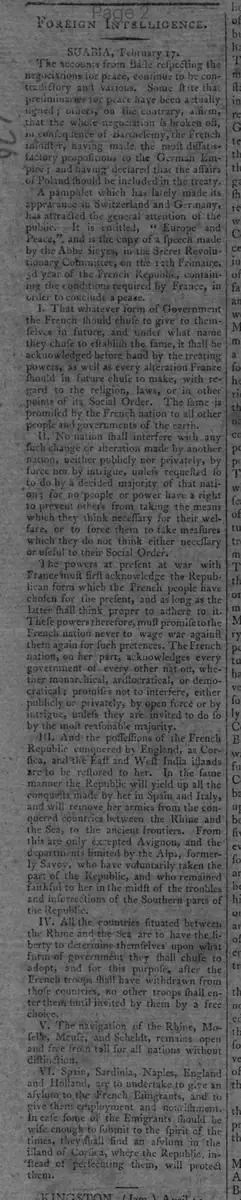
The accounts from Basle respecting the negotiations for peace, continue to be contradictory and various. Some state that preliminaries for peace have been actually signed; others, on the contrary, affirm, that the whole negotiation is broken off, in consequence of Barthelemy, the French minister, having made the most unsatisfactory propositions to the German Empire; and having declared that the affairs of Poland should be included in the treaty.
A pamphlet which has lately made its appearance in Switzerland and Germany, has attracted the general attention of the public. It is entitled, "Europe and Peace," and is the copy of a speech made by the Abbe Sieyes, in the Secret Revolutionary Committee, on the 12th Frimaire, 3d year of the French Republic, containing the conditions required by France, in order to conclude a peace.
I. That whatever form of Government the French should choose to give to themselves in future, and under what name they choose to establish the same, it shall be acknowledged beforehand by the treating powers, as well as every alteration France should in future choose to make, with regard to the religion, laws, or in other points of its Social Order. The same is promised by the French nation to all other people and governments of the earth.
II. No nation shall interfere with any such change or alteration made by another nation, neither publicly nor privately, by force nor by intrigue, unless requested so to do by a decided majority of that nation; for no people or power have a right to prevent others from taking the means which they think necessary for their welfare, or to force them to take measures which they do not think either necessary or useful to their Social Order.
The powers at present at war with France must first acknowledge the Republican form which the French people have chosen for the present, and as long as the latter shall think proper to adhere to it. These powers therefore, must promise to the French nation never to wage war against them again for such pretences. The French nation, on her part, acknowledges every government of every other nation, whether monarchical, aristocratical, or democratical; promises not to interfere, either publicly or privately, by open force or by intrigue, unless they are invited to do so by the most reasonable majority.
III. And the possessions of the French Republic conquered by England, as Corsica, and the East and West India islands are to be restored to her. In the same manner the Republic will yield up all the conquests made by her in Spain and Italy, and will remove her armies from the conquered countries between the Rhine and the Sea, to the ancient frontiers. From this are only excepted Avignon, and the departments limited by the Alps, formerly Savoy, who have voluntarily taken the part of the Republic, and who remained faithful to her in the midst of the troubles and insurrections of the Southern parts of the Republic.
IV. All the countries situated between the Rhine and the Sea are to have the liberty to determine themselves upon what form of government they shall choose to adopt, and for this purpose, after the French troops shall have withdrawn from those countries, no other troops shall enter them until invited by them by a free choice.
V. The navigation of the Rhine, Moselle, Meuse, and Scheldt, remains open and free from toll for all nations without distinction.
VI. Spain, Sardinia, Naples, England and Holland, are to undertake to give an asylum to the French Emigrants, and to give them employment and nourishment. In case some of the Emigrants should be wise enough to submit to the spirit of the times, they shall find an asylum in the island of Corsica, where the Republic, instead of persecuting them, will protect them.
What sub-type of article is it?
What keywords are associated?
What entities or persons were involved?
Where did it happen?
Foreign News Details
Primary Location
Basle
Event Date
February
Key Persons
Outcome
contradictory reports on peace preliminaries; proposed french conditions include recognition of republican government, non-interference, territorial restorations (e.g., corsica to france, french conquests in spain/italy yielded), free rhine navigation, asylum for emigrants.
Event Details
Accounts from Basle on peace negotiations with German Empire are contradictory: some report signed preliminaries, others a breakdown due to French minister Barthelemy's unsatisfactory proposals including Polish affairs. A pamphlet 'Europe and Peace' reprints Abbe Sieyes' speech from 12th Frimaire, 3d year of French Republic, listing six conditions for peace: acknowledgment of French government choices, mutual non-interference, recognition of French Republic, restoration of conquests with exceptions (Avignon, Savoy departments), self-determination for Rhine-Sea countries, free navigation of specified rivers, asylum for French emigrants by specified powers.