Thank you for visiting SNEWPapers!
Sign up free
Story
September 21, 1917
The Midland Journal
Rising Sun, Cecil County, Maryland
What is this article about?
An article explains the measurement of wireless telegraphy wave lengths using a wave meter, noting that an aerial's natural wave length is four times its linear length, analogous to organ pipes and tuning forks.
Clipping
OCR Quality
98%
Excellent
Full Text
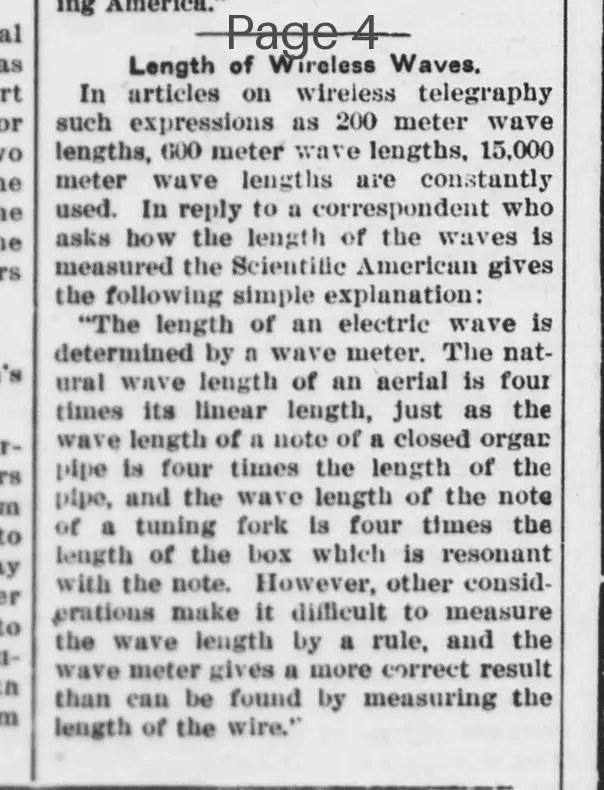
Length of Wireless Waves.
In articles on wireless telegraphy such expressions as 200 meter wave lengths, 600 meter wave lengths, 15,000 meter wave lengths are constantly used. In reply to a correspondent who asks how the length of the waves is measured the Scientific American gives the following simple explanation:
"The length of an electric wave is determined by a wave meter. The natural wave length of an aerial is four times its linear length, just as the wave length of a note of a closed organ pipe is four times the length of the pipe, and the wave length of the note of a tuning fork is four times the length of the box which is resonant with the note. However, other considerations make it difficult to measure the wave length by a rule, and the wave meter gives a more correct result than can be found by measuring the length of the wire."
In articles on wireless telegraphy such expressions as 200 meter wave lengths, 600 meter wave lengths, 15,000 meter wave lengths are constantly used. In reply to a correspondent who asks how the length of the waves is measured the Scientific American gives the following simple explanation:
"The length of an electric wave is determined by a wave meter. The natural wave length of an aerial is four times its linear length, just as the wave length of a note of a closed organ pipe is four times the length of the pipe, and the wave length of the note of a tuning fork is four times the length of the box which is resonant with the note. However, other considerations make it difficult to measure the wave length by a rule, and the wave meter gives a more correct result than can be found by measuring the length of the wire."
What sub-type of article is it?
Curiosity
What keywords are associated?
Wireless Telegraphy
Wave Lengths
Wave Meter
Electric Waves
Scientific American
Story Details
Story Details
Explanation of how the length of electric waves in wireless telegraphy is measured using a wave meter, with the natural wave length of an aerial being four times its linear length, analogous to organ pipes and tuning forks.