Thank you for visiting SNEWPapers!
Sign up free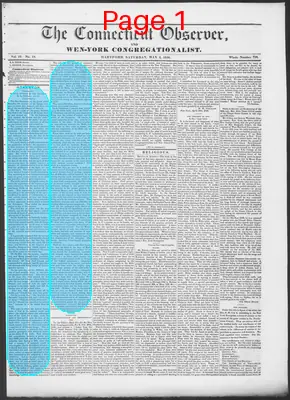
Literary
May 2, 1840
The Connecticut Observer, And New York Congregationalist
Hartford, Hartford County, Connecticut
What is this article about?
Continuation of Dr. Murdock's essay on the biblical creation account in Genesis, detailing the seven days of creation, its alignment with geological discoveries, and defending its divine inspiration against scientific discrepancies, particularly the length of creation periods.
Clipping
OCR Quality
95%
Excellent
Full Text
OBSERVER.
Communicated.
BIBLICAL ACCOUNT OF THE CREATION.
By Dr. Murdock. Art. III.
(Continued.)
The first document, or the poem which describes the creation of all things, occupies the entire first chapter, and three verses of the second chapter of Genesis.
The first verse of the poem, declares, that God is the Creator of all things above us and around us. "In the beginning, God created the heaven and the earth."
By the "heaven and the earth," we are to understand the visible universe, or all that we can behold, above and around us.
The second verse directs our attention to the condition of this earth, when first produced. It was an absolute chaos.— "And the earth was without form and void: and darkness was upon the face of the deep; and the spirit of God moved upon the face of the waters."
The third, fourth and fifth verses describe the production of light; the separation of it from darkness, and the establishment of day and night on the earth. Here ended the first day, or the first period of the creation. But whether it commenced with the production of the chaos, (and includes the whole time when "darkness" covered the face of the deep, and the spirit of God was moving upon the mighty waters;) or whether its commencement is to be dated from the production of the light, we are not informed. The writer appears not to have deemed it a point worth mentioning. Yet, according to some interpretations put upon the poem, it was a point, as we shall see hereafter, of very great importance.
The sixth, seventh and eighth verses, describe the separation of the vapors, or gaseous substances, from the more dense and ponderous fluids on the surface of the earth. This separation is represented—(according to the philosophy of the age)—as effected by means of a firmament, or a vast curtain, spread out over our heads; and the waters, or fluids, being remanded to their appointed stations above or below the firmament. Thus ended the second period or day of the creation.
The third day or period saw the seas subside, and the dry land appear; and afterwards all kinds of grass, herbs and trees, sprang out of the earth.
On the fourth day, the heavenly bodies—the sun, moon and stars—began to appear; which God created equally with all things, and intended for the use of man, as lights to guide his path, as the immediate cause of day and night, summer and winter, and as the external marks and boundaries of time.
It is generally supposed that the sun and other heavenly bodies were actually created before this fourth day; but that they did not become visible from this earth, till this time; and therefore, as the inspired poet describes things as they would appear to the eye, he makes no mention of this creation till he comes to this fourth day.
On the fifth day, the aquatic, amphibious, and flying animals were produced: and among them great monsters inhabiting the waters. All these God blessed, and commanded to multiply, and fill their allotted elements with living beings of their respective species.
On the sixth day, all the different species of land animals, were, in like manner produced and blessed. After this, and on the same day, God created the first man and the first woman; whom he formed after his own image. And these also God blessed; and invested with the right of property to the whole earth, and full dominion over all the animal tribes.
After this, God looked upon all his works and "behold they were very good."
On the seventh day, "the heavens and the earth" being finished, and "all the host of them," "God rested from all his work:" and he "blessed and sanctified the seventh day," because in it he rested from his work.
The order in which the several formations of God in the natural world took place—the original chaos—the submerged state of the earth for a time, while the spirit of God moved upon the face of the waters—the subsequent appearance of dry land—then vegetable substances—afterwards aquatic animals—then land animals and last of all human beings. This order of succession, is precisely that, which modern geologists find distinctly marked on the strata of the earth. Now whence this coincidence, between a poem more than 3000 years old, and the discoveries of scientific men during a little more than half a century? It certainly would be very singular, that in the infancy of science, it should have been the common and popular belief, that such was the order of creation, unless we suppose mankind to have been instructed on the subject by a divine revelation. And yet we must suppose that such was the popular belief; or else, that there was no current belief about it, so that the author could assume this to be the order, without shaking public opinion.— And if the author of this religious poem first taught mankind this order of creation, whence, it may be asked, did he derive his knowledge, unless it was from inspiration?
The order of the periods of creation, correspond, throughout, with the discoveries of modern science. But how is it with the length of these periods? According to our English translation of the Bible, the periods were natural days of twenty four hours each; while geologists suppose, and offer strong arguments to prove, that they must all have been of a much longer duration;—many years—perhaps many centuries, each. Here is a difficulty. The friends of the Bible, are unwilling to believe that in error; and the geologists cannot reconcile the English Bible with facts as they appear in nature. In the mean time unbelievers in the Bible, exult to find they have so strong an argument against its truth.
This point therefore, deserves our most serious and candid attention.
In the first place, I remark, that, according to the Bible itself, and to the belief of all Christians, one and the same omniscient Being was the author of nature, and the author of the Scriptures. Of course, he cannot contradict in the one, what he inculcates in the other. If there is palpable contradiction between the Bible, and plain facts as they exist in nature, the truth and inspiration of the Bible can no longer be maintained.
What, then, shall we do with our beautiful poem on the creation? Shall we, with the modern Germans, cut it out of our Bibles, and say, away with this trash, surreptitiously crept into the sacred volume? If so, how shall we vindicate Moses, the inserter of it; or the long list of prophets and apostles, and the Son of God himself, who suffered it to remain there, and to come down to us as a part of the inspired volume? Besides, how can we account for the fact, the extraordinary fact, that it arranges the six periods in the exact order, which modern science confirms? This surely is a desperate course.
Shall we, then, go over to a more numerous class of theologians, who knowing more of divinity than of geology, suppose that all difficulties will be removed, by admitting that the earth remained long in a chaotic and revolutionary state, before the six days work commenced; that the relics of an ancient world, brought forward by geologists, belongs to this period which was anterior to the proper creation described by Moses; and, that Moses, in his account of the six days work of God, describes, not the original or first formation of the earth, but rather its re-formation, or fitting up to be the residence of men. This hypothesis, removes only one difficulty, by creating others of greater magnitude. For, such are the geological facts, that to account for them on this hypothesis, we must suppose the chaos twice reduced to order: once before, and once during the six days; and that the former occupied six long periods, and the latter only six days; each arranged in the same order of succession. We must also suppose, very many of the same species of vegetables and animals, to have been twice created. Yet the Mosaic account speaks of only one reduction of the chaos, and only one creation of vegetables and animals; and represents these as being immediately consequent upon the first creating acts of the Almighty. This theory, therefore, I feel myself compelled to abandon.
Shall we then adopt a still older theory, viz: that the flood in the days of Noah, almost totally changed the surface of our globe, buried the antediluvian vegetables and animals many hundred feet deep in the earth; or threw their exuvia into heaps; scattered marine shells on the tops of the highest mountains; submerged whole continents in the ocean, and raised new ones from under the mighty deep; wore a large portion of the solid rocks to sand, and rounded pebbles; transported bowlder stones hundreds of miles, and deposited them in large masses here and there, far from their native beds? Such mighty changes cannot be attributed to that tranquil scene, during which the ark floated securely for a few months, and then settled down again not far from where it was built. Besides: why, on this hypothesis, are there no human bones, and no works of human art, found among these supposed relics of the antediluvian world? This theory seems not at all admissible.
Let us then examine the common interpretation, which makes the six periods to be natural days; and see if this interpretation is so clear and certain, that it must be retained, whatever may be the consequences.
(To be continued.)
Communicated.
BIBLICAL ACCOUNT OF THE CREATION.
By Dr. Murdock. Art. III.
(Continued.)
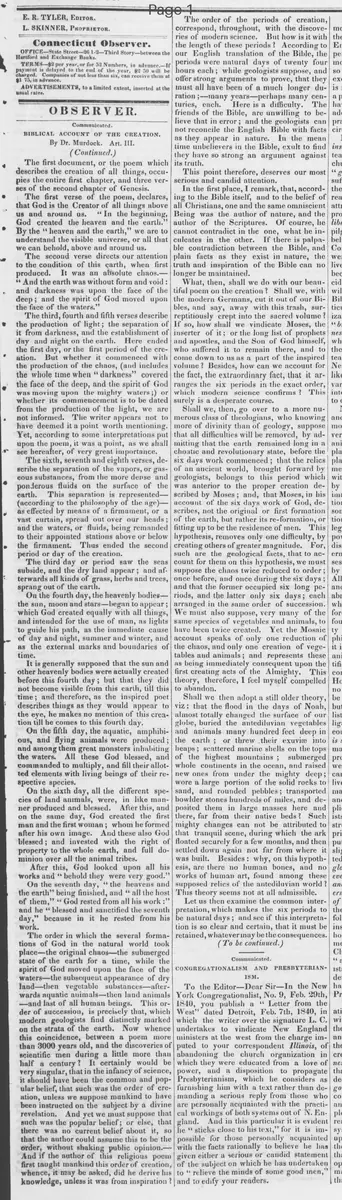
The first document, or the poem which describes the creation of all things, occupies the entire first chapter, and three verses of the second chapter of Genesis.
The first verse of the poem, declares, that God is the Creator of all things above us and around us. "In the beginning, God created the heaven and the earth."
By the "heaven and the earth," we are to understand the visible universe, or all that we can behold, above and around us.
The second verse directs our attention to the condition of this earth, when first produced. It was an absolute chaos.— "And the earth was without form and void: and darkness was upon the face of the deep; and the spirit of God moved upon the face of the waters."
The third, fourth and fifth verses describe the production of light; the separation of it from darkness, and the establishment of day and night on the earth. Here ended the first day, or the first period of the creation. But whether it commenced with the production of the chaos, (and includes the whole time when "darkness" covered the face of the deep, and the spirit of God was moving upon the mighty waters;) or whether its commencement is to be dated from the production of the light, we are not informed. The writer appears not to have deemed it a point worth mentioning. Yet, according to some interpretations put upon the poem, it was a point, as we shall see hereafter, of very great importance.
The sixth, seventh and eighth verses, describe the separation of the vapors, or gaseous substances, from the more dense and ponderous fluids on the surface of the earth. This separation is represented—(according to the philosophy of the age)—as effected by means of a firmament, or a vast curtain, spread out over our heads; and the waters, or fluids, being remanded to their appointed stations above or below the firmament. Thus ended the second period or day of the creation.
The third day or period saw the seas subside, and the dry land appear; and afterwards all kinds of grass, herbs and trees, sprang out of the earth.
On the fourth day, the heavenly bodies—the sun, moon and stars—began to appear; which God created equally with all things, and intended for the use of man, as lights to guide his path, as the immediate cause of day and night, summer and winter, and as the external marks and boundaries of time.
It is generally supposed that the sun and other heavenly bodies were actually created before this fourth day; but that they did not become visible from this earth, till this time; and therefore, as the inspired poet describes things as they would appear to the eye, he makes no mention of this creation till he comes to this fourth day.
On the fifth day, the aquatic, amphibious, and flying animals were produced: and among them great monsters inhabiting the waters. All these God blessed, and commanded to multiply, and fill their allotted elements with living beings of their respective species.
On the sixth day, all the different species of land animals, were, in like manner produced and blessed. After this, and on the same day, God created the first man and the first woman; whom he formed after his own image. And these also God blessed; and invested with the right of property to the whole earth, and full dominion over all the animal tribes.
After this, God looked upon all his works and "behold they were very good."
On the seventh day, "the heavens and the earth" being finished, and "all the host of them," "God rested from all his work:" and he "blessed and sanctified the seventh day," because in it he rested from his work.
The order in which the several formations of God in the natural world took place—the original chaos—the submerged state of the earth for a time, while the spirit of God moved upon the face of the waters—the subsequent appearance of dry land—then vegetable substances—afterwards aquatic animals—then land animals and last of all human beings. This order of succession, is precisely that, which modern geologists find distinctly marked on the strata of the earth. Now whence this coincidence, between a poem more than 3000 years old, and the discoveries of scientific men during a little more than half a century? It certainly would be very singular, that in the infancy of science, it should have been the common and popular belief, that such was the order of creation, unless we suppose mankind to have been instructed on the subject by a divine revelation. And yet we must suppose that such was the popular belief; or else, that there was no current belief about it, so that the author could assume this to be the order, without shaking public opinion.— And if the author of this religious poem first taught mankind this order of creation, whence, it may be asked, did he derive his knowledge, unless it was from inspiration?
The order of the periods of creation, correspond, throughout, with the discoveries of modern science. But how is it with the length of these periods? According to our English translation of the Bible, the periods were natural days of twenty four hours each; while geologists suppose, and offer strong arguments to prove, that they must all have been of a much longer duration;—many years—perhaps many centuries, each. Here is a difficulty. The friends of the Bible, are unwilling to believe that in error; and the geologists cannot reconcile the English Bible with facts as they appear in nature. In the mean time unbelievers in the Bible, exult to find they have so strong an argument against its truth.
This point therefore, deserves our most serious and candid attention.
In the first place, I remark, that, according to the Bible itself, and to the belief of all Christians, one and the same omniscient Being was the author of nature, and the author of the Scriptures. Of course, he cannot contradict in the one, what he inculcates in the other. If there is palpable contradiction between the Bible, and plain facts as they exist in nature, the truth and inspiration of the Bible can no longer be maintained.
What, then, shall we do with our beautiful poem on the creation? Shall we, with the modern Germans, cut it out of our Bibles, and say, away with this trash, surreptitiously crept into the sacred volume? If so, how shall we vindicate Moses, the inserter of it; or the long list of prophets and apostles, and the Son of God himself, who suffered it to remain there, and to come down to us as a part of the inspired volume? Besides, how can we account for the fact, the extraordinary fact, that it arranges the six periods in the exact order, which modern science confirms? This surely is a desperate course.
Shall we, then, go over to a more numerous class of theologians, who knowing more of divinity than of geology, suppose that all difficulties will be removed, by admitting that the earth remained long in a chaotic and revolutionary state, before the six days work commenced; that the relics of an ancient world, brought forward by geologists, belongs to this period which was anterior to the proper creation described by Moses; and, that Moses, in his account of the six days work of God, describes, not the original or first formation of the earth, but rather its re-formation, or fitting up to be the residence of men. This hypothesis, removes only one difficulty, by creating others of greater magnitude. For, such are the geological facts, that to account for them on this hypothesis, we must suppose the chaos twice reduced to order: once before, and once during the six days; and that the former occupied six long periods, and the latter only six days; each arranged in the same order of succession. We must also suppose, very many of the same species of vegetables and animals, to have been twice created. Yet the Mosaic account speaks of only one reduction of the chaos, and only one creation of vegetables and animals; and represents these as being immediately consequent upon the first creating acts of the Almighty. This theory, therefore, I feel myself compelled to abandon.
Shall we then adopt a still older theory, viz: that the flood in the days of Noah, almost totally changed the surface of our globe, buried the antediluvian vegetables and animals many hundred feet deep in the earth; or threw their exuvia into heaps; scattered marine shells on the tops of the highest mountains; submerged whole continents in the ocean, and raised new ones from under the mighty deep; wore a large portion of the solid rocks to sand, and rounded pebbles; transported bowlder stones hundreds of miles, and deposited them in large masses here and there, far from their native beds? Such mighty changes cannot be attributed to that tranquil scene, during which the ark floated securely for a few months, and then settled down again not far from where it was built. Besides: why, on this hypothesis, are there no human bones, and no works of human art, found among these supposed relics of the antediluvian world? This theory seems not at all admissible.
Let us then examine the common interpretation, which makes the six periods to be natural days; and see if this interpretation is so clear and certain, that it must be retained, whatever may be the consequences.
(To be continued.)
What sub-type of article is it?
Essay
What themes does it cover?
Religious
What keywords are associated?
Genesis Creation
Biblical Exegesis
Geology Harmony
Divine Inspiration
Mosaic Account
What entities or persons were involved?
By Dr. Murdock.
Literary Details
Title
Biblical Account Of The Creation. By Dr. Murdock. Art. Iii. (Continued.)
Author
By Dr. Murdock.
Subject
Reconciliation Of Genesis Creation Narrative With Geological Science
Key Lines
The Order Of Succession, Is Precisely That, Which Modern Geologists Find Distinctly Marked On The Strata Of The Earth.
According To Our English Translation Of The Bible, The Periods Were Natural Days Of Twenty Four Hours Each; While Geologists Suppose... That They Must All Have Been Of A Much Longer Duration;—Many Years—Perhaps Many Centuries, Each.
If There Is Palpable Contradiction Between The Bible, And Plain Facts As They Exist In Nature, The Truth And Inspiration Of The Bible Can No Longer Be Maintained.