Thank you for visiting SNEWPapers!
Sign up free
Story
December 8, 1768
The Virginia Gazette
Richmond, Williamsburg, Richmond County, Virginia
What is this article about?
In the vicinity of New Orleans, an elderly Collapia Indian sacrifices himself in place of his son, Tichou Mingo, to appease the Choctaw tribe after the son killed a Choctaw, preventing war and French involvement.
Clipping
OCR Quality
100%
Excellent
Full Text
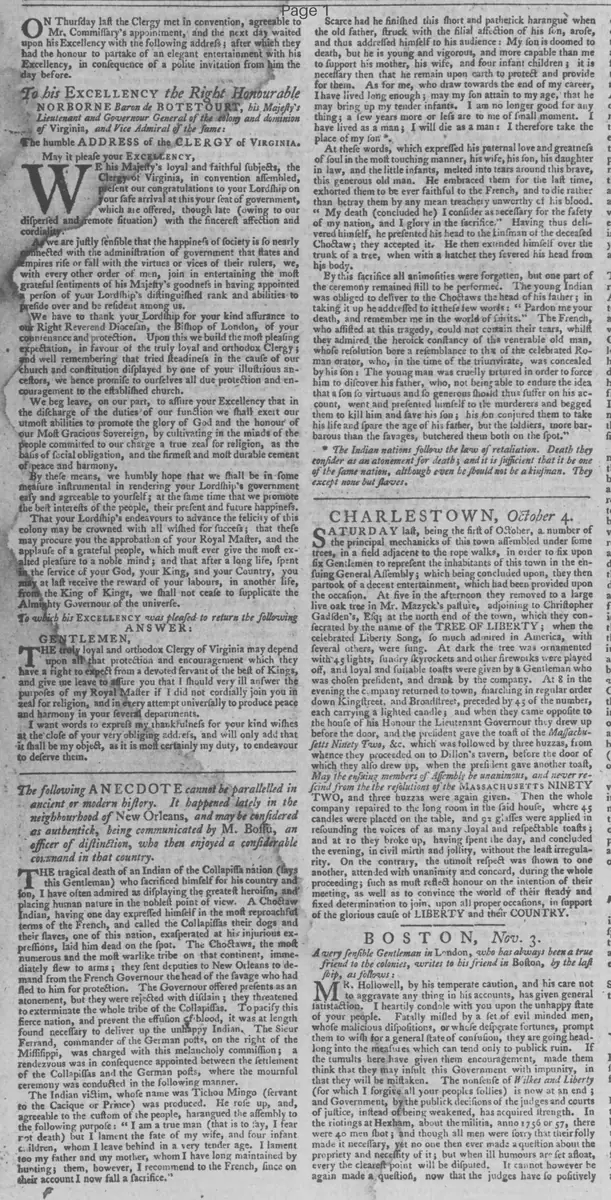
The following ANECDOTE cannot be paralleled in ancient or modern history. It happened lately in the neighbourhood of New Orleans, and may be considered as authentic, being communicated by M. Bou, an officer of distinction, who then enjoyed a considerable command in that country.
The tragical death of an Indian of the Collapia nation (says this Gentleman) who sacrificed himself for his country and son, I have often admired as displaying the greatest heroism, and placing human nature in the noblest point of view. A Choctaw Indian, having one day expressed himself in the most reproachful terms of the French, and called the Collapias their dogs and their slaves, one of this nation, exasperated at his injurious expressions, laid him dead on the spot. The Choctaws, the most numerous and the most warlike tribe on that continent, immediately flew to arms; they sent deputies to New Orleans to demand from the French Governour the head of the savage who had fled to him for protection. The Governour offered presents as an atonement, but they were rejected with disdain; they threatened to exterminate the whole tribe of the Collapias. To pacify this fierce nation, and prevent the effusion of blood, it was at length found necessary to deliver up the unhappy Indian. The Sieur Ferrand, commander of the German posts, on the right of the Mississippi, was charged with this melancholy commission; a rendezvous was in consequence appointed between the settlement of the Collapias and the German posts, where the mournful ceremony was conducted in the following manner.
The Indian victim, whose name was Tichou Mingo (servant to the Cacique or Prince) was produced. He rose up, and, agreeable to the custom of the people, harangued the assembly to the following purpose: "I am a true man (that is to say, I fear not death) but I lament the fate of my wife, and four infant children, whom I leave behind in a very tender age. I lament too my father and my mother, whom I have long maintained by hunting; them, however, I recommend to the French, since on their account I now fall a sacrifice."
Scarce had he finished this short and pathetic harangue when the old father, struck with the filial affection of his son, arose, and thus addressed himself to his audience: My son is doomed to death, but he is young and vigorous, and more capable than me to support his mother, his wife, and four infant children; it is necessary then that he remain upon earth to protect and provide for them. As for me, who draw towards the end of my career, I have lived long enough; may my son attain to my age, that he may bring up my tender infants. I am no longer good for any thing; a few years more or less are to me of small moment. I have lived as a man; I will die as a man: I therefore take the place of my son.
At these words, which expressed his paternal love and greatness of soul in the most touching manner, his wife, his son, his daughter in law, and the little infants, melted into tears around this brave, this generous old man. He embraced them for the last time, exhorted them to be ever faithful to the French, and to die rather than betray them by any mean treachery unworthy of his blood.
"My death (concluded he) I consider as necessary for the safety of my nation, and I glory in the sacrifice," Having thus delivered himself, he presented his head to the kinsman of the deceased Choctaw; they accepted it. He then extended himself over the trunk of a tree, when with a hatchet they severed his head from his body.
By this sacrifice all animosities were forgotten, but one part of the ceremony remained still to be performed. The young Indian was obliged to deliver to the Choctaws the head of his father; in taking it up he addressed to it these few words: "Pardon me your death, and remember me in the world of Spirits." The French, who assisted at this tragedy, could not contain their tears, whilst they admired the heroick constancy of this venerable old man, whose resolution bore a resemblance to that of the celebrated Roman orator, who, in the time of the triumvirate, was concealed by his son: The young man was cruelly tortured in order to force him to discover his father, who, not being able to endure the idea that a son so virtuous and so generous should thus suffer on his account, went and presented himself to the murderers and begged them to kill him and save his son; his son conjured them to take his life and spare the age of his father, but the soldiers, more barbarous than the savages, butchered them both on the spot.
The Indian nations follow the law of retaliation. Death they consider as an atonement for death; and it is sufficient that it be one of the same nation, although even he should not be a kinsman. They except none but slaves.
The tragical death of an Indian of the Collapia nation (says this Gentleman) who sacrificed himself for his country and son, I have often admired as displaying the greatest heroism, and placing human nature in the noblest point of view. A Choctaw Indian, having one day expressed himself in the most reproachful terms of the French, and called the Collapias their dogs and their slaves, one of this nation, exasperated at his injurious expressions, laid him dead on the spot. The Choctaws, the most numerous and the most warlike tribe on that continent, immediately flew to arms; they sent deputies to New Orleans to demand from the French Governour the head of the savage who had fled to him for protection. The Governour offered presents as an atonement, but they were rejected with disdain; they threatened to exterminate the whole tribe of the Collapias. To pacify this fierce nation, and prevent the effusion of blood, it was at length found necessary to deliver up the unhappy Indian. The Sieur Ferrand, commander of the German posts, on the right of the Mississippi, was charged with this melancholy commission; a rendezvous was in consequence appointed between the settlement of the Collapias and the German posts, where the mournful ceremony was conducted in the following manner.
The Indian victim, whose name was Tichou Mingo (servant to the Cacique or Prince) was produced. He rose up, and, agreeable to the custom of the people, harangued the assembly to the following purpose: "I am a true man (that is to say, I fear not death) but I lament the fate of my wife, and four infant children, whom I leave behind in a very tender age. I lament too my father and my mother, whom I have long maintained by hunting; them, however, I recommend to the French, since on their account I now fall a sacrifice."
Scarce had he finished this short and pathetic harangue when the old father, struck with the filial affection of his son, arose, and thus addressed himself to his audience: My son is doomed to death, but he is young and vigorous, and more capable than me to support his mother, his wife, and four infant children; it is necessary then that he remain upon earth to protect and provide for them. As for me, who draw towards the end of my career, I have lived long enough; may my son attain to my age, that he may bring up my tender infants. I am no longer good for any thing; a few years more or less are to me of small moment. I have lived as a man; I will die as a man: I therefore take the place of my son.
At these words, which expressed his paternal love and greatness of soul in the most touching manner, his wife, his son, his daughter in law, and the little infants, melted into tears around this brave, this generous old man. He embraced them for the last time, exhorted them to be ever faithful to the French, and to die rather than betray them by any mean treachery unworthy of his blood.
"My death (concluded he) I consider as necessary for the safety of my nation, and I glory in the sacrifice," Having thus delivered himself, he presented his head to the kinsman of the deceased Choctaw; they accepted it. He then extended himself over the trunk of a tree, when with a hatchet they severed his head from his body.
By this sacrifice all animosities were forgotten, but one part of the ceremony remained still to be performed. The young Indian was obliged to deliver to the Choctaws the head of his father; in taking it up he addressed to it these few words: "Pardon me your death, and remember me in the world of Spirits." The French, who assisted at this tragedy, could not contain their tears, whilst they admired the heroick constancy of this venerable old man, whose resolution bore a resemblance to that of the celebrated Roman orator, who, in the time of the triumvirate, was concealed by his son: The young man was cruelly tortured in order to force him to discover his father, who, not being able to endure the idea that a son so virtuous and so generous should thus suffer on his account, went and presented himself to the murderers and begged them to kill him and save his son; his son conjured them to take his life and spare the age of his father, but the soldiers, more barbarous than the savages, butchered them both on the spot.
The Indian nations follow the law of retaliation. Death they consider as an atonement for death; and it is sufficient that it be one of the same nation, although even he should not be a kinsman. They except none but slaves.
What sub-type of article is it?
Heroic Act
Tragedy
Historical Event
What themes does it cover?
Bravery Heroism
Family
Justice
What keywords are associated?
Indian Sacrifice
Heroic Death
Tribal Retaliation
Collapia Nation
Choctaw Tribe
French Protection
What entities or persons were involved?
Tichou Mingo
Old Father
M. Bou
Sieur Ferrand
Where did it happen?
Neighbourhood Of New Orleans, German Posts On The Right Of The Mississippi
Story Details
Key Persons
Tichou Mingo
Old Father
M. Bou
Sieur Ferrand
Location
Neighbourhood Of New Orleans, German Posts On The Right Of The Mississippi
Event Date
Lately
Story Details
A Choctaw insults Collapias, leading to his death by Tichou Mingo; Choctaws demand retribution. To avert war, Tichou Mingo's father sacrifices himself, delivering a poignant speech and dying nobly, allowing his son to live and support the family.