Thank you for visiting SNEWPapers!
Sign up free
Thomas's Massachusetts Spy, Or, Worcester Gazette
Worcester, Worcester County, Massachusetts
What is this article about?
James Mease critiques the Philadelphia cattle show for overfeeding animals without improving breeds, advocating selective breeding and importing superior short-horned cattle from England for efficient meat and milk production.
Merged-components note: Merged continuation of the agricultural article on improving the breed of cattle, spanning the right column of page 1 and left column of page 2, based on sequential reading order and text flow.
Clippings
1 of 2
OCR Quality
Full Text
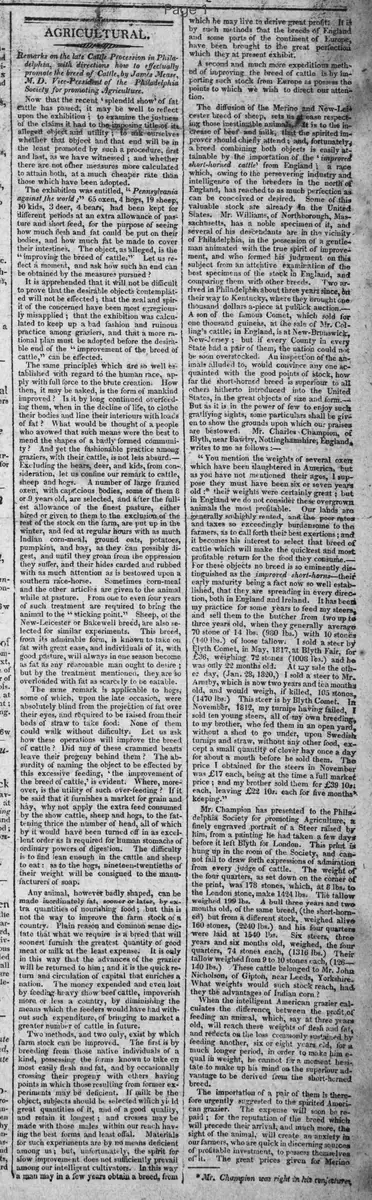
Remarks on the late Cattle Procession in Philadelphia, with directions how to effectually promote the breed of Cattle by James Mease, M. D. Vice-President of the Philadelphia Society for promoting Agriculture.
Now that the recent 'splendid show' of fat cattle has passed, it may be well to reflect upon the exhibition; to examine the justness of the claims it had to the imposing title of its alleged object and utility; to ask ourselves whether that object and that end will be in the least promoted by such a procedure, first and last, as we have witnessed; and whether there are not other measures more calculated to attain both, at a much cheaper rate than those which have been adopted.
The exhibition was entitled, "Pennsylvania against the world;" 65 oxen, 4 hogs, 19 sheep: 10 kids, 3 deer, 4 bears; had been kept for different periods at an extra allowance of pasture and short feed, for the purpose of seeing how much flesh and fat could be put on their bodies, and how much fat be made to cover their intestines. The object, as alleged, is the "improving the breed of cattle:" Let us reflect a moment, and ask how such an end can be obtained by the measures pursued?
It is apprehended that it will not be difficult to prove that the desirable objects contemplated will not be effected; that the zeal and spirit of the concerned have been most egregiously misapplied; that the exhibition was calculated to keep up a bad fashion and ruinous practice among graziers, and that a more rational plan must be adopted before the desirable end of the "improvement of the breed of cattle," can be effected:
The same principles which are so well established with regard to the human race, apply with full force to the brute creation: How then, it may be asked, is the form of mankind improved? Is it by long continued overfeeding them, when in the decline of life, to clothe their bodies and line their interiors with loads of fat? What would be thought of a people who avowed that such means were the best to mend the shapes of a badly formed community? And yet the fashionable practice among graziers, with their cattle, is not less absurd.—
Excluding the bears, deer, and kids, from consideration, let us confine our remark to cattle, sheep and hogs. A number of large framed oxen, with capacious bodies, some of them 8 or 9 years old, are selected, and after the fullest allowance of the finest pasture, either hired or given to them to the exclusion of the rest of the stock on the farm, are put up in the winter, and fed at regular hours with as much Indian corn-meal, ground oats, potatoes, pumpkins, and hay, as they can possibly digest, and until they groan from the oppression they suffer, and their hides carded and rubbed with as much attention as is bestowed upon a southern race-horse. Sometimes corn-meal and the other articles are given to the animal while at pasture. From one to even four years of such treatment are required to bring the animal to the "sticking point." Sheep, of the New Leicester or Bakewell breed, are also selected for similar experiments. This breed, from its admirable form, is known to take on fat with great ease, and individuals of it, with good pasture, will always in one season become as fat as any reasonable man ought to desire; but by the treatment mentioned, they are so overloaded with fat as scarcely to be eatable.
The same remark is applicable to hogs, some of which, upon the late occasion, were absolutely blind from the projection of fat over their eyes, and required to be raised from their beds of straw to take food: None of them could walk without difficulty: Let us ask how these operations will improve the breed of cattle? Did any of these crammed beasts leave their progeny behind them? The absurdity of naming the object to be effected by this excessive feeding, the improvement of the breed of cattle, is evident. Where, moreover, is the utility of such over-feeding? If it be said that it furnishes a market for grain and hay, why not apply the extra feed consumed by the show cattle, sheep and hogs, to the fattening thrice the number of head, all of which by it would have been turned off in as excellent order as is required for human stomachs of ordinary powers of digestion. The difficulty is to find lean enough in the cattle and sheep to eat: as to the hogs, nineteen-twentieths of their weight will be consigned to the manufacturers of soap.
Any animal, however badly shaped, can be made inordinately fat, sooner or later, by extra quantities of nourishing food; but this is not the way to improve the farm stock of a country. Plain reason and common sense dictate that what we require is a breed that will soonest furnish the greatest quantity of good meat or milk at the least expense. It is only in this way that the advances of the grazier will be returned to him: and it is the quick return and circulation of capital that enriches a nation. The money expended and even lost by feeding heavy show beef cattle, impoverish more or less a country, by diminishing the means which the feeders would have had without such expenditure, of bringing to market a greater number of cattle in future.
Two methods, and two only, exist by which farm stock can be improved. The first is by breeding from those native individuals of a kind, possessing the farms known to take on most easily flesh and fat, and by occasionally crossing their progeny with others having points in which those resulting from former experiments may be deficient. If milk be the object, subjects should be selected which yield great quantities of it, and of a good quality, and retain it longest; and crosses may be made with those males within our reach having the best forms and least offal. Materials for such experiments are by no means deficient among us; but, unfortunately, the spirit for slow improvement does not sufficiently prevail among our intelligent cultivators. In this way a man may in a few years obtain a breed, from which he may live to derive great profit: It is by such methods that the breeds of England and some parts of the continent of Europe have been brought to the great perfection which they at present exhibit.
A second and much more expeditious method of improving the breed of cattle is by importing such stock from Europe as possess the points to which we wish to direct our attention.
The diffusion of the Merino and New Leicester breed of sheep, sets us at ease respecting those inestimable animals, it is to the increase of beef and milk, that the spirited improver should chiefly attend; and, fortunately a breed combining both objects is easily attainable by the importation of the improved short-horned cattle from England; a race which, owing to the persevering industry and intelligence of the breeders in the north of England, has reached to as much perfection as can be conceived or desired. Some of this valuable stock are already in the United States. Mr. Williams, of Northborough, Massachusetts, has a noble specimen of it, and several of his descendants are in the vicinity of Philadelphia, in the possession of a gentleman animated with the true spirit of improvement, and who formed his judgment on this subject from an attentive examination of the best specimens of the stock in England, and comparing them with other breeds. Two arrived in Philadelphia about three years since, on their way to Kentucky, where they brought one thousand dollars a-piece at public auction.— A son of the famous Comet, which sold for one thousand guineas, at the sale of Mr. Colling's cattle, in England, is at New-Brunswick, New-Jersey; but if every County in every State had a pair of them, the nation could not be soon overstocked. An inspection of the animals alluded to, would convince any one acquainted with the good points of stock, how far the short-horned breed is superior to all others hitherto introduced into the United States, in the great objects of size and form.— But as it is in the power of few to enjoy such gratifying sights, some particulars shall be given to show the grounds upon which our praises are bestowed. Mr. Charles Champion, of Blyth, near Bawtry, Nottinghamshire, England writes to me as follows:—
"You mention the weights of several oxen which have been slaughtered in America, but as you have not mentioned their ages, I suppose they must have been six or seven years old:* their weights were certainly great; but in England we do not consider these overgrown animals the most profitable. Our lands are generally so highly rented, and the poor rates and taxes so exceedingly burdensome to the farmers, as to call forth their best exertions; and it becomes his interest to select that breed of cattle which will make the quickest and most profitable return for the food they consume.— For these objects no breed is so eminently distinguished as the improved short-horns—their early maturity being a fact now so well established, that they are spreading in every direction, both in England and Ireland. It has been my practice for some years to feed my steers; and sell them to the butcher from two up to three years old, when they generally average 70 stone of 14 lbs: (980 lbs.) with 10 stones (140 lbs.) of loose tallow. I sold a steer by Blyth Comet, in May, 1817, at Blyth Fair, for £36, weighing 72 stones (1008 lbs.) and he was only 22 months old.: At my sale the other day, (Jan. 28, 1820,) I sold a steer to Mr. Arnsby, which is now two years and ten months old, and would weigh, if killed, 105 stones. (1470 lbs.) This steer is by Blyth Comet. In November, 1812, my turnips having failed, I sold ten young steers, all of my own breeding, to my brother, who fed them in an open yard, without a shed to go under, upon Swedish turnips and straw, without any other food, except a small quantity of clover hay once a day for about a month before he sold them. The price I obtained for the steers in November was £17 each, being at the time a full market price; and my brother sold them for 39 10s each, leaving £22 10s: each for five months keeping."
Mr. Champion has presented to the Philadelphia Society for promoting Agriculture, a finely engraved portrait of a Steer raised by him, from a painting he had taken a few days before it left Blyth for London. This print is hung up in the room of the Society, and cannot fail to draw forth expressions of admiration from every judge of cattle. The weight of the four quarters, as set down on the corner of the print, was 178 stones, which, at 8 lbs. to the London stone, make 1424 lbs. This tallow weighed 199 lbs. A bull three years and two months old, of the same breed, (the short-horned but from a different stock, weighed alive 160 stones, (2240 lbs.) and his four quarters were laid at 1540 lbs. Six steers, three years and six months old, weighed, the four quarters, 74 stones each, (1316 lbs.) Their tallow weighed from 9 to 10 stones each, (126 140 lbs.) These cattle belonged to Mr. John Nicholson, of Gipton, near Leeds, Yorkshire.
What weights would such stock reach, had they the advantages of Indian corn?
When the intelligent American grazier calculates the difference between the profit of feeding an animal, which, say at three years old, will reach these weights of flesh and fat, and reflects on the loss commonly sustained by feeding another, six or eight years old, for a much longer period, in order to make him equal in weight, he cannot for a moment hesitate to make up his mind on the superior advantage to be derived from the short-horned breed.
The importation of a pair of them is therefore urgently suggested to the spirited American grazier. The expense will soon be repaid; for the reputation of the breed which will precede their arrival, and much more, the sight of the animal; will create an anxiety in our farmers, who are quick in discerning sources of profitable investment, to possess themselves of it. The great prices given for Merino * Mr. Champion was right in his conjecture
Sheep during the late war with England, and for the mere use of a New-Leicester tup, before that event, and while the full-blood was confined to one man, afforded ample proof that farmers do not hesitate to risk high prices for stock, when a reasonable probability exists of obtaining quickly an interest for capital advanced; and when we reflect that the amount of the losses sustained by those concerned in preparing the objects for the late show, and of two former similar exhibitions, would be much more than sufficient to secure to Pennsylvania a pair of the breed of cattle in question, it is to be regretted that so much money should have been thrown away without producing any permanent benefit to the country.
Our farmers reflecting that, by crossing the best of their own stock, or the best they could procure, with the foreign breed, they secured a portion of a distinctive, strongly marked race, the characters and valuable properties of which would certainly increase as they advanced in the blood, would be led to make the experiment; and the gratification derived from the thriving disposition and beauty of form exhibited in the progeny shortly after their appearance on their farms, would stimulate them to its repetition; and when, after a few years, they found that the new breed furnished more and richer beef, at a much earlier age, and with less feed than is commonly required for native stock, and richer milk, and better working oxen than they before had, their minds will be made up as to the exclusion of all other breeds of horned cattle from their farms. But this is not all—their stock will be viewed by their less enterprising and more cautious neighbours; motives of interest and self-satisfaction, derived from the treasure in possession, will excite the owner to diffuse a knowledge of its value, which will be every year more and more enhanced, and the demand for it be enlarged, from the increasing numbers annually engaging in the agricultural life. Hence a source of revenue will be secured to himself and family.
The peculiar marks which designate this breed from all others are, capacious barrel-shaped bodies, straight backs, broad loins, small neck and head, full chines, leaving no hollows behind the shoulders, clean chaps, bright and prominent eyes, deep chests projecting well before the legs; fore legs clean, straight, and standing wide, not knock-kneed, (or in-kneed); wide hips and round; rump lying in a horizontal direction, not sinking backwards; the tail set on so high as to take in the same line with the back; and, lastly, small bones.
There is another breed of cattle, the Scotch, or Kyloes, well deserving the attention of the American improver, on account of their extreme hardy constitution and tendency to early fatting on grass alone, and of their filling up a vacancy in the supply of good beef about August and September: a time when the heavy cattle of the preceding season have all been killed off, and the stock of the season have not come in. Repeated experiments with the Kyloes in England have shown, that in one summer, at four years old, they will reach from 500 to 700 lbs. weight, with from 70 to 90 lbs. loose fat.
The great misfortune has hitherto been in the United States, as respects cattle, that although within the last 30 years, they have greatly improved in form, owing to judicious crosses between native stock, and occasionally with foreign breeds that were introduced, yet no blood has been kept so pure, as to enable any one to say he possessed a race with characters so strongly marked, as would insure their transmission to his or her descendants. Our whole procedure in this business has been a system of chance; and this want of certainty in our crosses has been one reason why so few have hesitated to accept of a high price for a thriving calf which, had it been raised, might have proved the origin of a valuable breed. It is full time to begin to conduct our operations upon fixed principles: and no time could be more propitious than the present, when a spirit of improvement, which the friends to agriculture have been striving for many years to excite, is diffused through the United States, and when foreign commerce has ceased to offer those allurements which so powerfully attracted our citizens, and drew off their attention from internal objects.
What sub-type of article is it?
What themes does it cover?
What keywords are associated?
What entities or persons were involved?
Where did it happen?
Story Details
Key Persons
Location
Philadelphia, Pennsylvania; England
Event Date
Circa 1820
Story Details
James Mease criticizes the Philadelphia cattle show for promoting overfeeding rather than breed improvement, analogizing to human overfeeding absurdity. He advocates selective breeding from superior native stock and importing English short-horned cattle for early maturity, high yield of meat and milk at low cost, citing examples from English breeders and suggesting benefits for American agriculture.