Thank you for visiting SNEWPapers!
Sign up free
The Southern Herald
Liberty, Amite County, Mississippi
What is this article about?
Historical overview from the Pall Mall Gazette on cholera epidemics, prompted by the current outbreak in Egypt. Details past severe occurrences in Mecca, Japan, India, Europe, England, America, and other regions from 1829 to 1866, with mortality figures and spread patterns.
Clipping
OCR Quality
Full Text
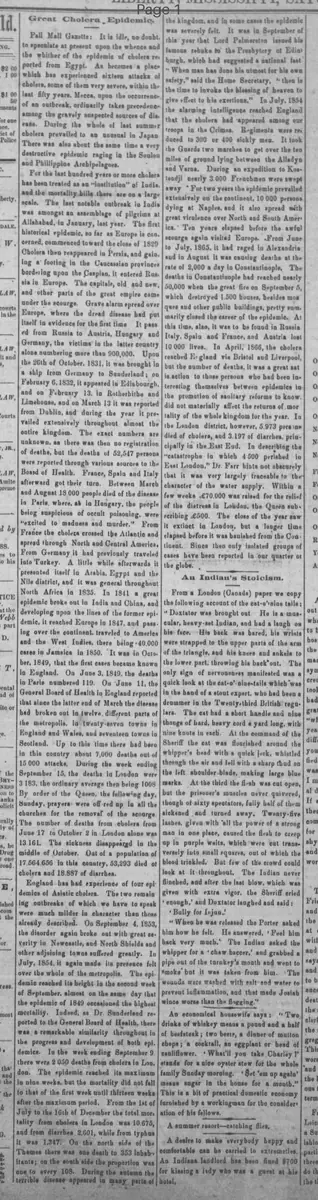
Pall Mall Gazette: It is idle, no doubt, to speculate at present upon the whence and the whither of the epidemic of cholera reported from Egypt. As becomes a place which has experienced sixteen attacks of cholera, some of them very severe, within the last fifty years, Mecca, upon the occurrence of an outbreak, ordinarily takes precedence among the gravely suspected sources of disease. During the whole of last summer cholera prevailed to an unusual in Japan. There was also about the same time a very destructive epidemic raging in the Sulu and Philippine Archipelagos.
For the last hundred years or more cholera has been treated as an "institution" of India, and the mortality bills there are on a large scale. The last notable outbreak in India was amongst an assemblage of pilgrims at Allahabad, in January, last year. The first historical epidemic, so far as Europe is concerned, commenced toward the close of 1829. Cholera then reappeared in Persia, and gaining a footing in the Caucasian provinces bordering upon the Caspian, it entered Russia in Europe. The capitals, old and new, and other parts of the great empire came under the scourge. Grave alarm spread over Europe, where the dread disease had put itself in evidence for the first time. It passed from Russia to Austria, Hungary and Germany, the victims in the latter country alone numbering more than 900,000. Upon the 26th of October, 1831, it was brought in a ship from Germany to Sunderland; on February 6, 1832, it appeared in Edinburgh, and on February 13, in Rotherhithe and Limehouse, and on March 13 it was reported from Dublin, and during the year it prevailed extensively throughout almost the entire kingdom. The exact numbers are unknown, as there was then no registration of deaths, but the deaths of 52,547 persons were reported through various sources to the Board of Health. France, Spain and Italy afterward got their turn. Between March and August 18,000 people died of the disease in Paris, where, as in Hungary, the people being suspicious of occult poisoning, were "excited to madness and murder." From France the cholera crossed the Atlantic and spread through North and Central America. From Germany it had previously traveled into Turkey. A little while afterwards it presented itself in Arabia, Egypt and the Nile district, and it was general throughout North Africa in 1835. In 1841 a great epidemic broke out in India and China, and developing upon the lines of the former epidemic, it reached Europe in 1847, and passing over the continent, traveled to America and the West Indies, there being 40,000 cases in Jamaica in 1850. It was in October, 1849, that the first cases became known in England. On June 3, 1849, the deaths in Paris numbered 119. On June 11, the General Board of Health in England reported that since the latter end of March the disease had broken out in twelve different parts of the metropolis, in twenty-seven towns in England and Wales, and seventeen towns in Scotland. Up to this time there had been in this country about 7,000 deaths out of 15,000 attacks. During the week ending September 15, the deaths in London were 3,183, the ordinary average then being 1,008. By order of the Queen, the following day, Sunday, prayers were offered up in all the churches for the removal of the scourge. The number of deaths from cholera from June 17 to October 2 in London alone was 13,161. The sickness disappeared in the middle of October. Out of a population of 17,564,656 in this country, 53,293 died of cholera and 18,887 of diarrhea.
England has had experience of four epidemics of Asiatic cholera. The two remaining outbreaks of which we have to speak were much milder in character than those already described. On September 4, 1853, the disorder again broke out with great severity in Newcastle, and North Shields and other adjoining towns suffered greatly. In July, 1854, it again made its presence felt over the whole of the metropolis. The epidemic reached its height in the second week of September, almost on the same day that the epidemic of 1849 occasioned the highest mortality. Indeed, as Dr. Sunderland reported to the General Board of Health, there was a remarkable similarity throughout in the progress and development of both epidemics. In the week ending September 9 there were 2,050 deaths from cholera in London. The epidemic reached its maximum in nine weeks, but the mortality did not fall to that of the first week until thirteen weeks after the maximum period. From the 1st of July to the 16th of December the total mortality from cholera in London was 10,675, and from diarrhea 2,601, while from typhus it was 1,347. On the north side of the Thames there was one death to 353 inhabitants; on the south side the proportion was one to every 108. During the autumn the terrible disease appeared in many parts of the kingdom, and in some cases the epidemic was severely felt. It was in September of this year that Lord Palmerston issued his famous rebuke to the Presbytery of Edinburgh, which had suggested a national fast. "When man has done his utmost for his own safety," said the Home Secretary, "then is the time to invoke the blessing of heaven to give effect to his exertions." In July, 1854, the alarming intelligence reached England that the cholera had appeared among our troops in the Crimea. Regiments were reduced to 300 or 400 sickly men. It took the Guards two marches to get over the ten miles of ground lying between the Aladyn and Varna. During an expedition to Kostenji nearly 3,000 Frenchmen were swept away. For two years the epidemic prevailed extensively on the continent, 10,000 persons dying at Naples, and it also spread with great virulence over North and South America. Ten years elapsed before the awful scourge again visited Europe. From June to July, 1865, it had raged in Alexandria and in August it was causing deaths at the rate of 2,000 a day in Constantinople. The deaths in Constantinople had reached nearly 50,000 when the great fire on September 5, which destroyed 1,500 houses, besides mosques and other public buildings, pretty summarily closed the career of the epidemic. At this time, also, it was to be found in Russia, Italy, Spain and France, and Austria lost 10,000 lives. In April, 1866, the cholera reached England via Bristol and Liverpool, but the number of deaths, it was a great satisfaction to those persons who had been interesting themselves between epidemics in the promotion of sanitary reforms to know, did not materially affect the returns of mortality of the whole kingdom for the year. In the London district, however, 5,973 persons died of cholera, and 3,197 of diarrhea, principally in the East End. In describing the "catastrophe in which 4,500 perished in East London," Dr. Farr hints not obscurely that it was very largely traceable to the character of the water supply. Within a few weeks £70,000 was raised for the relief of the distress in London, the Queen subscribing £500. The close of the year saw it extinct in London, but a longer time elapsed before it was banished from the Continent. Since then only isolated groups of cases have been reported in our quarter of the globe.
What sub-type of article is it?
What keywords are associated?
Where did it happen?
Foreign News Details
Primary Location
Egypt
Outcome
multiple epidemics with high mortality: e.g., over 900,000 in germany (1831), 52,547 reported in uk (1832), 13,161 in london (1849), 10,675 in london (1854), nearly 50,000 in constantinople (1865); spread globally with significant deaths in asia, europe, americas.
Event Details
The article discusses the ongoing cholera epidemic in Egypt, speculating on origins like Mecca, Japan, and the Philippines. It provides a historical account of cholera as an Indian institution, with major outbreaks: 1829-1835 from India to Europe, Russia, UK (52,547 deaths), France (18,000 in Paris), Americas, Africa; 1841-1850 from India/China to Europe, UK (53,293 deaths), Americas; 1853-1854 in UK (10,675 in London), Crimea; 1865-1866 in Middle East, Europe, UK (5,973 in London). Emphasizes spread patterns, sanitary reforms, and government responses.