Thank you for visiting SNEWPapers!
Sign up free
Editorial
November 4, 1935
The Daily Alaska Empire
Juneau, Juneau County, Alaska
What is this article about?
Editorial critiques Col. Frank Knox's attacks on President Roosevelt by highlighting similarities between the 1912 Progressive Party platform, which Knox endorses, and FDR's New Deal reforms like the National Labor Relations Act and Social Security Act.
Clipping
OCR Quality
98%
Excellent
Full Text
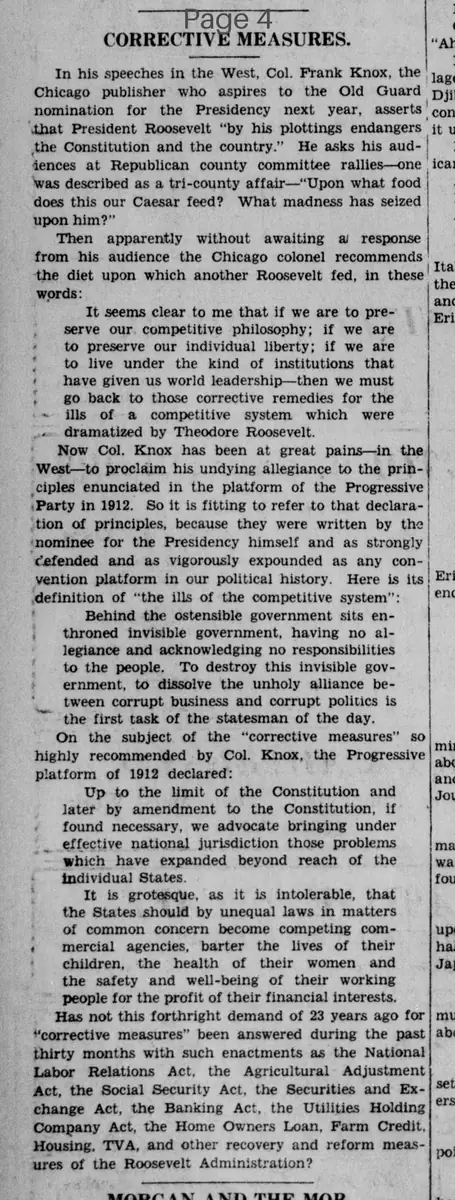
CORRECTIVE MEASURES.
In his speeches in the West, Col. Frank Knox, the Chicago publisher who aspires to the Old Guard nomination for the Presidency next year, asserts that President Roosevelt "by his plottings endangers the Constitution and the country." He asks his audiences at Republican county committee rallies—one was described as a tri-county affair—"Upon what food does this our Caesar feed? What madness has seized upon him?"
Then apparently without awaiting a response from his audience the Chicago colonel recommends the diet upon which another Roosevelt fed, in these words:
It seems clear to me that if we are to preserve our competitive philosophy; if we are to preserve our individual liberty; if we are to live under the kind of institutions that have given us world leadership then we must go back to those corrective remedies for the ills of a competitive system which were dramatized by Theodore Roosevelt.
Now Col. Knox has been at great pains in the West—to proclaim his undying allegiance to the principles enunciated in the platform of the Progressive Party in 1912. So it is fitting to refer to that declaration of principles, because they were written by the nominee for the Presidency himself and as strongly defended and as vigorously expounded as any convention platform in our political history. Here is its definition of "the ills of the competitive system":
Behind the ostensible government sits enthroned invisible government, having no allegiance and acknowledging no responsibilities to the people. To destroy this invisible government, to dissolve the unholy alliance between corrupt business and corrupt politics is the first task of the statesman of the day.
On the subject of the "corrective measures" so highly recommended by Col. Knox, the Progressive platform of 1912 declared:
Up to the limit of the Constitution and later by amendment to the Constitution, if found necessary, we advocate bringing under effective national jurisdiction those problems which have expanded beyond reach of the individual States.
It is grotesque, as it is intolerable, that the States should by unequal laws in matters of common concern become competing commercial agencies, barter the lives of their children, the health of their women and the safety and well-being of their working people for the profit of their financial interests.
Has not this forthright demand of 23 years ago for "corrective measures" been answered during the past thirty months with such enactments as the National Labor Relations Act, the Agricultural Adjustment Act, the Social Security Act, the Securities and Exchange Act, the Banking Act, the Utilities Holding Company Act, the Home Owners Loan, Farm Credit, Housing. TVA, and other recovery and reform measures of the Roosevelt Administration?
In his speeches in the West, Col. Frank Knox, the Chicago publisher who aspires to the Old Guard nomination for the Presidency next year, asserts that President Roosevelt "by his plottings endangers the Constitution and the country." He asks his audiences at Republican county committee rallies—one was described as a tri-county affair—"Upon what food does this our Caesar feed? What madness has seized upon him?"
Then apparently without awaiting a response from his audience the Chicago colonel recommends the diet upon which another Roosevelt fed, in these words:
It seems clear to me that if we are to preserve our competitive philosophy; if we are to preserve our individual liberty; if we are to live under the kind of institutions that have given us world leadership then we must go back to those corrective remedies for the ills of a competitive system which were dramatized by Theodore Roosevelt.
Now Col. Knox has been at great pains in the West—to proclaim his undying allegiance to the principles enunciated in the platform of the Progressive Party in 1912. So it is fitting to refer to that declaration of principles, because they were written by the nominee for the Presidency himself and as strongly defended and as vigorously expounded as any convention platform in our political history. Here is its definition of "the ills of the competitive system":
Behind the ostensible government sits enthroned invisible government, having no allegiance and acknowledging no responsibilities to the people. To destroy this invisible government, to dissolve the unholy alliance between corrupt business and corrupt politics is the first task of the statesman of the day.
On the subject of the "corrective measures" so highly recommended by Col. Knox, the Progressive platform of 1912 declared:
Up to the limit of the Constitution and later by amendment to the Constitution, if found necessary, we advocate bringing under effective national jurisdiction those problems which have expanded beyond reach of the individual States.
It is grotesque, as it is intolerable, that the States should by unequal laws in matters of common concern become competing commercial agencies, barter the lives of their children, the health of their women and the safety and well-being of their working people for the profit of their financial interests.
Has not this forthright demand of 23 years ago for "corrective measures" been answered during the past thirty months with such enactments as the National Labor Relations Act, the Agricultural Adjustment Act, the Social Security Act, the Securities and Exchange Act, the Banking Act, the Utilities Holding Company Act, the Home Owners Loan, Farm Credit, Housing. TVA, and other recovery and reform measures of the Roosevelt Administration?
What sub-type of article is it?
Partisan Politics
Economic Policy
Constitutional
What keywords are associated?
Frank Knox
Roosevelt Administration
Progressive Party
1912 Platform
New Deal Reforms
Corrective Measures
Constitutional Jurisdiction
What entities or persons were involved?
Col. Frank Knox
President Roosevelt
Theodore Roosevelt
Progressive Party
Editorial Details
Primary Topic
Critique Of Frank Knox's Attacks On Fdr And Defense Of New Deal As Fulfilling 1912 Progressive Platform
Stance / Tone
Supportive Of Fdr's Reforms, Critical Of Republican Nominee Aspirant Knox
Key Figures
Col. Frank Knox
President Roosevelt
Theodore Roosevelt
Progressive Party
Key Arguments
Knox Attacks Fdr For Endangering Constitution But Praises Theodore Roosevelt's Corrective Measures
1912 Progressive Platform Defines Ills As Invisible Government And Corrupt Alliances
Platform Advocates National Jurisdiction Over Problems Beyond State Reach
Criticizes States Competing Harmfully For Business Interests
Fdr's New Deal Acts Like National Labor Relations Act And Social Security Act Fulfill These Demands