Thank you for visiting SNEWPapers!
Sign up free
National Gazette
Philadelphia, Philadelphia County, Pennsylvania
What is this article about?
In a letter to the National Gazette, David Jones argues that the Indian War in the Northwest Territory stems from ongoing aggression by bands like the Mingoes, British influence, and Indian raiding, not settler encroachments, defending Congress's decision to raise arms.
Clipping
OCR Quality
Full Text
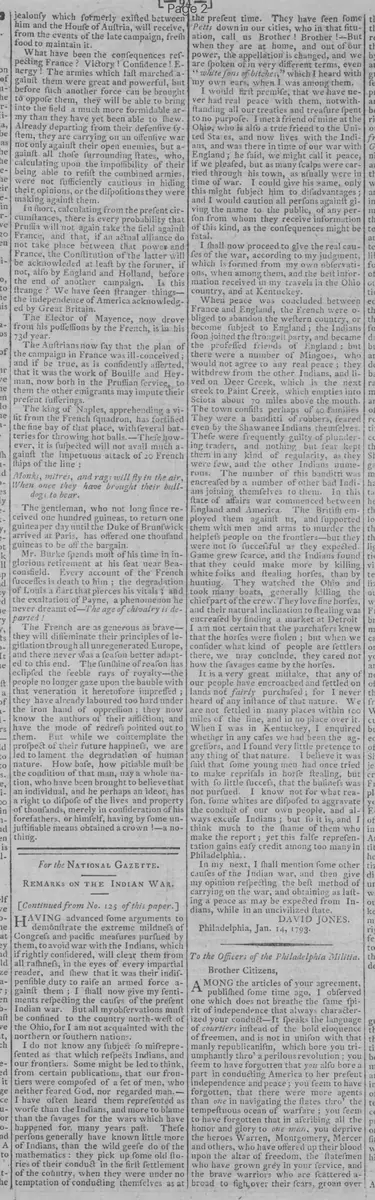
REMARKS ON The Indian War.
[Continued from No. 125 of this paper.]
HAVING advanced some arguments to demonstrate the extreme mildness of Congress and pacific measures pursued by them, to avoid war with the Indians, which if rightly considered, will clear them from all rashness, in the eyes of every impartial reader, and shew that it was their indispensable duty to raise an armed force against them; I shall now give my sentiments respecting the causes of the present Indian war. But all my observations must be confined to the country north-west of the Ohio, for I am not acquainted with the northern or southern nations.
I do not know any subject more misrepresented than that which respects Indians, and our frontiers. Some might be led to think, from certain publications, that our frontiers were composed of a set of men, who neither feared God, nor regarded man. I have often heard them represented as worse than the Indians, and more to blame than the savages for the wars which have happened for many years past. These persons generally have known little more of Indians, than the wild geese do of the mathematics: they pick up some old stories of their conduct in the first settlement of the country, when they were under no temptation of conducting themselves as at the present time. They have seen some Pets down in our cities, who in that situation, call us Brother! Brother!—But when they are at home, and out of our power, the appellation is changed, and we are spoken of in very different terms, even "white sons of bitches," which I heard with my own ears, when I was among them.
I would first premise, that we have never had real peace with them, notwithstanding all our treaties and treasure spent to no purpose. I met a friend of mine at the Ohio, who is also a true friend to the United States, and now lives with the Indians, and was there in time of our war with England; he said, we might call it peace, if we pleased, but as many scalps were carried through his town, as usually were in time of war. I could give his name, only this might subject him to disadvantages; and I would caution all persons against giving the name to the public, of any person from whom they receive information of this kind, as the consequences might be fatal.
I shall now proceed to give the real causes of the war, according to my judgment, which is formed from my own observations, when among them, and the best information received in my travels in the Ohio country, and at Kentucky.
When peace was concluded between France and England, the French were obliged to abandon the western country, or become subject to England; the Indians soon joined the strongest party, and became the professed friends of England: but there were a number of Mingoes, who would not agree to any real peace; they withdrew from the other Indians, and lived on Deer Creek, which is the next creek to Paint Creek, which empties into Sciota about 70 miles above the mouth. The town consists perhaps of 40 families. They were a banditti of robbers, feared even by the Shawanee Indians themselves. These were frequently guilty of plundering traders, and nothing, but fear kept them in any kind of regularity, as they were few, and the other Indians numerous. The number of this banditti was increased by a number of other bad Indians joining themselves to them. In this state of affairs war commenced between England and America. The British employed them against us, and supported them with men and arms to murder the helpless people on the frontiers—but they were not so successful as they expected. Game grew scarce, and the Indians found that they could make more by killing white folks and stealing horses, than by hunting. They watched the Ohio and took many boats, generally killing the chief part of the crew. They love fine horses, and their natural inclination to stealing was increased by finding a market at Detroit. I am not certain that the purchasers knew that the horses were stolen: but when we consider what kind of people are settlers there, we may conclude, they cared not how the savages came by the horses.
It is a very great mistake, that any of our people have encroached and settled on lands not fairly purchased; for I never heard of any instance of that nature. We are not settled in many places within 100 miles of the line, and in no place over it. When I was in Kentucky, I enquired whether in any cases we had been the aggressors, and I found very little pretence to any thing of that nature. I believe it was said that some young men had once tried to make reprisals in horse stealing, but with so little success, that the business was not pursued. I know not for what reason, some whites are disposed to aggravate the conduct of our own people, and always excuse Indians; but so it is, and I think much to the shame of them who make the report; yet this false representation gains easy credit among too many in Philadelphia.
In my next, I shall mention some other causes of the Indian war, and then give my opinion respecting the best method of carrying on the war, and obtaining as lasting a peace as may be expected from Indians, while in an uncivilized state.
DAVID JONES.
Philadelphia, Jan. 14, 1793.
What sub-type of article is it?
What keywords are associated?
What entities or persons were involved?
Where did it happen?
Domestic News Details
Primary Location
North West Of The Ohio
Event Date
Jan. 14, 1793
Key Persons
Outcome
ongoing indian raids involving scalps, murders of frontiersmen, boat crews killed, horse thefts; no lasting peace despite treaties.
Event Details
David Jones argues that the Indian War arises from persistent aggression by Mingoes and other bands on Deer Creek, supported by British during the Revolutionary War, leading to raids on Ohio River boats and frontiers; denies settler encroachments on Indian lands and criticizes misrepresentations of frontiersmen.