Thank you for visiting SNEWPapers!
Sign up free
Gazette Of The United States
Philadelphia, Philadelphia County, Pennsylvania
What is this article about?
A letter refuting a correspondent's observations on Jay's Treaty in the Charleston City Gazette, arguing that prohibiting French prize sales in U.S. ports does not harm southern citizens or agriculture, as benefits accrue to merchants via remittances, and revenue remains unaffected due to duty drawbacks on exports.
Merged-components note: Merged the two sequential components into a single letter_to_editor, as the second is a direct continuation of the letter from the Charleston City Gazette discussing the British treaty's effects.
Clippings
1 of 2
OCR Quality
Full Text
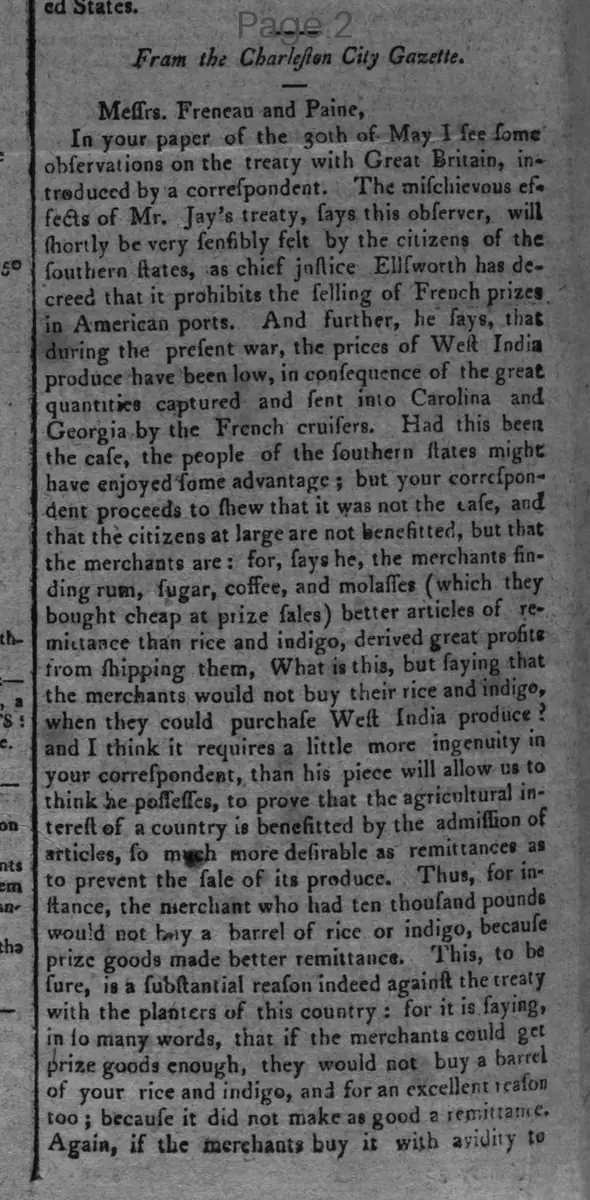
Messrs. Freneau and Paine,
In your paper of the 30th of May I see some
observations on the treaty with Great Britain, introduced by a correspondent. The mischievous effects
of Mr. Jay's treaty, says this observer, will
shortly be very sensibly felt by the citizens of the
southern states, as chief justice Ellsworth has decreed
that it prohibits the selling of French prizes
in American ports. And further, he says, that
during the present war, the prices of West India
produce have been low, in consequence of the great
quantities captured and sent into Carolina and
Georgia by the French cruisers. Had this been
the case, the people of the southern states might
have enjoyed some advantage; but your correspondent
proceeds to shew that it was not the case, and
that the citizens at large are not benefitted, but that
the merchants are: for, says he, the merchants importing
rum, sugar, coffee, and molasses (which they
bought cheap at prize sales) better articles of remittance
than rice and indigo, derived great profit
from shipping them. What is this, but saying that
the merchants would not buy their rice and indigo,
when they could purchase West India produce?
and I think it requires a little more ingenuity in
your correspondent, than his piece will allow us to
think he possesses, to prove that the agricultural interest
of a country is benefitted by the admission of
articles, so much more desirable as remittances as
to prevent the sale of its produce. Thus, for instance,
the merchant who had ten thousand pounds
would not buy a barrel of rice or indigo, because
prize goods made better remittance. This, to be
sure, is a substantial reason indeed against the treaty
with the planters of this country: for it is saying,
in so many words, that if the merchants could get
prize goods enough, they would not buy a barrel
of your rice and indigo, and for an excellent reason
too; because it did not make as good a remittance.
Again, if the merchants buy it with avidity to
export, how are the citizens benefitted by the sale of
these articles? for they are not used, but remitted,
as they answer better than rice, indigo and cotton.
But if any one will take the trouble to enquire, he
will find that even the merchants generally are not
benefitted; for the prize goods are monopolized by a
few monied men, and they, and not the citizens, are
benefitted by this advantageous commerce, as he calls
it. So that, from his own shewing, the southern states,
if he means the citizens of the southern states, will
not feel the mischievous effects of the treaty.
But he tells you that the revenue will be injured as
the duties paid on them at the custom house amounted
to thirty thousand dollars. This observer either wilfully
misrepresents, or is very ignorant of what he has undertaken
to explain; for every farthing of the duty except one per
cent is returned on these goods being exported. So that
the revenue does not get one six pence by them if they
are remitted. Now, if this is such an advantageous commerce
to our merchants, the articles must be exported; if they
are exported, the revenue is not benefitted; as the drawback
would be allowed, and the citizens will derive no advantage,
for they cannot be consumed in a foreign country and in this also.
A Friend to Truth.
What sub-type of article is it?
What themes does it cover?
What keywords are associated?
What entities or persons were involved?
Letter to Editor Details
Author
A Friend To Truth
Recipient
Messrs. Freneau And Paine
Main Argument
the letter argues that jay's treaty does not harm southern states' citizens or agriculture by prohibiting french prize sales, as any benefits from cheap west india produce go to a few merchants for export remittances rather than local consumption, and revenue is not lost due to duty drawbacks on exports.
Notable Details