Thank you for visiting SNEWPapers!
Sign up free
Story
August 11, 1841
Farmers' Gazette, And Cheraw Advertiser
Cheraw, Chesterfield County, South Carolina
What is this article about?
John Mahard, Jr., a Cincinnati pork packer since 1820, advocates for medium-sized Berkshire hogs over large breeds. He details improvements in hog quality, benefits for farmers and packers, and his own breeding efforts, dated July 5, 1841.
Clipping
OCR Quality
98%
Excellent
Full Text
From the Western Farmer and Gardener.
MEDIUM SIZED, VERSUS LARGE HOGS.
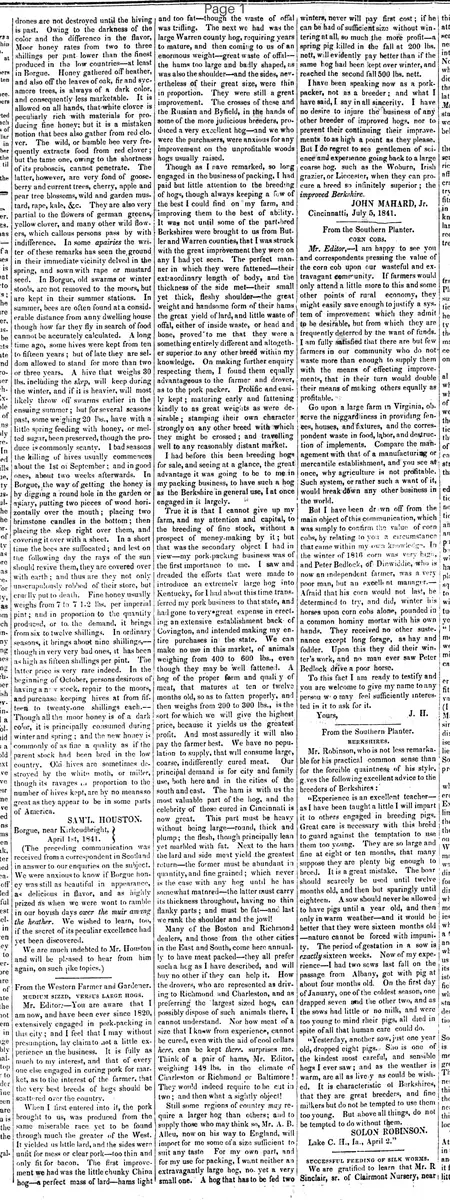
Mr. Editor:—You are aware that I am now, and have been ever since 1820, extensively engaged in pork-packing in this city; and I feel that I may without presumption, lay claim to not a little experience in the business. It is fully as much to my interest, and that of every one else engaged in curing pork for market, as to the interest of the farmer, that the very best breeds of hogs should be scattered over the country.
When I first entered into it, the pork brought to us, was produced from the same miserable race yet to be found through much the greater of the West. It yielded us little lard, and the sides were unfit for mess or clear pork—too thin and only fit for bacon. The first improvement we had was the little chunky China hog—a perfect mass of lard—hams light and too fat though the waste of offal was trifling. The next we had was the large Warren county hog, requiring years to mature, and then coming to us of an enormous weight—great waste of offal—the hams too large and badly shaped, as was also the shoulder—and the sides, nevertheless of their great size, were thin in proportion. They were still a great improvement. The crosses of these and the Russian and Byfield, in the hands of some of the more judicious breeders, produced a very excellent hog—and we who were the purchasers, were anxious for any improvement on the unprofitable woods hogs usually raised.
Though as I have remarked, so long engaged in the business of packing, I had paid but little attention to the breeding of hogs, though always keeping a few of the best I could find on my farm, and improving them to the best of ability. It was not until some of the part-bred Berkshires were brought to us from Butler and Warren counties, that I was struck with the great improvement they were on any I had yet seen. The perfect manner in which they were fattened—their extraordinary length of body, and the thickness of the side meat—their small yet thick, fleshy shoulder—the great weight and handsome form of their hams—the great yield of lard, and little waste of offal, either of inside waste, or head and bone, proved to me that they were a something entirely different and altogether superior to any other breed within my knowledge. On making further enquiry respecting them, I found them equally advantageous to the farmer and drover, as to the pork packer. Prolific and easily kept; maturing early and fattening kindly to as great weights as were desirable; stamping their own character strongly on any other breed with which they might be crossed; and travelling well to any reasonably distant market.
I had before this been breeding hogs for sale, and seeing at a glance, the great advantage it was going to be to me in my packing business, to have such a hog as the Berkshire in general use, I at once engaged in it largely.
True it is that I cannot give up my farm, and my attention and capital, to the breeding of fine stock, without a prospect of money-making by it; but that was the secondary object I had in view—my pork-packing business was of the first importance to me. I saw and dreaded the efforts that were made to introduce an extremely large hog into Kentucky, for I had about this time transferred my pork business to that state, and had gone to very great expense in erecting an extensive establishment back of Covington, and intended making my entire purchases in the state. We can make no use in this market, of animals weighing from 400 to 600 lbs., even though they may be well fattened. A hog of the proper form and quality of meat, that matures at ten or twelve months old, so as to fatten properly, and then weighs from 200 to 300 lbs., is the sort for which we will give the highest price, because it yields us the greatest profit. And most assuredly it will also pay the farmer best. We have no population to supply, that will consume large, coarse, indifferently cured meat. Our principal demand is for city and family use, both here and in the cities of the south and east. The ham is with us the most valuable part of the hog, and the celebrity of those cured in Cincinnati is now great. This part must be heavy without being large—round, thick and plump; the flesh, though principally lean yet marbled with fat. Next to the ham the lard and side meat yield the greatest return—the former must be abundant in quantity, and fine grained; which never is the case with any hog until he has somewhat matured—the latter must carry its thickness throughout, having no thin flanky parts; and must be fat and last we rank the shoulder and the jowl!
Many of the Boston and Richmond dealers, and those from the other cities in the East and South, come here annually to have meat packed—they all prefer such a hog as I have described, and will buy no other if they can help it. How the drovers, who are represented as driving to Richmond and Charleston, and as preferring the 'largest sized hogs, can possibly dispose of such animals there, I cannot understand. Nor how meat of a size that I know from experience, cannot be cured, even with the aid of cool cellars here, can be kept there, surprises me. Think of a pair of hams, Mr. Editor, weighing 148 lbs. in the climate of Charleston or Richmond or Baltimore! They would indeed require to be cut in two; and then what a sightly object!
Still some regions of country may require a larger hog than others; and to supply those who may think so, Mr. A. B. Allen, now on his way to England, will import for me some of a size sufficient to suit any taste. For my own part, and for my use for packing, I want neither an extravagantly large hog, nor yet a very small one. A hog that has to be fed two winters, never will pay first cost; if he can be had of sufficient size without wintering at all, so much the more profit—a spring pig killed in the fall at 200 lbs. nett, will evidently pay better than if the same hog had been kept over winter, and reached the second fall 500 lbs. nett.
I have been speaking now as a pork-packer, not as a breeder: and what I have said, I say in all sincerity. I have no desire to injure the business of any other breeder of improved hogs, nor to prevent their continuing their improvements to as high a point as they please. But I do regret to see gentlemen of science and experience going back to a large coarse hog, such as the Woburn, Irish grazier, or Leicester, when they can procure a breed so infinitely superior; the improved Berkshire.
JOHN MAHARD, Jr.
Cincinnati, July 5, 1841.
MEDIUM SIZED, VERSUS LARGE HOGS.
Mr. Editor:—You are aware that I am now, and have been ever since 1820, extensively engaged in pork-packing in this city; and I feel that I may without presumption, lay claim to not a little experience in the business. It is fully as much to my interest, and that of every one else engaged in curing pork for market, as to the interest of the farmer, that the very best breeds of hogs should be scattered over the country.
When I first entered into it, the pork brought to us, was produced from the same miserable race yet to be found through much the greater of the West. It yielded us little lard, and the sides were unfit for mess or clear pork—too thin and only fit for bacon. The first improvement we had was the little chunky China hog—a perfect mass of lard—hams light and too fat though the waste of offal was trifling. The next we had was the large Warren county hog, requiring years to mature, and then coming to us of an enormous weight—great waste of offal—the hams too large and badly shaped, as was also the shoulder—and the sides, nevertheless of their great size, were thin in proportion. They were still a great improvement. The crosses of these and the Russian and Byfield, in the hands of some of the more judicious breeders, produced a very excellent hog—and we who were the purchasers, were anxious for any improvement on the unprofitable woods hogs usually raised.
Though as I have remarked, so long engaged in the business of packing, I had paid but little attention to the breeding of hogs, though always keeping a few of the best I could find on my farm, and improving them to the best of ability. It was not until some of the part-bred Berkshires were brought to us from Butler and Warren counties, that I was struck with the great improvement they were on any I had yet seen. The perfect manner in which they were fattened—their extraordinary length of body, and the thickness of the side meat—their small yet thick, fleshy shoulder—the great weight and handsome form of their hams—the great yield of lard, and little waste of offal, either of inside waste, or head and bone, proved to me that they were a something entirely different and altogether superior to any other breed within my knowledge. On making further enquiry respecting them, I found them equally advantageous to the farmer and drover, as to the pork packer. Prolific and easily kept; maturing early and fattening kindly to as great weights as were desirable; stamping their own character strongly on any other breed with which they might be crossed; and travelling well to any reasonably distant market.
I had before this been breeding hogs for sale, and seeing at a glance, the great advantage it was going to be to me in my packing business, to have such a hog as the Berkshire in general use, I at once engaged in it largely.
True it is that I cannot give up my farm, and my attention and capital, to the breeding of fine stock, without a prospect of money-making by it; but that was the secondary object I had in view—my pork-packing business was of the first importance to me. I saw and dreaded the efforts that were made to introduce an extremely large hog into Kentucky, for I had about this time transferred my pork business to that state, and had gone to very great expense in erecting an extensive establishment back of Covington, and intended making my entire purchases in the state. We can make no use in this market, of animals weighing from 400 to 600 lbs., even though they may be well fattened. A hog of the proper form and quality of meat, that matures at ten or twelve months old, so as to fatten properly, and then weighs from 200 to 300 lbs., is the sort for which we will give the highest price, because it yields us the greatest profit. And most assuredly it will also pay the farmer best. We have no population to supply, that will consume large, coarse, indifferently cured meat. Our principal demand is for city and family use, both here and in the cities of the south and east. The ham is with us the most valuable part of the hog, and the celebrity of those cured in Cincinnati is now great. This part must be heavy without being large—round, thick and plump; the flesh, though principally lean yet marbled with fat. Next to the ham the lard and side meat yield the greatest return—the former must be abundant in quantity, and fine grained; which never is the case with any hog until he has somewhat matured—the latter must carry its thickness throughout, having no thin flanky parts; and must be fat and last we rank the shoulder and the jowl!
Many of the Boston and Richmond dealers, and those from the other cities in the East and South, come here annually to have meat packed—they all prefer such a hog as I have described, and will buy no other if they can help it. How the drovers, who are represented as driving to Richmond and Charleston, and as preferring the 'largest sized hogs, can possibly dispose of such animals there, I cannot understand. Nor how meat of a size that I know from experience, cannot be cured, even with the aid of cool cellars here, can be kept there, surprises me. Think of a pair of hams, Mr. Editor, weighing 148 lbs. in the climate of Charleston or Richmond or Baltimore! They would indeed require to be cut in two; and then what a sightly object!
Still some regions of country may require a larger hog than others; and to supply those who may think so, Mr. A. B. Allen, now on his way to England, will import for me some of a size sufficient to suit any taste. For my own part, and for my use for packing, I want neither an extravagantly large hog, nor yet a very small one. A hog that has to be fed two winters, never will pay first cost; if he can be had of sufficient size without wintering at all, so much the more profit—a spring pig killed in the fall at 200 lbs. nett, will evidently pay better than if the same hog had been kept over winter, and reached the second fall 500 lbs. nett.
I have been speaking now as a pork-packer, not as a breeder: and what I have said, I say in all sincerity. I have no desire to injure the business of any other breeder of improved hogs, nor to prevent their continuing their improvements to as high a point as they please. But I do regret to see gentlemen of science and experience going back to a large coarse hog, such as the Woburn, Irish grazier, or Leicester, when they can procure a breed so infinitely superior; the improved Berkshire.
JOHN MAHARD, Jr.
Cincinnati, July 5, 1841.
What sub-type of article is it?
Agricultural Advice
Personal Experience
What keywords are associated?
Hog Breeding
Berkshire Hogs
Pork Packing
Cincinnati Market
Livestock Improvement
Medium Hogs
What entities or persons were involved?
John Mahard, Jr.
A. B. Allen
Where did it happen?
Cincinnati, Kentucky, Covington
Story Details
Key Persons
John Mahard, Jr.
A. B. Allen
Location
Cincinnati, Kentucky, Covington
Event Date
1841 07 05
Story Details
John Mahard shares his extensive experience in pork packing since 1820, advocating for medium-sized Berkshire hogs over large breeds due to better yield, maturation, and market demand. He discusses breed improvements, his breeding efforts, and economic benefits for farmers and packers.