Thank you for visiting SNEWPapers!
Sign up free
The Portland Daily Press
Portland, Cumberland County, Maine
What is this article about?
A detailed eyewitness account from a soldier in the 17th Maine Regiment describing the movements, engagements, and experiences of the Third Corps during the Battle of Chancellorsville, from April 28 to early May 1863, including the night attack and retreat.
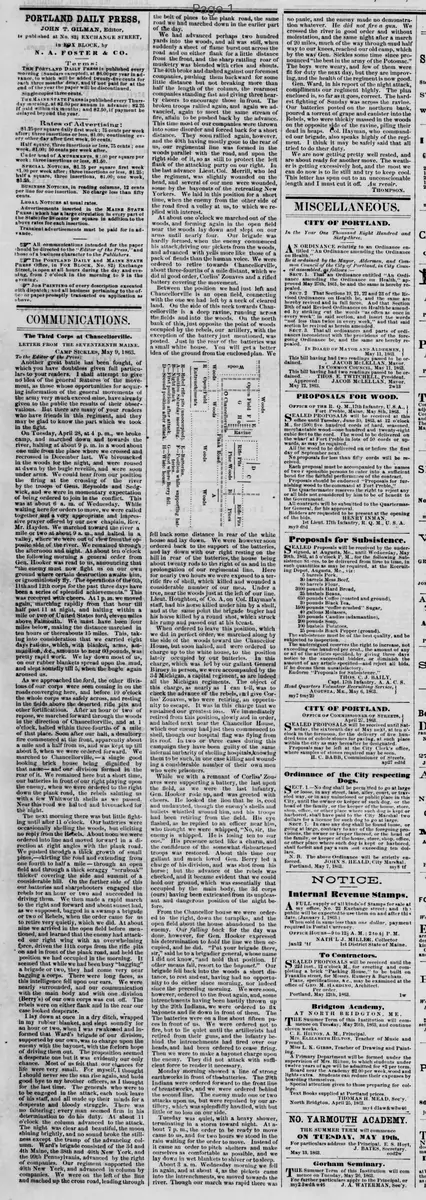
Merged-components note: Image bbox overlaps with the letter text, indicating it is an embedded illustration in the letter.
Clipping
OCR Quality
Full Text
The Third Corps at Chancellorsville.
LETTER FROM THE SEVENTEENTH MAINE.
CAMP SICKLES, May 9, 1863.
To the Editor of the Press:
Another great battle has been fought, of which you have doubtless given full particulars to your readers. I shall attempt to give no idea of the general features of the movement, as those whose opportunities for acquiring information of the general movements of the army very much exceed mine, have already given to the public the results of their observations. But there are many of your readers who have friends in this regiment, and they may be glad to know the part which we took in the fight.
On Tuesday, April 28, at 4 p. m., we broke camp, and marched down and towards the river, halting at about 9 p. m. in a wood about one mile from the place where we crossed and recrossed in December last. We bivouacked in the woods for the night, and were roused at dawn by the bugle reveille, and were soon under arms. We could hear from our position the firing at the crossing of the river by the troops of Gens. Reynolds and Sedgwick, and we were in momentary expectation of being ordered to join in the conflict. This was at about 6 a. m. of Wednesday. While waiting here for orders to move, we were called together and a very appropriate and impressive prayer offered by our new chaplain, Rev. Mr. Hayden. We marched toward the river a mile or two at about 9 a. m., and halted in a valley, where we were out of view from the opposite side of the river. We remained through the afternoon and night. At about ten o'clock the following morning a general order from Gen. Hooker was read to us, announcing that "the enemy must now fight us on our own ground where certain destruction awaits him, or ignominiously fly. The operations of the 6th, 11th and 12th corps for the past three days have been a series of splendid achievements." This was received with cheers. At 1 p. m. we moved again, marching rapidly from that hour till half past 11 at night, and halting within a mile or two of United States ford, eleven miles above Falmouth. We must have been four miles below, making the distance marched in ten hours or thereabouts 15 miles. This, taking into consideration that we carried eight days rations, which, with blanket, arms, ammunition, &c., amounts to near 60 pounds, was pretty rapid work. We lay down most of us, on our rubber blankets spread upon the mud, and slept soundly till 5, when the bugle again aroused us.
As we approached the ford, the other divisions of our corps were seen coming in on the roads converging here, and before 10 o'clock the whole corps was safely across, and resting in the fields above the deserted rifle pits and other fortifications. After an hour or two of repose, we marched forward through the woods in the direction of Chancellorsville, and at 1 o'clock, halted within three-fourths of a mile of that place. Soon after our halt, a desultory fire commenced at the front, apparently about a mile and a half from us, and was kept up till about 5, when we were ordered forward. We marched to Chancellorsville,-a single good looking brick house being dignified by that name-and our division formed in the rear of it. We remained here but a short time. our batteries in front of our right playing upon the enemy, when we were ordered to the right down the plank road, the rebels saluting us with a few Whitworth shells as we passed. Near this road we halted and bivouacked for the night.
The next morning there was but little fighting until after 11 o'clock. Our batteries were occasionally shelling the woods, but eliciting no reply from the Rebels. About noon we were ordered into line and moved forward in a direction at right angles with the plank road. We pushed through a thick growth of small pines,-skirting the road and extending from one fourth to half a mile-through an open field and through a thick scraggy "scrub oak" thicket covering the side and summit of a considerable hill. On the further side of this our batteries and sharpshooters engaged the rebels for an hour or two and succeeded in driving them. We then made a rapid march to the right and forward and about sunset had, as we supposed, bagged in a swamp a brigade or two of Rebels, when the order came for us to retire very quietly, which we did. At about nine we arrived in the open field before mentioned, and learned that the enemy had attacked our right wing with an overwhelming force, driven the 11th corps from the rifle pits on and in front of the plank road, and held the position we had occupied in the morning. It seemed that while we had been busy "bagging" a brigade or two, they had come very near bagging a corps. There were long faces, as this intelligence fell upon our ears. We were nearly surrounded, and our communication with the main body and with one division (Berry's) of our own corps was cut off. The rebels were on either flank and in the rear our case looked desperate.
I lay down at once in a dry ditch, wrapped in my rubber blanket, and slept soundly for an hour or two, when I was awakened and informed that Ward's brigade of our division, supported by our own, was to charge upon the enemy with the bayonet, with the forlorn hope of driving them out. The proposition seemed a desperate one but it was evidently our only chance. Most of us felt that our chances for life were very small. For myself, I thought I should never see the sun rise again, and bade good bye to my brother officers, as I thought for the last time. The generals who were to be engaged in the attack, each took leave of his staff, and all made up their minds for a desperate and bloody struggle. There was no faltering; every man seemed firm in his determination to do his duty. At about 11 o'clock the column advanced to the attack. The night was clear and beautiful, the moon shining brightly, and no sound broke the stillness except the tramp of the advancing column. Ward's brigade consisted of the 3d and 4th Maine, the 35th and 40th New York, and the 99th Pennsylvania, advanced by the right of companies. Our regiment supported the 40th New York, and advanced in column by companies. We were on the left of the line and marched up the cross road, leading through the belt of pines to the plank road, the same road we had marched down in the earlier part of the day.
We had advanced perhaps two hundred yards into the woods, and all was still, when suddenly a sheet of flame burst out across the road and on either flank for a little distance from the front, and the sharp rattling roar of musketry was blended with cries and shouts. The 40th broke and dashed against our foremost companies, pushing them backward for some little distance but not breaking more than half the length of the column, the rearmost companies standing fast and giving three hearty cheers to encourage those in front. The broken troops rallied again, and again we advanced, again to meet the same stream of fire, again to be pushed back by the advance. This time most of our companies were thrown into some disorder and forced back for a short distance. They soon rallied again, however, and the 40th having mostly gone to the rear of us, our regimental line was formed in the woods parallel with the road, and upon the right side of it, so as still to protect the left flank of the attacking party on our right. In the last advance Lieut. Col. Merrill, who led the regiment, was slightly wounded on the head, and several of our men were wounded, some by the bayonets of the retreating New Yorkers. We laid in this position for a short time, when the enemy from the other side of the road fired a volley at us, to which we replied with interest.
At about one o'clock we marched out of the woods, and forming again in the open field near the woods lay down and slept on our arms until nearly four. Our brigade was hardly formed, when the enemy commenced his attack, driving our pickets from the woods, and advanced with yells more like those of a pack of fiends than the human voice. We were ordered to retire towards Chancellorsville, almost three-fourths of a mile distant, which we did in good order, Corliss' Zouaves and a rifled battery covering the movement. Between the position we had just left and Chancellorsville is an open field, connecting with the one we had left by a neck of cleared land. On the side of this neck towards Chancellorsville is a deep ravine, running across the fields and into the woods. On the north bank of this, just opposite the point of woods occupied by the rebels, our artillery, with the exception of the battery just mentioned, was posted. Just in the rear of the batteries was a small white house. You will get a better idea of the ground from the enclosed plan. We fell back some distance in rear of the white house and lay down. We were however soon ordered back to the support of the batteries, and lay down with our right resting on the hill in rear of the batteries, the house being about twenty rods to the right of us and in the prolongation of our regimental line. Here for nearly two hours we were exposed to a terrible fire of shell, which killed and wounded a considerable number of our men. Under a tree, near the woods just at the left of our line. Lieut. Houghton, of Co. A, on Col. Hayman's staff, had his horse killed under him by a shell. And at the same point the brigade bugler had his horse killed by a round shot, which struck his rump and passed out at his breast.
When ordered to leave this position, which we did in perfect order, we marched along by the side of the woods toward the Chancellor House, but soon halted, and were ordered to charge up to the white house, to the position lately occupied by our batteries. In this charge, which was led by our gallant General Birney in person, we were accompanied by the 3d Michigan, a capital regiment, as are indeed all the Michigan regiments. The object of this charge, as nearly as I can tell, was to check the advance of the rebels, and give Corliss' Zouaves, who were retiring, an opportunity to escape. It was in this charge that we sustained our greatest loss. We immediately retired from this position, slowly and in order, and halted next near the Chancellor House, which our enemy had just then commenced to shell, though our hospital flag was flying from its roof. In two or three cases during this campaign they have been guilty of the same infernal barbarity of shelling hospitals, knowing them to be such, in one case killing and wounding a considerable number of their own men who were prisoners.
While we with a remnant of Corliss' Zouaves were supporting a battery, the last upon the field, as we were the last infantry, Gen. Hooker rode up, and was greeted with cheers. He looked the lion that he is, cool and undaunted, though the enemy's shells and bullets whistled around him, and his troops had been retiring from the field. His eye flashed, as he replied to an officer near him, who thought we were whipped, "No, sir, the enemy is whipped. He is losing ten to our one."
His presence acted like a charm, and the confidence of the somewhat disheartened troops was restored. About this time our gallant and much loved Gen. Berry led a charge of his division, and was shot from his horse; but the advance of the rebels was checked, and it became evident that we could hold our ground, which was essentially that occupied by the main body, the 3d corps (ours) having been extricated from its unpleasant and dangerous position of the night before.
From the Chancellor house we were ordered to the right, down the turnpike, and the open field about the house abandoned to the enemy. Our falling back for the day was done, however, for Gen. Hooker expressed his determination to hold the line we then occupied, and he did. "Put your brigade there, sir," said he to a brigadier general, whose name I did not know, "and hold that position. If other means fail, resort to the bayonet." Our brigade fell back into the woods a short distance, to rest and eat, having had no opportunity to do either since morning, nor indeed since the preceding morning. We were soon, however, ordered to the front again, and, some intrenchments having been hastily thrown up by the 20th Indiana, we were ordered to fix bayonets and lie down in front of them. The batteries were on a line about fifteen paces in front of us. We were ordered not to fire, but to lie quiet until the artillerists had retired from their guns, and the infantry behind the intrenchments had fired over our heads, and had been ordered to cease firing. Then we were to make a bayonet charge upon the enemy. They did not attack with sufficient force to render it necessary.
Monday morning showed a line of strong earthworks in front of the batteries. The 20th Indiana were ordered forward to the front line of breastworks, and we were ordered behind the second line. The enemy made one or two attacks upon us, but were repulsed by our artillery, which was splendidly handled, with but little or no loss on our side.
Tuesday was quiet, with a heavy shower, terminating in a storm toward night. At about 7 p. m., the order to be ready to move came to us, and for two hours we stood in the rain waiting for the order to move. Instead of it came an order to pitch shelters and make ourselves as comfortable as possible, and we lay down in wet blankets to shiver or to sleep. About 3 a. m. Wednesday morning we fell in again, and at about 4, as the pickets came into the intrenchments, we moved towards the river. Though our march was rapid there was no panic, and the enemy made no demonstration whatever. He did not fire a gun. We crossed the river in good order and without molestation, and the same night after a march of 20 miles, much of the way through mud half way to our knees, reached our old camp, which by the way Gen. Sickles some time since pronounced "the best in the army of the Potomac."
The boys were weary, and few of them were fit for duty the next day, but they are improving, and the health of the regiment is now good. Gen. Ward, in his report of the night attack, compliments our regiment highly. The plan enclosed is, so far as it goes, correct. The hardest fighting of Sunday was across the ravine. Our batteries posted on the northern bank, poured a torrent of grape and canister into the Rebels, who were thickly massed in the woods on the opposite side of the ravine, piling their dead in heaps. Col. Hayman, who commanded our brigade, also speaks highly of the regiment. I think it may be safely said that all tried to do their duty.
We are now getting pretty well rested, and are about ready for another move. The weather is getting excessively hot, and the most we can do now is to lie still and try to keep cool. This letter has spun out to an unconscionable length and I must cut it off. Au revoir.
THOMPSON.
What sub-type of article is it?
What themes does it cover?
What keywords are associated?
What entities or persons were involved?
Letter to Editor Details
Author
Thompson.
Recipient
To The Editor Of The Press
Main Argument
provides a firsthand account of the 17th maine regiment's actions and the third corps' experiences in the battle of chancellorsville, emphasizing their bravery and role in key engagements despite heavy losses and desperate situations.
Notable Details