Thank you for visiting SNEWPapers!
Sign up free
Editorial
July 18, 1809
Virginia Argus
Richmond, Virginia
What is this article about?
Joel Barlow's oration on July 5 at Washington City advocates for republican public education to ensure informed voters and preserve the union, internal improvements like roads and canals funded by surplus revenue to bind states together, and adoption of submarine warfare innovations to counter European naval aggression without escalating military forces.
Clipping
OCR Quality
98%
Excellent
Full Text
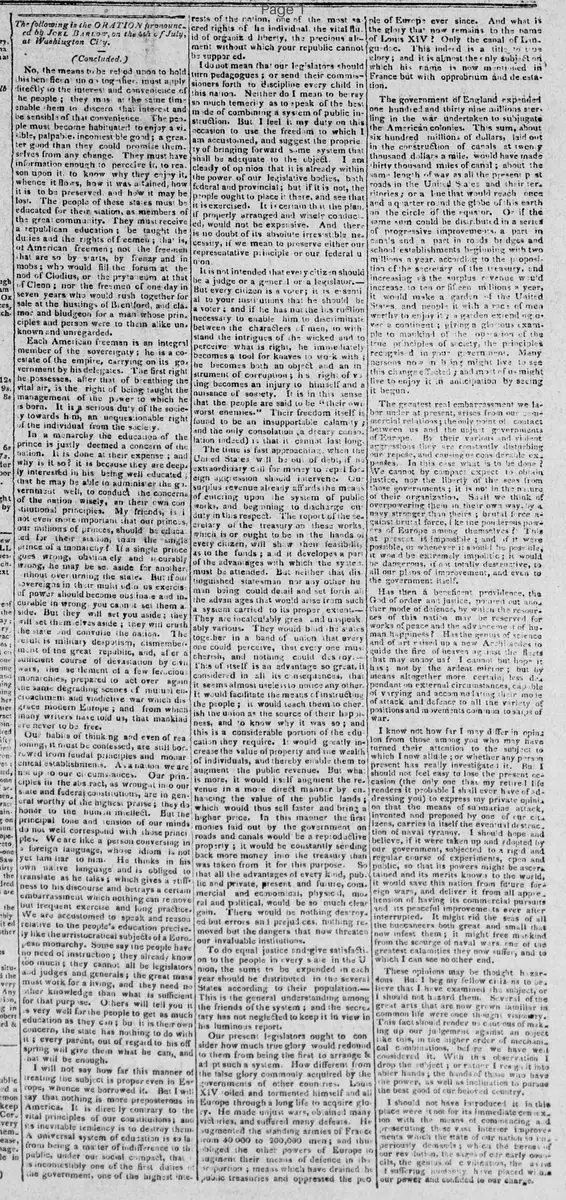
The following is the ORATION pronounced by Joel Barlow, on the 5th of July, at Washington City.
(Concluded.)
No, the means to be relied upon to hold this beneficent union together, must apply directly to the interest and convenience of the people; they must at the same time enable them to discern that interest and be sensible of that convenience. The people must become habituated to enjoy a visible, palpable, incontestable good; a greater good than they could promise themselves from any change. They must have information enough to perceive it, to reason upon it, to know why they enjoy it, whence it flows, how it was attained, how it is to be preserved, and how it may be lost. The people of these states must be educated for their station, as members of the great community. They must receive a republican education; be taught the duties and the rights of freemen; that is, of American freemen; not the freemen that are so by starts, by frenzy and in mobs; who would fill the forum at the nod of Clodius, or the prytaneum at that of Cleon; nor the freemen of one day in seven years who would rush together for sale at the hustings of Brentford, and claim and bludgeon for a man whose principles and person were to them alike unknown and unregarded.
Each American freeman is an integral member of the sovereignty; he is a co-estate of the empire, carrying on its government by his delegates. The first right he possesses, after that of breathing the vital air, is the right of being taught the management of the power into which he is born. It is a serious duty of the society towards him, an unquestionable right of the individual from the society.
In a monarchy the education of the prince is justly deemed a concern of the nation. It is done at their expense; and why is it so? it is because they are deeply interested in his being well educated; that he may be able to administer the government well, to conduct the concerns of the nation wisely, and their own constitutional principles. My Friends, is it not even more important that our princes, our millions of princes, should be educated for their station, than the single prince of a monarchy? If a single prince goes wrong, obstinately and incurably wrong, he may be set aside for another, without overturning the state. But if our sovereigns in their multitudinous exercise of power should become obstinate and incurable in wrong, you cannot set them aside. But they will set you aside; they will set themselves aside; they will crush the state and convulse the nation. The result is military despotism, dismemberment of the great republic, and, after a sufficient course of devastation by civil wars, the settlement of a few ferocious monarchies, prepared to act over again the same degrading scenes of mutual encroachment and vindictive war which disgrace modern Europe; and from which many writers have thought, that mankind are never to be free.
Our habits of thinking and even of reasoning, it must be confessed, are still borrowed from feudal principles and monarchical establishments. As a nation we are not up to our circumstances. Our principles in the abstract, as wrought into our state and federal constitutions, are in general worthy of the highest praise; they do honor to the human intellect. But the principal tone and tension of our minds do not well correspond with these principles. We are like a person conversing in a foreign language, whose idiom is not yet familiar to him. He thinks in his own native language and is obliged to translate as he talks; which gives a stiffness to his discourse and betrays a certain embarrassment which nothing can remove but frequent exercise and long practice.
We are accustomed to speak and reason relative to the people's education precisely like the aristocratical subjects of a European monarchy. Some say the people have no need of instruction; they already know too much; they cannot all be legislators and judges and generals; the great mass must work for a living, and they need no other knowledge than what is sufficient for that purpose. Others will tell you it is very well for the people to get as much education as they can; but it is their own concern, the state has nothing to do with it; every parent, out of regard to his offspring will give them what he can, and that will be enough.
I will not say how far this manner of treating the subject is proper even in Europe, whence we borrowed it. But I will say that nothing is more preposterous in America. It is directly contrary to the vital principles of our constitutions; and its inevitable tendency is to destroy them.
A universal system of education is so far from being a matter of indifference to the public, under our social compact, that it is indispensably one of the first duties of the government, one of the highest interests of the nation, one of the most sacred rights of the individual, the vital fluid of organized liberty, the precious aliment without which your republic cannot be supported.
I do not mean that our legislators should turn pedagogues; or send their commissioners forth to discipline every child in this nation. Neither do I mean to betray so much temerity as to speak of the best mode of combining a system of public instruction. But I feel it my duty on this occasion to use the freedom to which I am accustomed, and suggest the propriety of bringing forward some system that shall be adequate to the object. I am clearly of opinion that it is already within the power of our legislative bodies, both federal and provincial; but if it is not, the people ought to place it there, and see that it is exercised. It is certain that the plan, if properly arranged and wisely conducted, would not be expensive. And there is no doubt of its absolutely irresistible necessity, if we mean to preserve either our representative principle or our federal union.
It is not intended that every citizen should be a judge or a general or a legislator.—But every citizen is a voter; it is essential to your institutions that he should be a voter: and if he has not the instruction necessary to enable him to discriminate between the characters of men, to withstand the intrigues of the wicked and to perceive what is right, he immediately becomes a tool for knaves to work with; he becomes both an object and an instrument of corruption; his right of voting becomes an injury to himself and a nuisance of society. It is in this sense that the people are said to be "their own worst enemies." Their freedom itself is found to be an insupportable calamity; and the only consolation (a dreary consolation indeed) is that it cannot last long.
The time is fast approaching, when the United States will be out of debt, if no extraordinary call for money to repel foreign aggression should intervene. Our surplus revenue already affords the means of entering upon the system of public works, and beginning to discharge our duty in this respect. The report of the secretary of the treasury on these works, which is or ought to be in the hands of every citizen, will show the feasibility, as to the funds; and it develops a part of the advantages with which the system must be attended. But neither that distinguished statesman nor any other human being could detail and set forth all the advantages that would arise from such a system carried to its proper extent.—They are incalculably great and unspeakably various. They would bind the states together in a band of union that every one could perceive, that every one must cherish, and nothing could destroy.—
This of itself is an advantage so great, if considered in all its consequences, that it seems almost useless to notice any other. It would facilitate the means of instructing the people; it would teach them to cherish the union as the source of their happiness, and to know why it was so; and this is a considerable portion of the education they require. It would greatly increase the value of property and the wealth of individuals, and thereby enable them to augment the public revenue. But what is more, it would itself augment the revenue in a more direct manner by enhancing the value of the public lands: which would thus sell faster and bring a higher price. In this manner the first monies paid out by the government on roads and canals would be a reproductive property; it would be constantly sending back more money into the treasury than was taken from it for this purpose. So that all the advantages of every kind, public and private, present and future, commercial and economical, physical, moral and political, would be so much clear gain. There would be nothing destroyed but errors and prejudices, nothing removed but the dangers that now threaten our invaluable institutions.
To do equal justice and give satisfaction to the people in every state in the Union, the sums to be expended in each year should be distributed in the several States according to their population.—This is the general understanding among the friends of the system; and the secretary has not neglected to keep it in view in his luminous report.
Our present legislators ought to consider how much true glory would redound to them from being the first to arrange & adopt such a system. How different from the false glory commonly acquired by the governments of other countries. Louis XIV toiled and tormented himself and all Europe through a long life to acquire glory. He made unjust wars, obtained many victories, and suffered many defeats. He augmented the standing armies of France from 40,000 to 200,000 men; and thus obliged the other powers of Europe to augment their means of defence in the same proportion; means which have drained the public treasuries and oppressed the people of Europe ever since. And what is the glory that now remains to the name of Louis XIV? Only the canal of Languedoc. This indeed is a title to live glory; and it is almost the only subject on which his name is now mentioned in France but with opprobrium and detestation.
The government of England expended one hundred and thirty-nine millions sterling in the war undertaken to subjugate the American colonies. This sum, about six hundred millions of dollars, laid out in the construction of canals at twenty thousand dollars a mile, would have made thirty thousand miles of canal: about the same length of way as all the present post roads in the United States and their territories: or a line that would reach once and a quarter round the globe of this earth on the circle of the equator. Or if the same sum could be distributed in a series of progressive improvements, a part in canals and a part in roads bridges and school establishments beginning with two millions a year, according to the proposition of the secretary of the treasury, and increasing as the surplus revenue would increase, to ten or fifteen millions a year, it would make a garden of the United States, and people it with a race of men worthy to enjoy it; a garden extending over a continent; giving a glorious example to mankind of the operation of the true principles of society, the principles recognized in your government. Many persons now hoping might live to see this change effected: and most of us might live to enjoy it in anticipation by seeing it begun:
The greatest real embarrassment we labor under at present, arises from our commercial relations; the only point of contact between us and the unjust governments of Europe. By their various and violent aggressions they are constantly disturbing our repose, and causing us considerable expense. In this case what is to be done? We cannot by compact expect to obtain justice, nor the liberty of the seas from those governments; it is not in the nature of their organization. Shall we think of overpowering them in their own way, by a navy stronger than theirs: brutal force against brutal force, like the ponderous powers of Europe among themselves? This at present is impossible; and if it were possible, or whenever it should be possible; it would be extremely impolitic; it would be dangerous, if not totally destructive, to all our plans of improvement, and even to the government itself.
Has then a beneficent providence, the God of order and justice, pointed out another mode of defence, by which the resources of this nation may be reserved for works of peace and the advancement of human happiness? Has the genius of science and of art raised up a new Archimedes to guide the fire of heaven against the fleets that may annoy us? I cannot but hope it is so; not by the ardent mirror; but by means altogether more certain, less dependent on external circumstances, capable of varying and accommodating their mode of attack and defence to all the variety of positions and movements common to ships of war.
I know not how far I may differ in opinion from those among you who may have turned their attention to the subject to which I now allude; or whether any person present has really investigated it. But I should not feel easy to lose the present occasion (the only one that my retired life renders it probable I shall ever have of addressing you) to express my private opinion that the means of submarine attack, invented and proposed by one of our citizens, carries in itself the eventual destruction of naval tyranny. I should hope and believe, if it were taken up and adopted by our government, subjected to a rigid and regular course of experiments, open and public, so that its powers might be ascertained and its merits known to the world, it would save this nation from future foreign wars, and deliver it from all apprehension of having its commercial pursuits and its peaceful improvements ever after interrupted. It might rid the seas of all the buccaneers both great and small that now infest them; it might free mankind from the scourge of naval wars, one of the greatest calamities they now suffer, and to which I can see no other end.
These opinions may be thought hazardous. But I beg my fellow citizens to believe that I have examined the subject, or I should not hazard them. Several of the great arts that are now grown familiar in common life were once thought visionary. This fact should render us cautious of making up our judgment against an object like this, in the higher order of mechanical combinations, before we have well considered it. With this observation I drop the subject; or rather I resign it into abler hands; the hands of those who have the power, as well as inclination to pursue the best good of our beloved country.
I should not have introduced it in this place were it not for its immediate connection with the means of commencing and prosecuting those vast interior improvements which the state of our nation so imperiously demands; which the heroes of our revolution, the sages of our early councils, the genius of civilization, the voice of suffering humanity have placed within our power and confided to our charge.
(Concluded.)
No, the means to be relied upon to hold this beneficent union together, must apply directly to the interest and convenience of the people; they must at the same time enable them to discern that interest and be sensible of that convenience. The people must become habituated to enjoy a visible, palpable, incontestable good; a greater good than they could promise themselves from any change. They must have information enough to perceive it, to reason upon it, to know why they enjoy it, whence it flows, how it was attained, how it is to be preserved, and how it may be lost. The people of these states must be educated for their station, as members of the great community. They must receive a republican education; be taught the duties and the rights of freemen; that is, of American freemen; not the freemen that are so by starts, by frenzy and in mobs; who would fill the forum at the nod of Clodius, or the prytaneum at that of Cleon; nor the freemen of one day in seven years who would rush together for sale at the hustings of Brentford, and claim and bludgeon for a man whose principles and person were to them alike unknown and unregarded.
Each American freeman is an integral member of the sovereignty; he is a co-estate of the empire, carrying on its government by his delegates. The first right he possesses, after that of breathing the vital air, is the right of being taught the management of the power into which he is born. It is a serious duty of the society towards him, an unquestionable right of the individual from the society.
In a monarchy the education of the prince is justly deemed a concern of the nation. It is done at their expense; and why is it so? it is because they are deeply interested in his being well educated; that he may be able to administer the government well, to conduct the concerns of the nation wisely, and their own constitutional principles. My Friends, is it not even more important that our princes, our millions of princes, should be educated for their station, than the single prince of a monarchy? If a single prince goes wrong, obstinately and incurably wrong, he may be set aside for another, without overturning the state. But if our sovereigns in their multitudinous exercise of power should become obstinate and incurable in wrong, you cannot set them aside. But they will set you aside; they will set themselves aside; they will crush the state and convulse the nation. The result is military despotism, dismemberment of the great republic, and, after a sufficient course of devastation by civil wars, the settlement of a few ferocious monarchies, prepared to act over again the same degrading scenes of mutual encroachment and vindictive war which disgrace modern Europe; and from which many writers have thought, that mankind are never to be free.
Our habits of thinking and even of reasoning, it must be confessed, are still borrowed from feudal principles and monarchical establishments. As a nation we are not up to our circumstances. Our principles in the abstract, as wrought into our state and federal constitutions, are in general worthy of the highest praise; they do honor to the human intellect. But the principal tone and tension of our minds do not well correspond with these principles. We are like a person conversing in a foreign language, whose idiom is not yet familiar to him. He thinks in his own native language and is obliged to translate as he talks; which gives a stiffness to his discourse and betrays a certain embarrassment which nothing can remove but frequent exercise and long practice.
We are accustomed to speak and reason relative to the people's education precisely like the aristocratical subjects of a European monarchy. Some say the people have no need of instruction; they already know too much; they cannot all be legislators and judges and generals; the great mass must work for a living, and they need no other knowledge than what is sufficient for that purpose. Others will tell you it is very well for the people to get as much education as they can; but it is their own concern, the state has nothing to do with it; every parent, out of regard to his offspring will give them what he can, and that will be enough.
I will not say how far this manner of treating the subject is proper even in Europe, whence we borrowed it. But I will say that nothing is more preposterous in America. It is directly contrary to the vital principles of our constitutions; and its inevitable tendency is to destroy them.
A universal system of education is so far from being a matter of indifference to the public, under our social compact, that it is indispensably one of the first duties of the government, one of the highest interests of the nation, one of the most sacred rights of the individual, the vital fluid of organized liberty, the precious aliment without which your republic cannot be supported.
I do not mean that our legislators should turn pedagogues; or send their commissioners forth to discipline every child in this nation. Neither do I mean to betray so much temerity as to speak of the best mode of combining a system of public instruction. But I feel it my duty on this occasion to use the freedom to which I am accustomed, and suggest the propriety of bringing forward some system that shall be adequate to the object. I am clearly of opinion that it is already within the power of our legislative bodies, both federal and provincial; but if it is not, the people ought to place it there, and see that it is exercised. It is certain that the plan, if properly arranged and wisely conducted, would not be expensive. And there is no doubt of its absolutely irresistible necessity, if we mean to preserve either our representative principle or our federal union.
It is not intended that every citizen should be a judge or a general or a legislator.—But every citizen is a voter; it is essential to your institutions that he should be a voter: and if he has not the instruction necessary to enable him to discriminate between the characters of men, to withstand the intrigues of the wicked and to perceive what is right, he immediately becomes a tool for knaves to work with; he becomes both an object and an instrument of corruption; his right of voting becomes an injury to himself and a nuisance of society. It is in this sense that the people are said to be "their own worst enemies." Their freedom itself is found to be an insupportable calamity; and the only consolation (a dreary consolation indeed) is that it cannot last long.
The time is fast approaching, when the United States will be out of debt, if no extraordinary call for money to repel foreign aggression should intervene. Our surplus revenue already affords the means of entering upon the system of public works, and beginning to discharge our duty in this respect. The report of the secretary of the treasury on these works, which is or ought to be in the hands of every citizen, will show the feasibility, as to the funds; and it develops a part of the advantages with which the system must be attended. But neither that distinguished statesman nor any other human being could detail and set forth all the advantages that would arise from such a system carried to its proper extent.—They are incalculably great and unspeakably various. They would bind the states together in a band of union that every one could perceive, that every one must cherish, and nothing could destroy.—
This of itself is an advantage so great, if considered in all its consequences, that it seems almost useless to notice any other. It would facilitate the means of instructing the people; it would teach them to cherish the union as the source of their happiness, and to know why it was so; and this is a considerable portion of the education they require. It would greatly increase the value of property and the wealth of individuals, and thereby enable them to augment the public revenue. But what is more, it would itself augment the revenue in a more direct manner by enhancing the value of the public lands: which would thus sell faster and bring a higher price. In this manner the first monies paid out by the government on roads and canals would be a reproductive property; it would be constantly sending back more money into the treasury than was taken from it for this purpose. So that all the advantages of every kind, public and private, present and future, commercial and economical, physical, moral and political, would be so much clear gain. There would be nothing destroyed but errors and prejudices, nothing removed but the dangers that now threaten our invaluable institutions.
To do equal justice and give satisfaction to the people in every state in the Union, the sums to be expended in each year should be distributed in the several States according to their population.—This is the general understanding among the friends of the system; and the secretary has not neglected to keep it in view in his luminous report.
Our present legislators ought to consider how much true glory would redound to them from being the first to arrange & adopt such a system. How different from the false glory commonly acquired by the governments of other countries. Louis XIV toiled and tormented himself and all Europe through a long life to acquire glory. He made unjust wars, obtained many victories, and suffered many defeats. He augmented the standing armies of France from 40,000 to 200,000 men; and thus obliged the other powers of Europe to augment their means of defence in the same proportion; means which have drained the public treasuries and oppressed the people of Europe ever since. And what is the glory that now remains to the name of Louis XIV? Only the canal of Languedoc. This indeed is a title to live glory; and it is almost the only subject on which his name is now mentioned in France but with opprobrium and detestation.
The government of England expended one hundred and thirty-nine millions sterling in the war undertaken to subjugate the American colonies. This sum, about six hundred millions of dollars, laid out in the construction of canals at twenty thousand dollars a mile, would have made thirty thousand miles of canal: about the same length of way as all the present post roads in the United States and their territories: or a line that would reach once and a quarter round the globe of this earth on the circle of the equator. Or if the same sum could be distributed in a series of progressive improvements, a part in canals and a part in roads bridges and school establishments beginning with two millions a year, according to the proposition of the secretary of the treasury, and increasing as the surplus revenue would increase, to ten or fifteen millions a year, it would make a garden of the United States, and people it with a race of men worthy to enjoy it; a garden extending over a continent; giving a glorious example to mankind of the operation of the true principles of society, the principles recognized in your government. Many persons now hoping might live to see this change effected: and most of us might live to enjoy it in anticipation by seeing it begun:
The greatest real embarrassment we labor under at present, arises from our commercial relations; the only point of contact between us and the unjust governments of Europe. By their various and violent aggressions they are constantly disturbing our repose, and causing us considerable expense. In this case what is to be done? We cannot by compact expect to obtain justice, nor the liberty of the seas from those governments; it is not in the nature of their organization. Shall we think of overpowering them in their own way, by a navy stronger than theirs: brutal force against brutal force, like the ponderous powers of Europe among themselves? This at present is impossible; and if it were possible, or whenever it should be possible; it would be extremely impolitic; it would be dangerous, if not totally destructive, to all our plans of improvement, and even to the government itself.
Has then a beneficent providence, the God of order and justice, pointed out another mode of defence, by which the resources of this nation may be reserved for works of peace and the advancement of human happiness? Has the genius of science and of art raised up a new Archimedes to guide the fire of heaven against the fleets that may annoy us? I cannot but hope it is so; not by the ardent mirror; but by means altogether more certain, less dependent on external circumstances, capable of varying and accommodating their mode of attack and defence to all the variety of positions and movements common to ships of war.
I know not how far I may differ in opinion from those among you who may have turned their attention to the subject to which I now allude; or whether any person present has really investigated it. But I should not feel easy to lose the present occasion (the only one that my retired life renders it probable I shall ever have of addressing you) to express my private opinion that the means of submarine attack, invented and proposed by one of our citizens, carries in itself the eventual destruction of naval tyranny. I should hope and believe, if it were taken up and adopted by our government, subjected to a rigid and regular course of experiments, open and public, so that its powers might be ascertained and its merits known to the world, it would save this nation from future foreign wars, and deliver it from all apprehension of having its commercial pursuits and its peaceful improvements ever after interrupted. It might rid the seas of all the buccaneers both great and small that now infest them; it might free mankind from the scourge of naval wars, one of the greatest calamities they now suffer, and to which I can see no other end.
These opinions may be thought hazardous. But I beg my fellow citizens to believe that I have examined the subject, or I should not hazard them. Several of the great arts that are now grown familiar in common life were once thought visionary. This fact should render us cautious of making up our judgment against an object like this, in the higher order of mechanical combinations, before we have well considered it. With this observation I drop the subject; or rather I resign it into abler hands; the hands of those who have the power, as well as inclination to pursue the best good of our beloved country.
I should not have introduced it in this place were it not for its immediate connection with the means of commencing and prosecuting those vast interior improvements which the state of our nation so imperiously demands; which the heroes of our revolution, the sages of our early councils, the genius of civilization, the voice of suffering humanity have placed within our power and confided to our charge.
What sub-type of article is it?
Education
Infrastructure
Foreign Affairs
What keywords are associated?
Public Education
Republican Education
Internal Improvements
Roads And Canals
Federal Union
Submarine Attack
Naval Defense
Surplus Revenue
What entities or persons were involved?
Joel Barlow
Secretary Of The Treasury
Louis Xiv
English Government
American Freemen
European Monarchies
Editorial Details
Primary Topic
Advocacy For Public Education, Internal Improvements, And Submarine Defense To Preserve The Republic
Stance / Tone
Strong Advocacy For Enlightened Republicanism And Peaceful Progress
Key Figures
Joel Barlow
Secretary Of The Treasury
Louis Xiv
English Government
American Freemen
European Monarchies
Key Arguments
Public Education Is Essential For Informed Voters To Maintain The Union And Prevent Despotism.
Internal Improvements Like Roads And Canals Will Bind States, Enhance Economy, And Fund Themselves Via Increased Land Values.
Submarine Attack Innovations Can Neutralize Naval Threats Without Building A Large Navy, Preserving Resources For Domestic Progress.
Monarchical Education Models Are Inadequate; America Needs Universal Republican Education.
Surplus Revenue Should Fund Education And Infrastructure Proportionally By Population.
Uneducated Populace Risks Corruption And Loss Of Liberty.