Thank you for visiting SNEWPapers!
Sign up free
Story
July 12, 1820
Daily National Intelligencer
Washington, District Of Columbia
What is this article about?
In the House of Representatives, Mr. Whitman of Massachusetts delivers a speech opposing a bill on duties and tariffs, arguing it undermines commerce and agriculture to favor premature manufacturing growth, citing historical revenue from trade and warning of economic imbalance.
Clipping
OCR Quality
98%
Excellent
Full Text
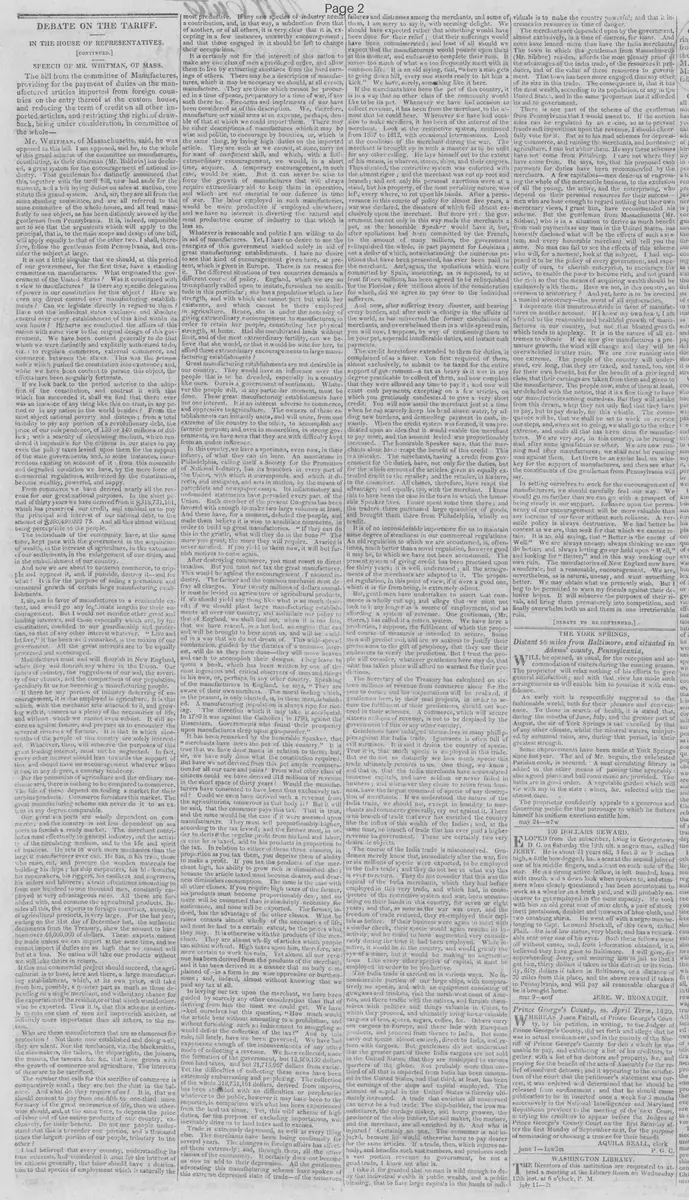
DEBATE ON THE TARIFF
IN THE HOUSE OF REPRESENTATIVES
[CONTINUED.]
SPEECH OF MR. WHITMAN, OF MASS.
The bill from the committee of Manufactures, providing for the payment of duties on the manufactured articles imported from foreign countries on the entry thereof at the custom house, and reducing the term of credit on all other imported articles, and restricting the right of drawback, being under consideration, in committee of the whole—
Mr. Whitman, of Massachusetts, said, he was opposed to this bill. I am opposed, said he, to the whole of this grand scheme of the committee on manufactures, constituting, as their chairman (Mr. Baldwin) has declared, a great system for the encouragement of national industry. That gentleman has distinctly announced that this, together with the tariff bill, now laid aside for the moment, and a bill laying duties on sales at auction, constitute this grand system. And, sir, they are all from the same standing committee, and are all referred to the same committee of the whole house, and all tend manifestly to one object, as has been distinctly avowed by the gentleman from Pennsylvania. It is, indeed, impossible not to see that the arguments which will apply to the principal, that is, to the main scope and design of one bill, will apply equally to that of the other two. I shall, therefore, follow the gentleman from Pennsylvania, and consider the subject at large.
It is not a little singular that we should, at this period of our government, for the first time, have a standing committee on manufactures. What originated the government of the United States? Was it constituted with a view to manufactures? Is there any specific delegation of power in our constitution for this object? Have we even any direct control over manufacturing establishments? Can we legislate directly in regard to them? Have not the individual states exclusive and absolute control over every establishment of this kind within its own limits? Hitherto we conducted the affairs of this nation with some view to the original design of this government. We have been content generally to do that which we were distinctly and explicitly authorized to do, viz.: to regulate commerce, external commerce, and commerce between the states. This was the primum mobile which pushed the constitution into existence; and while we have been content to pursue this object, the effects have been singularly fortunate.
If we look back to the period anterior to the adoption of the constitution, and contrast it with that which has succeeded it, shall we find that there ever was an instance of any thing like this contrast, in any period or in any nation in the world besides? From the most abject national poverty and distress; from a total inability to pay any portion of a revolutionary debt, the price of our independence, of 130 or 140 millions of dollars; with a scarcity of circulating medium, which rendered it impossible for the citizens in our states to pay even the paltry taxes levied upon them for the support of the state governments, and, in some instances, insurrections existing on account of it: from this miserable and degraded condition we have, by the mere force of commercial regulations, authorized by the constitution, become wealthy, powerful, and happy.
From commerce we have derived nearly all the revenue for our great national purposes. In the short period of thirty years we have derived from it $318,731,161, which has preserved our credit, and enabled us to pay the principal and interest of our national debt, to the amount of $260,450,022.75. And all this almost without being perceptible to the people.
The individuals of the community have, at the same time, kept pace with the government in the acquisition of wealth, in the increase of agriculture, in the extension of our settlements, in the enlargement of our cities, and in the embellishment of our country.
And now we are about to contemn commerce, to cripple and oppress it, and, if possible, destroy it—and for what? It is for the purpose of aiding a premature and unnatural growth of certain large manufacturing establishments.
I, sir, am in favor of manufactures to a reasonable extent, and would go any legitimate lengths for their encouragement. But I would not sacrifice other great and leading interests, and those especially which are, by the constitution, confided to our guardianship and protection, to that of any other interest whatever. "Live and let live," it has been well remarked, is the maxim of our government. All the great interests are to be equally protected and encouraged.
Manufactures must and will flourish in New England, when they will flourish anywhere in the Union. Our habits of industry, the ruggedness of our soil, the severity of our climate, and the compactness of our population, peculiarly fit us for becoming a manufacturing people.
If there be any portion of industry deserving of encouragement, it is that employed in agriculture. It is that which, with the mechanic arts attached to it, and growing with it, insures us a plenty of the necessaries of life, and without which we cannot even subsist. It will secure us against famine, and prepare us to encounter the severest reverses of fortune. It is that in which nine-tenths of the people of this country are solely interested. Whatever, then, will subserve the purposes of this great leading interest, must not be neglected. In fact, every other interest should lean towards the support of this, and should have no encouragement whatever when it has, in any degree, a contrary tendency.
For the promotion of agriculture and the ordinary mechanic arts, there is nothing to be compared to commerce. The life of these depend on finding a market for their surplus products. Commerce furnishes this market. The great manufacturing scheme can never do it to an extent in any degree comparable.
Our great sea ports are wholly dependent on commerce; and the country is not less dependent on sea ports to furnish a ready market. The merchant contributes most effectually to general industry, and the activity of the circulating medium, and to the life and spirit of business. He sets to work more mechanics than the largest manufacturer ever can. He has, in his train, those who raise, cut, and procure the wooden materials for building his ships; his ship carpenters, his blacksmiths, his ropemakers, his riggers, his caulkers and engravers, his sailors and laborers; a train oftentimes amounting to from one hundred to one thousand men, constantly employed at very advantageous rates. All these are furnished with, and consume the agricultural products. Besides all this, the exports to foreign countries, annually, of agricultural products, is very large. For the last year, ending on the 31st day of December last, the authentic documents from the Treasury, shew the amount to have been over $46,000,000 of dollars. These exports cannot be made unless we can import at the same time, and we cannot import if duties are so high that we cannot sell but at a loss. No nation will take our products without we will take theirs in return.
If this anti-commercial project should succeed, the agriculturist is to have, here and there, a large manufacturing establishment, which, at its own price, will take from him, possibly, a quarter part as much as those depending on a single merchant, and without any chance for the exportation of the residue, or of that which would otherwise be exported. Thus it is, that this scheme is entirely to ruin one class of men and impoverish another, of infinitely more importance than all others, to the nation.
Who are these manufacturers that are so clamorous for protection? Not those now established and doing well; they are silent. Nor the mechanics, viz. the blacksmiths, the shoemakers, the tailors, the shipwrights, the joiners, the masons, the tanners &c. &c. that have grown with the growth of commerce and agriculture. The interests of these are to be sacrificed.
The number that calls for this sacrifice of commerce is comparatively small; they are but the dust in the balance. And what do they require of us? It is, that we should consent to pay from one-fifth to one-third more for many of the great necessaries of life, than we otherwise should, and, at the same time, to depress the price of labor and of the native products of our country, exclusively, for their benefit. Do not our people understand that this is to render one portion, and a thousand times the largest portion of our people, tributary to the other?
I had believed that every country, understanding its true interests, had considered it most for the interest of its citizens generally, that labor should have a destination to that species of employment which is naturally the most productive. If any one species of industry needs a contribution, and, in that way, a subduction from that of another, or of all others, it is very clear that it is, excepting in a few instances, unworthy encouragement; and that those engaged in it should be left to change their occupations.
It is certainly not for the interest of this nation to make any one class of men a privileged order, and allow them to live by extracting assistance from the hard earnings of others. There may be a description of manufactures, which it may be necessary we should, at all events, manufacture. They are those which cannot be procured in a time of peace, preparatory to a time of war, if any such there be. Fire-arms and implements of war have been considered as of this description. We, therefore, manufacture our small arms at an expense, perhaps, double of that at which we could import them. There may be other descriptions of manufactures which it may be wise and politic, to encourage by bounties, or, which is the same thing, by laying high duties on the imported article. They are such as we cannot, at once, carry on for want of competent skill, and which, with a little extraordinary encouragement, we would, in a short time, acquire. A temporary encouragement, in such case, would be wise. But it can never be wise to force the growth of manufactures that will always require extraordinary aid to keep them in operation, and which are not essential to our defence in time of war. The labor employed in such manufactories, would be more productive if employed elsewhere and we have no interest in diverting the natural and most productive course of industry to that which is less so.
Whatever is reasonable and politic I am willing to do in aid of manufactures. Yet, I have no desire to see the energies of this government wielded solely in aid of great manufacturing establishments. I have no desire to see that kind of encouragement given here, at present, which is given in Europe. There is no reason for it. The different situations of two countries demands a different course of policy. England, which we are so triumphantly called upon to imitate, furnishes no similitude in this particular: she has a population which is her strength, and with which she cannot part but with her existence, and which cannot be there employed in agriculture. Hence, she is under the necessity of giving extraordinary encouragement to manufactures, in order to retain her people, constituting her physical strength, at home. Had she uncultivated lands without limit, and of the most extraordinary fertility, can we believe that she would, or that it would be wise for her, to afford these extraordinary encouragements to large manufacturing establishments?
Great manufacturing establishments are not desirable in our country. They would have an influence over the people that is to be dreaded, especially in a country like ours. Ours is a government of sentiment. Whatever the people will, at any particular moment, must be done. These great manufacturing establishments have but one interest. It is an interest adverse to commerce, and oppressive to agriculture. The owners of these establishments can instantly unite, and will unite, from one extreme of the country to the other, to accomplish any favorite purpose; and even in monarchies, in strong governments, we have seen that they are with difficulty kept from an undue influence.
In this country, we have a specimen, even now, in their infancy, of what they can do here. An association in Philadelphia, calling itself a Society for the Promotion of National Industry, has its branches in every part of the Union, with which it corresponds, and which it directs, and instigates, and sets in motion, by the means of pamphlets and newspaper essays. Its inflammatory and unfounded statements have pervaded every part of the Union. Each member of the present Congress has been favored with enough to make two large volumes at least. And these have, for a moment, deluded the people, and made them believe it is wise to annihilate commerce, in order to build up great manufactories. If they can do this in the gristle, what will they do in the bone? The more you grant, the more they will require. Avarice is never satisfied. If you yield to them now, it will but furnish motives to come again.
After destroying commerce, you must resort to direct taxation. But you must not tax the great manufacturer. This would be against the encouragement of national industry. The farmer and the common mechanic must defray all charges. Your twenty millions of dollars annually must be levied on agriculture or agricultural products.
If we should yield any thing like what is so much desired; if we should plant large manufacturing establishments all over our country, and assimilate our policy to that of England, we shall find out, when it is too late, that we have reared, in a hot bed, an engine that can and will be brought to bear upon us, and will be wielded in a way that we do not dream of. This wide-spread combination, guided by the dictates of a common interest, will do as they have done—they will move heaven and earth to accomplish their designs. I beg leave to quote a book, which has been written by one of the most ingenious and critical observers of men and things in his own, or, perhaps, in any other country. Speaking of the manufacturers in England, he says, "They are aware of their own numbers. The moral feeling which, in the peasant, is only blunted, is, in these men, debauched. A manufacturing population is always ripe for rioting. The direction which it may take is accidental. In 1780 it was against the Catholics; in 1790, against the Dissenters. Governments who found their prosperity upon manufactures sleep upon gun-powder."
It has been remarked by the honorable Speaker, that "merchants have been the pet of this country." It is true that we have done much in relation to them; but, sir, we have only done what the constitution required. But have we not derived from this pet ample remuneration for all our care and pains? From what other class of citizens could we have derived $318 millions of revenue in the short space of thirty years? Would the manufacturers have consented to have been thus exclusively taxed? Could we even have derived such a revenue from the agriculturists, numerous as that body is? But it will be said, that the consumer pays this tax. That is true, and the same would be the case if it were assessed upon manufacturers. They must sell proportionably higher, according to the tax levied; and the farmer must, in order to derive the regular profit from his land and labor, in case he is taxed, add to his products in proportion to the tax. In relation to either of these three classes, in proportion as you tax them, you deprive them of ability to make a profit. If you tax the products of the merchant high, his ability to grow rich is diminished also; because the article taxed must become dearer, and dearness diminishes consumption. The same is the case with all other classes. If you require high taxes of the farmer his products must become proportionably dear, and no more will be consumed than is absolutely necessary for sustenance, and none will be exported. The farmer, indeed, has the advantage of the other classes. What he raises consists almost wholly of the necessaries of life, and must be had to a certain extent, be the prices what they may. It is otherwise with the products of the merchant. They are almost wholly of articles which people can subsist without. High taxes upon him, therefore, are more certain to work his ruin. Yet almost all our revenue has been derived from the products of the merchant; and it has been derived in a manner that no body complained of—in a form in no wise oppressive or burthensome; and, indeed, almost without knowing that we paid any tax at all.
In levying our tax upon the merchant, we have been guided by scarcely any other consideration than that of deriving from him the most we could get. We have asked ourselves but this question, "How much would the article bear without amounting to a prohibition, and without furnishing such an inducement to smuggling as would defeat the collection of the tax?" And by this rule, till lately, have we been governed. We have had experience enough of the inconveniences of any other mode of collecting a revenue. We have collected, since the formation of the government, but $12,500,130 dollars from land taxes, and but $21,715,967 dollars from excise. Yet the difficulties of collecting these sums have been extremely embarrassing and perplexing. The collection of the whole $318,731,161 dollars, derived from imports, has been attended with no difficulties or perplexities whatever to the public, however it may have been to the importer, in comparison with what has been experienced from the land tax alone. Yet, this wild scheme of high duties, for the purpose of excluding importations, will inevitably drive us to land taxes and to excises.
Trade is extremely depressed, as well as every thing else. The merchants have been losing continually for several years. The changes in foreign affairs has affected them extremely; and, through them, all the other classes of the community. It certainly does not become us now to add to their depression. All the gentlemen advocating this manufacturing scheme have spoken of this extreme depressed state of trade—of the numerous failures and distresses among the merchants, and some of them, I am sorry to say it, with seeming delight. We should have expected rather that something would have been done for their relief: that their sufferings would have been commiserated; and least of all should we expect that the manufacturers would pounce upon them at this moment, and endeavor to complete their ruin. It savors too much of what we too frequently meet with in common life. It is an old saying, that, "when a man gets to going down hill, every one stands ready to hit him a kick." We have, surely, something like it here.
If the merchants have been the pet of this country, it is in a way that no other class of the community would like to be its pet. Whenever we have had occasion to collect revenue, it has been from the merchant, to the utmost that he could bear. Whenever we have had occasion to make sacrifices, it has been of the interest of the merchant. Look at the restrictive system, continued from 1807 to 1812, with occasional intermissions. Look at the condition of the merchant during the war. The merchant is brought up in such a manner as to be unfit for any other calling. He lays himself out to the extent of his means, in wharves, stores, ships, and their cargoes. Thus situated, the restrictive system was enforced with the utmost rigor; and the merchant was cut up root and branch; and not only his personal exertions were at a stand, but his property, of the most perishing nature, was left, every where, to rot upon his hands. After a perseverance in this course of policy for almost five years, a war was declared, the disasters of which fell almost exclusively upon the merchant. But more yet: the government has not only in this way made the merchants a pet, as the honorable Speaker would have it, but, after spoliations had been committed by the French, to the amount of many millions, the government relinquished the whole, in part payment for Louisiana; not a dollar of which, notwithstanding the numerous petitions that have been presented, has ever been paid to the merchant. And, again, the spoliations which were committed by Spain, amounting, as is supposed, to at least fifteen millions, has been agreed to be relinquished for the Floridas; five millions alone of the consideration for which, did we agree to pay over to the individual sufferers.
And now, after suffering every disaster, and bearing every burden, and after such a change in the affairs of the world, as has subverted the former calculations of merchants, and overwhelmed them in a wide-spread ruin, you will now, I suppose, by way of continuing them to be your pet, superadd insufferable duties, and instant cash payments.
The credit heretofore extended to them for duties, is complained of as a favor. You first required of them, almost exclusively, to submit to be taxed for the entire support of government—a tax as heavy as it was in any degree practicable to collect of them, and now complain that they were allowed any time to pay it; and now will exact cash payments, excepting on a few articles, on which you graciously condescend to give a very short credit. You will now assail the merchant just at a time when he can scarcely keep his head above water, by adding new burdens, and demanding payment in cash, instantly. When the credit system was formed, it was predicated upon an idea that it would enable the merchant to pay more, and the amount levied was proportionably increased. The honorable Speaker says, that the merchants alone have reapt the benefit of this credit. This is a mistake. The merchants, having a credit from government for the duties, have, not only for the duties, but for the whole amount of the articles, given an equally extended credit to the retailer; and the retailer, in his turn, to the consumer. All classes, therefore, have reapt the advantage; and equally, too, with the merchant. I know this to have been the case in the town in which the honorable Speaker lives. I once spent some time there; and the traders there purchased large quantities of goods, and brought them there from Philadelphia, wholly on credit.
It is of no inconsiderable importance for us to maintain some degree of steadiness in our commercial regulations. An old regulation to which we are accustomed, is, oftentimes, much better than a novel regulation, however good it may be, to which we have not been accustomed. The present system of giving credit has been practised upon for thirty years; it is well understood; all the arrangements of the merchants are adapted to it. The proposed regulation, in this point of view, if it were a good one, which it is far from being, is extremely odious.
But, gentlemen have undertaken to assert that commerce is wholly cut up; and allege that we must not look to it any longer as a source of employment, and as affording a system of revenue. One gentleman, (Mr. Storrs,) has called it a rotten system. We have here a prediction, I suppose, the fulfilment of which the proposed course of measures is intended to secure. Some men will predict evil, and are so anxious to justify their pretensions to the gift of prophecy, that they use their endeavors to verify the prediction. But I trust the people will consider, whatever gentlemen here may do, that what has taken place will afford no warrant for their predictions.
The Secretary of the Treasury has calculated on sixteen millions of revenue from commerce alone for the year to come; and his expectations will be realized, if gentlemen here, by their mad projects, in order to secure the fulfilment of their predictions, should not succeed in their schemes. A commerce, which will secure sixteen millions of revenue, is not to be despised by the government of this or any other country.
Gentlemen have indulged themselves in many philippics against the India trade. Ignorance is often full of evil surmises. It is said it drains the country of specie. True it is, that much specie is employed in this trade. But we do not so distinctly see how much specie this trade ultimately restores to us. One thing, we know; and that is, that the India merchants have accumulated immense capitals, and have seldom or never failed in business; and whenever they chuse to retire from business, have the largest command of specie of any description of merchants. If we understood the nature of the India trade, we should not, except in hostility to merchants and commerce generally, cry out against it. There is no branch of trade that ever has enriched the country like the influx of this wealth of the Indies; and, at the same time, no branch of trade that has ever paid a higher revenue to government. These are certainly two very desirable objects.
The course of the India trade is misconceived. Gentlemen merely know that, immediately after the war, five or six millions of specie were exported, to be employed in the India trade; and they do not see in what way this is ever to return. They do not consider that this was the capital of the India merchants, which they had before employed in this very trade, and which had, in consequence of the restrictive system and war, been accumulating on their hands in this country, for seven or eight years; and that, as soon as the war was over, and the freedom of trade restored, they re-employed their capitals as before. If their business were again to meet with a similar check, their specie would again resume its inactivity, and be found to have augmented very considerably during the time it had been employed. While inactive, it would be in the country, and would gratify the eye of a miser, but it would be making no augmentations. Like every other species of capital, it must be employed in order to be productive.
The India trade is carried on in various ways. No inconsiderable portion of our large ships, with comparatively no specie, and with an equipment consisting of gewgaws and trinkets, visit the north-west coast of America, and there traffic with the natives, and furnish themselves with peltries and things valuable in China, to which they proceed, and ultimately bring home valuable cargoes of teas, spices, sugars, coffee, &c. Others carry out cargoes to Europe, and there lade with European products, and proceed from thence to India. But some carry out specie almost entirely, direct to India, and return with cargoes. But gentlemen do not understand that the greater part of these India cargoes are not sold in the United States; that they are reshipped to various quarters of the globe. Not probably more than one-third of all that is imported from India has been consumed in the United States, and that third, at least, has been the earnings of the ships and capital employed. The amount of capital in the United States is thereby ultimately increased. A trade that enriches all concerned can never be a bad trade. The ship-builder, the iron manufacturer, the cordage maker, and hemp grower, the producer of the ship timber, the sail maker, the mariner, and the merchant, are all enriched by it. And who is injured? Certainly no one. The consumer is not injured, because he would otherwise have to pay dearer for the same articles. If a trade, then, which injures nobody, and benefits such vast numbers, and produces such a vast portion revenue to government, be not a good trade, I know not what is.
I take it for granted that no man is wild enough to deny that individual wealth is public wealth, and a public blessing, that to have large capitals in the hands of individuals is to make the country powerful: and that it increases its resources in time of danger.
The merchants are depended upon by the government almost exclusively, in a time of distress, for loans. And none have loaned more than have the India merchants. The town in which the gentleman from Massachusetts (Mr. Silsbee) resides, affords the most plenary proof of the advantages of the India trade, of the resources it produces, and of the value of these resources to government. That town has been more engaged than any other of its size in this trade. The consequence is, that it has the most wealth, according to its population, of any in the United States, and in the same proportion has it afforded its aid to government.
There is one part of the scheme of the gentleman from Pennsylvania that I would assent to. If the auction sales can be regulated by an excise, so as to prevent frauds and impositions upon the revenue, I should cheerfully vote for it. But as to his mad schemes for depressing commerce, and ruining the merchants, and burdening agriculture, I can but abhor them. He says these schemes have not come from Pittsburg: I care not where they have come from. He says, too, that his proposed cash payments for duties have been recommended by the merchants. A few capitalists—men desirous of engrossing the whole of the mercantile business, to the exclusion of all the young, the active, and the enterprising, who depend on their personal resources for their success—men who are base enough to regard nothing but their own mercenary views, I grant him, have recommended his scheme. But the gentleman from Massachusetts (Mr. Silsbee,) who is in a situation to derive as much benefit from cash payments as any man in the United States, has honestly disclosed what will be the effects of such a system; and every honorable merchant will tell you the same. No man can fail to see the effects of this scheme who will, for a moment, look at the subject. I had supposed it to be the policy of every government, and especially of ours, to cherish enterprise, to encourage the active, to enable the poor to become rich, and not guard the rich so that the means of acquiring wealth should be exclusively with them. Have we not, in this country, an aversion to aristocracy? And yet, here is to be erected a monied aristocracy—the worst of all aristocracies.
I deprecate this monstrous stride in favor of manufactures on another account. If I know my own heart, I am a friend to the reasonable and healthful growth of manufactures in our country, but not that bloated growth which tends to apoplexy. It is in the nature of all extremes to vibrate. If we now give manufactures a premature growth, the wind will change and they will be overwhelmed in utter ruin. We are now running into one extreme. The people of the country will understand, ere long, that they are taxed, and taxed, too, not for their own benefit, but for the benefit of a privileged class; that their earnings are taken from them and given to the manufacturer. The people now, some of them at least, are deluded with the notion, that it is a fine thing to have our manufactories among ourselves. But they will awake from this dream, when they not only find that they have to pay, but to pay dearly, for this whistle. The consequence will be, that we shall be set to work to retrace our steps, and, when set to going, we shall go to the other extreme, and undo all that has been done for manufactures. We are very apt, in this country, to be running mad after some ignis fatuus or other. We are now running mad after manufactures; we shall next be running mad against them. Let there be an excise laid on whiskey for the support of manufactures, and then see what the constituents of the gentleman from Pennsylvania will say.
In setting ourselves to work for the encouragement of manufacturers, we should carefully feel our way. We should go no farther than we can go with a prospect of being steady in our support. Reliance upon the permanency of our encouragement will be more valuable than any increase of our favor without such reliance. A versatile policy is always destructive. We had better be content as we are, than seek for that which we cannot retain. It is an old saying, that "Better is the enemy of Well." We are always uneasy; always thinking we can do better; and always letting go our hold upon "Well," and looking for "Better;" and in this way working our own ruin. The manufactories of New England now have a moderate, but a reasonable, encouragement. We are, nevertheless, as is natural, uneasy, and want something better. We may obtain what we presently wish. But I beg to be permitted to warn my friends against their delusive hopes. It will subserve the purposes of their rivals, and bring them prematurely into competition, and finally overwhelm both us and them in one irretrievable ruin.
[DEBATE TO BE CONTINUED.]
IN THE HOUSE OF REPRESENTATIVES
[CONTINUED.]
SPEECH OF MR. WHITMAN, OF MASS.
The bill from the committee of Manufactures, providing for the payment of duties on the manufactured articles imported from foreign countries on the entry thereof at the custom house, and reducing the term of credit on all other imported articles, and restricting the right of drawback, being under consideration, in committee of the whole—
Mr. Whitman, of Massachusetts, said, he was opposed to this bill. I am opposed, said he, to the whole of this grand scheme of the committee on manufactures, constituting, as their chairman (Mr. Baldwin) has declared, a great system for the encouragement of national industry. That gentleman has distinctly announced that this, together with the tariff bill, now laid aside for the moment, and a bill laying duties on sales at auction, constitute this grand system. And, sir, they are all from the same standing committee, and are all referred to the same committee of the whole house, and all tend manifestly to one object, as has been distinctly avowed by the gentleman from Pennsylvania. It is, indeed, impossible not to see that the arguments which will apply to the principal, that is, to the main scope and design of one bill, will apply equally to that of the other two. I shall, therefore, follow the gentleman from Pennsylvania, and consider the subject at large.
It is not a little singular that we should, at this period of our government, for the first time, have a standing committee on manufactures. What originated the government of the United States? Was it constituted with a view to manufactures? Is there any specific delegation of power in our constitution for this object? Have we even any direct control over manufacturing establishments? Can we legislate directly in regard to them? Have not the individual states exclusive and absolute control over every establishment of this kind within its own limits? Hitherto we conducted the affairs of this nation with some view to the original design of this government. We have been content generally to do that which we were distinctly and explicitly authorized to do, viz.: to regulate commerce, external commerce, and commerce between the states. This was the primum mobile which pushed the constitution into existence; and while we have been content to pursue this object, the effects have been singularly fortunate.
If we look back to the period anterior to the adoption of the constitution, and contrast it with that which has succeeded it, shall we find that there ever was an instance of any thing like this contrast, in any period or in any nation in the world besides? From the most abject national poverty and distress; from a total inability to pay any portion of a revolutionary debt, the price of our independence, of 130 or 140 millions of dollars; with a scarcity of circulating medium, which rendered it impossible for the citizens in our states to pay even the paltry taxes levied upon them for the support of the state governments, and, in some instances, insurrections existing on account of it: from this miserable and degraded condition we have, by the mere force of commercial regulations, authorized by the constitution, become wealthy, powerful, and happy.
From commerce we have derived nearly all the revenue for our great national purposes. In the short period of thirty years we have derived from it $318,731,161, which has preserved our credit, and enabled us to pay the principal and interest of our national debt, to the amount of $260,450,022.75. And all this almost without being perceptible to the people.
The individuals of the community have, at the same time, kept pace with the government in the acquisition of wealth, in the increase of agriculture, in the extension of our settlements, in the enlargement of our cities, and in the embellishment of our country.
And now we are about to contemn commerce, to cripple and oppress it, and, if possible, destroy it—and for what? It is for the purpose of aiding a premature and unnatural growth of certain large manufacturing establishments.
I, sir, am in favor of manufactures to a reasonable extent, and would go any legitimate lengths for their encouragement. But I would not sacrifice other great and leading interests, and those especially which are, by the constitution, confided to our guardianship and protection, to that of any other interest whatever. "Live and let live," it has been well remarked, is the maxim of our government. All the great interests are to be equally protected and encouraged.
Manufactures must and will flourish in New England, when they will flourish anywhere in the Union. Our habits of industry, the ruggedness of our soil, the severity of our climate, and the compactness of our population, peculiarly fit us for becoming a manufacturing people.
If there be any portion of industry deserving of encouragement, it is that employed in agriculture. It is that which, with the mechanic arts attached to it, and growing with it, insures us a plenty of the necessaries of life, and without which we cannot even subsist. It will secure us against famine, and prepare us to encounter the severest reverses of fortune. It is that in which nine-tenths of the people of this country are solely interested. Whatever, then, will subserve the purposes of this great leading interest, must not be neglected. In fact, every other interest should lean towards the support of this, and should have no encouragement whatever when it has, in any degree, a contrary tendency.
For the promotion of agriculture and the ordinary mechanic arts, there is nothing to be compared to commerce. The life of these depend on finding a market for their surplus products. Commerce furnishes this market. The great manufacturing scheme can never do it to an extent in any degree comparable.
Our great sea ports are wholly dependent on commerce; and the country is not less dependent on sea ports to furnish a ready market. The merchant contributes most effectually to general industry, and the activity of the circulating medium, and to the life and spirit of business. He sets to work more mechanics than the largest manufacturer ever can. He has, in his train, those who raise, cut, and procure the wooden materials for building his ships; his ship carpenters, his blacksmiths, his ropemakers, his riggers, his caulkers and engravers, his sailors and laborers; a train oftentimes amounting to from one hundred to one thousand men, constantly employed at very advantageous rates. All these are furnished with, and consume the agricultural products. Besides all this, the exports to foreign countries, annually, of agricultural products, is very large. For the last year, ending on the 31st day of December last, the authentic documents from the Treasury, shew the amount to have been over $46,000,000 of dollars. These exports cannot be made unless we can import at the same time, and we cannot import if duties are so high that we cannot sell but at a loss. No nation will take our products without we will take theirs in return.
If this anti-commercial project should succeed, the agriculturist is to have, here and there, a large manufacturing establishment, which, at its own price, will take from him, possibly, a quarter part as much as those depending on a single merchant, and without any chance for the exportation of the residue, or of that which would otherwise be exported. Thus it is, that this scheme is entirely to ruin one class of men and impoverish another, of infinitely more importance than all others, to the nation.
Who are these manufacturers that are so clamorous for protection? Not those now established and doing well; they are silent. Nor the mechanics, viz. the blacksmiths, the shoemakers, the tailors, the shipwrights, the joiners, the masons, the tanners &c. &c. that have grown with the growth of commerce and agriculture. The interests of these are to be sacrificed.
The number that calls for this sacrifice of commerce is comparatively small; they are but the dust in the balance. And what do they require of us? It is, that we should consent to pay from one-fifth to one-third more for many of the great necessaries of life, than we otherwise should, and, at the same time, to depress the price of labor and of the native products of our country, exclusively, for their benefit. Do not our people understand that this is to render one portion, and a thousand times the largest portion of our people, tributary to the other?
I had believed that every country, understanding its true interests, had considered it most for the interest of its citizens generally, that labor should have a destination to that species of employment which is naturally the most productive. If any one species of industry needs a contribution, and, in that way, a subduction from that of another, or of all others, it is very clear that it is, excepting in a few instances, unworthy encouragement; and that those engaged in it should be left to change their occupations.
It is certainly not for the interest of this nation to make any one class of men a privileged order, and allow them to live by extracting assistance from the hard earnings of others. There may be a description of manufactures, which it may be necessary we should, at all events, manufacture. They are those which cannot be procured in a time of peace, preparatory to a time of war, if any such there be. Fire-arms and implements of war have been considered as of this description. We, therefore, manufacture our small arms at an expense, perhaps, double of that at which we could import them. There may be other descriptions of manufactures which it may be wise and politic, to encourage by bounties, or, which is the same thing, by laying high duties on the imported article. They are such as we cannot, at once, carry on for want of competent skill, and which, with a little extraordinary encouragement, we would, in a short time, acquire. A temporary encouragement, in such case, would be wise. But it can never be wise to force the growth of manufactures that will always require extraordinary aid to keep them in operation, and which are not essential to our defence in time of war. The labor employed in such manufactories, would be more productive if employed elsewhere and we have no interest in diverting the natural and most productive course of industry to that which is less so.
Whatever is reasonable and politic I am willing to do in aid of manufactures. Yet, I have no desire to see the energies of this government wielded solely in aid of great manufacturing establishments. I have no desire to see that kind of encouragement given here, at present, which is given in Europe. There is no reason for it. The different situations of two countries demands a different course of policy. England, which we are so triumphantly called upon to imitate, furnishes no similitude in this particular: she has a population which is her strength, and with which she cannot part but with her existence, and which cannot be there employed in agriculture. Hence, she is under the necessity of giving extraordinary encouragement to manufactures, in order to retain her people, constituting her physical strength, at home. Had she uncultivated lands without limit, and of the most extraordinary fertility, can we believe that she would, or that it would be wise for her, to afford these extraordinary encouragements to large manufacturing establishments?
Great manufacturing establishments are not desirable in our country. They would have an influence over the people that is to be dreaded, especially in a country like ours. Ours is a government of sentiment. Whatever the people will, at any particular moment, must be done. These great manufacturing establishments have but one interest. It is an interest adverse to commerce, and oppressive to agriculture. The owners of these establishments can instantly unite, and will unite, from one extreme of the country to the other, to accomplish any favorite purpose; and even in monarchies, in strong governments, we have seen that they are with difficulty kept from an undue influence.
In this country, we have a specimen, even now, in their infancy, of what they can do here. An association in Philadelphia, calling itself a Society for the Promotion of National Industry, has its branches in every part of the Union, with which it corresponds, and which it directs, and instigates, and sets in motion, by the means of pamphlets and newspaper essays. Its inflammatory and unfounded statements have pervaded every part of the Union. Each member of the present Congress has been favored with enough to make two large volumes at least. And these have, for a moment, deluded the people, and made them believe it is wise to annihilate commerce, in order to build up great manufactories. If they can do this in the gristle, what will they do in the bone? The more you grant, the more they will require. Avarice is never satisfied. If you yield to them now, it will but furnish motives to come again.
After destroying commerce, you must resort to direct taxation. But you must not tax the great manufacturer. This would be against the encouragement of national industry. The farmer and the common mechanic must defray all charges. Your twenty millions of dollars annually must be levied on agriculture or agricultural products.
If we should yield any thing like what is so much desired; if we should plant large manufacturing establishments all over our country, and assimilate our policy to that of England, we shall find out, when it is too late, that we have reared, in a hot bed, an engine that can and will be brought to bear upon us, and will be wielded in a way that we do not dream of. This wide-spread combination, guided by the dictates of a common interest, will do as they have done—they will move heaven and earth to accomplish their designs. I beg leave to quote a book, which has been written by one of the most ingenious and critical observers of men and things in his own, or, perhaps, in any other country. Speaking of the manufacturers in England, he says, "They are aware of their own numbers. The moral feeling which, in the peasant, is only blunted, is, in these men, debauched. A manufacturing population is always ripe for rioting. The direction which it may take is accidental. In 1780 it was against the Catholics; in 1790, against the Dissenters. Governments who found their prosperity upon manufactures sleep upon gun-powder."
It has been remarked by the honorable Speaker, that "merchants have been the pet of this country." It is true that we have done much in relation to them; but, sir, we have only done what the constitution required. But have we not derived from this pet ample remuneration for all our care and pains? From what other class of citizens could we have derived $318 millions of revenue in the short space of thirty years? Would the manufacturers have consented to have been thus exclusively taxed? Could we even have derived such a revenue from the agriculturists, numerous as that body is? But it will be said, that the consumer pays this tax. That is true, and the same would be the case if it were assessed upon manufacturers. They must sell proportionably higher, according to the tax levied; and the farmer must, in order to derive the regular profit from his land and labor, in case he is taxed, add to his products in proportion to the tax. In relation to either of these three classes, in proportion as you tax them, you deprive them of ability to make a profit. If you tax the products of the merchant high, his ability to grow rich is diminished also; because the article taxed must become dearer, and dearness diminishes consumption. The same is the case with all other classes. If you require high taxes of the farmer his products must become proportionably dear, and no more will be consumed than is absolutely necessary for sustenance, and none will be exported. The farmer, indeed, has the advantage of the other classes. What he raises consists almost wholly of the necessaries of life, and must be had to a certain extent, be the prices what they may. It is otherwise with the products of the merchant. They are almost wholly of articles which people can subsist without. High taxes upon him, therefore, are more certain to work his ruin. Yet almost all our revenue has been derived from the products of the merchant; and it has been derived in a manner that no body complained of—in a form in no wise oppressive or burthensome; and, indeed, almost without knowing that we paid any tax at all.
In levying our tax upon the merchant, we have been guided by scarcely any other consideration than that of deriving from him the most we could get. We have asked ourselves but this question, "How much would the article bear without amounting to a prohibition, and without furnishing such an inducement to smuggling as would defeat the collection of the tax?" And by this rule, till lately, have we been governed. We have had experience enough of the inconveniences of any other mode of collecting a revenue. We have collected, since the formation of the government, but $12,500,130 dollars from land taxes, and but $21,715,967 dollars from excise. Yet the difficulties of collecting these sums have been extremely embarrassing and perplexing. The collection of the whole $318,731,161 dollars, derived from imports, has been attended with no difficulties or perplexities whatever to the public, however it may have been to the importer, in comparison with what has been experienced from the land tax alone. Yet, this wild scheme of high duties, for the purpose of excluding importations, will inevitably drive us to land taxes and to excises.
Trade is extremely depressed, as well as every thing else. The merchants have been losing continually for several years. The changes in foreign affairs has affected them extremely; and, through them, all the other classes of the community. It certainly does not become us now to add to their depression. All the gentlemen advocating this manufacturing scheme have spoken of this extreme depressed state of trade—of the numerous failures and distresses among the merchants, and some of them, I am sorry to say it, with seeming delight. We should have expected rather that something would have been done for their relief: that their sufferings would have been commiserated; and least of all should we expect that the manufacturers would pounce upon them at this moment, and endeavor to complete their ruin. It savors too much of what we too frequently meet with in common life. It is an old saying, that, "when a man gets to going down hill, every one stands ready to hit him a kick." We have, surely, something like it here.
If the merchants have been the pet of this country, it is in a way that no other class of the community would like to be its pet. Whenever we have had occasion to collect revenue, it has been from the merchant, to the utmost that he could bear. Whenever we have had occasion to make sacrifices, it has been of the interest of the merchant. Look at the restrictive system, continued from 1807 to 1812, with occasional intermissions. Look at the condition of the merchant during the war. The merchant is brought up in such a manner as to be unfit for any other calling. He lays himself out to the extent of his means, in wharves, stores, ships, and their cargoes. Thus situated, the restrictive system was enforced with the utmost rigor; and the merchant was cut up root and branch; and not only his personal exertions were at a stand, but his property, of the most perishing nature, was left, every where, to rot upon his hands. After a perseverance in this course of policy for almost five years, a war was declared, the disasters of which fell almost exclusively upon the merchant. But more yet: the government has not only in this way made the merchants a pet, as the honorable Speaker would have it, but, after spoliations had been committed by the French, to the amount of many millions, the government relinquished the whole, in part payment for Louisiana; not a dollar of which, notwithstanding the numerous petitions that have been presented, has ever been paid to the merchant. And, again, the spoliations which were committed by Spain, amounting, as is supposed, to at least fifteen millions, has been agreed to be relinquished for the Floridas; five millions alone of the consideration for which, did we agree to pay over to the individual sufferers.
And now, after suffering every disaster, and bearing every burden, and after such a change in the affairs of the world, as has subverted the former calculations of merchants, and overwhelmed them in a wide-spread ruin, you will now, I suppose, by way of continuing them to be your pet, superadd insufferable duties, and instant cash payments.
The credit heretofore extended to them for duties, is complained of as a favor. You first required of them, almost exclusively, to submit to be taxed for the entire support of government—a tax as heavy as it was in any degree practicable to collect of them, and now complain that they were allowed any time to pay it; and now will exact cash payments, excepting on a few articles, on which you graciously condescend to give a very short credit. You will now assail the merchant just at a time when he can scarcely keep his head above water, by adding new burdens, and demanding payment in cash, instantly. When the credit system was formed, it was predicated upon an idea that it would enable the merchant to pay more, and the amount levied was proportionably increased. The honorable Speaker says, that the merchants alone have reapt the benefit of this credit. This is a mistake. The merchants, having a credit from government for the duties, have, not only for the duties, but for the whole amount of the articles, given an equally extended credit to the retailer; and the retailer, in his turn, to the consumer. All classes, therefore, have reapt the advantage; and equally, too, with the merchant. I know this to have been the case in the town in which the honorable Speaker lives. I once spent some time there; and the traders there purchased large quantities of goods, and brought them there from Philadelphia, wholly on credit.
It is of no inconsiderable importance for us to maintain some degree of steadiness in our commercial regulations. An old regulation to which we are accustomed, is, oftentimes, much better than a novel regulation, however good it may be, to which we have not been accustomed. The present system of giving credit has been practised upon for thirty years; it is well understood; all the arrangements of the merchants are adapted to it. The proposed regulation, in this point of view, if it were a good one, which it is far from being, is extremely odious.
But, gentlemen have undertaken to assert that commerce is wholly cut up; and allege that we must not look to it any longer as a source of employment, and as affording a system of revenue. One gentleman, (Mr. Storrs,) has called it a rotten system. We have here a prediction, I suppose, the fulfilment of which the proposed course of measures is intended to secure. Some men will predict evil, and are so anxious to justify their pretensions to the gift of prophecy, that they use their endeavors to verify the prediction. But I trust the people will consider, whatever gentlemen here may do, that what has taken place will afford no warrant for their predictions.
The Secretary of the Treasury has calculated on sixteen millions of revenue from commerce alone for the year to come; and his expectations will be realized, if gentlemen here, by their mad projects, in order to secure the fulfilment of their predictions, should not succeed in their schemes. A commerce, which will secure sixteen millions of revenue, is not to be despised by the government of this or any other country.
Gentlemen have indulged themselves in many philippics against the India trade. Ignorance is often full of evil surmises. It is said it drains the country of specie. True it is, that much specie is employed in this trade. But we do not so distinctly see how much specie this trade ultimately restores to us. One thing, we know; and that is, that the India merchants have accumulated immense capitals, and have seldom or never failed in business; and whenever they chuse to retire from business, have the largest command of specie of any description of merchants. If we understood the nature of the India trade, we should not, except in hostility to merchants and commerce generally, cry out against it. There is no branch of trade that ever has enriched the country like the influx of this wealth of the Indies; and, at the same time, no branch of trade that has ever paid a higher revenue to government. These are certainly two very desirable objects.
The course of the India trade is misconceived. Gentlemen merely know that, immediately after the war, five or six millions of specie were exported, to be employed in the India trade; and they do not see in what way this is ever to return. They do not consider that this was the capital of the India merchants, which they had before employed in this very trade, and which had, in consequence of the restrictive system and war, been accumulating on their hands in this country, for seven or eight years; and that, as soon as the war was over, and the freedom of trade restored, they re-employed their capitals as before. If their business were again to meet with a similar check, their specie would again resume its inactivity, and be found to have augmented very considerably during the time it had been employed. While inactive, it would be in the country, and would gratify the eye of a miser, but it would be making no augmentations. Like every other species of capital, it must be employed in order to be productive.
The India trade is carried on in various ways. No inconsiderable portion of our large ships, with comparatively no specie, and with an equipment consisting of gewgaws and trinkets, visit the north-west coast of America, and there traffic with the natives, and furnish themselves with peltries and things valuable in China, to which they proceed, and ultimately bring home valuable cargoes of teas, spices, sugars, coffee, &c. Others carry out cargoes to Europe, and there lade with European products, and proceed from thence to India. But some carry out specie almost entirely, direct to India, and return with cargoes. But gentlemen do not understand that the greater part of these India cargoes are not sold in the United States; that they are reshipped to various quarters of the globe. Not probably more than one-third of all that is imported from India has been consumed in the United States, and that third, at least, has been the earnings of the ships and capital employed. The amount of capital in the United States is thereby ultimately increased. A trade that enriches all concerned can never be a bad trade. The ship-builder, the iron manufacturer, the cordage maker, and hemp grower, the producer of the ship timber, the sail maker, the mariner, and the merchant, are all enriched by it. And who is injured? Certainly no one. The consumer is not injured, because he would otherwise have to pay dearer for the same articles. If a trade, then, which injures nobody, and benefits such vast numbers, and produces such a vast portion revenue to government, be not a good trade, I know not what is.
I take it for granted that no man is wild enough to deny that individual wealth is public wealth, and a public blessing, that to have large capitals in the hands of individuals is to make the country powerful: and that it increases its resources in time of danger.
The merchants are depended upon by the government almost exclusively, in a time of distress, for loans. And none have loaned more than have the India merchants. The town in which the gentleman from Massachusetts (Mr. Silsbee) resides, affords the most plenary proof of the advantages of the India trade, of the resources it produces, and of the value of these resources to government. That town has been more engaged than any other of its size in this trade. The consequence is, that it has the most wealth, according to its population, of any in the United States, and in the same proportion has it afforded its aid to government.
There is one part of the scheme of the gentleman from Pennsylvania that I would assent to. If the auction sales can be regulated by an excise, so as to prevent frauds and impositions upon the revenue, I should cheerfully vote for it. But as to his mad schemes for depressing commerce, and ruining the merchants, and burdening agriculture, I can but abhor them. He says these schemes have not come from Pittsburg: I care not where they have come from. He says, too, that his proposed cash payments for duties have been recommended by the merchants. A few capitalists—men desirous of engrossing the whole of the mercantile business, to the exclusion of all the young, the active, and the enterprising, who depend on their personal resources for their success—men who are base enough to regard nothing but their own mercenary views, I grant him, have recommended his scheme. But the gentleman from Massachusetts (Mr. Silsbee,) who is in a situation to derive as much benefit from cash payments as any man in the United States, has honestly disclosed what will be the effects of such a system; and every honorable merchant will tell you the same. No man can fail to see the effects of this scheme who will, for a moment, look at the subject. I had supposed it to be the policy of every government, and especially of ours, to cherish enterprise, to encourage the active, to enable the poor to become rich, and not guard the rich so that the means of acquiring wealth should be exclusively with them. Have we not, in this country, an aversion to aristocracy? And yet, here is to be erected a monied aristocracy—the worst of all aristocracies.
I deprecate this monstrous stride in favor of manufactures on another account. If I know my own heart, I am a friend to the reasonable and healthful growth of manufactures in our country, but not that bloated growth which tends to apoplexy. It is in the nature of all extremes to vibrate. If we now give manufactures a premature growth, the wind will change and they will be overwhelmed in utter ruin. We are now running into one extreme. The people of the country will understand, ere long, that they are taxed, and taxed, too, not for their own benefit, but for the benefit of a privileged class; that their earnings are taken from them and given to the manufacturer. The people now, some of them at least, are deluded with the notion, that it is a fine thing to have our manufactories among ourselves. But they will awake from this dream, when they not only find that they have to pay, but to pay dearly, for this whistle. The consequence will be, that we shall be set to work to retrace our steps, and, when set to going, we shall go to the other extreme, and undo all that has been done for manufactures. We are very apt, in this country, to be running mad after some ignis fatuus or other. We are now running mad after manufactures; we shall next be running mad against them. Let there be an excise laid on whiskey for the support of manufactures, and then see what the constituents of the gentleman from Pennsylvania will say.
In setting ourselves to work for the encouragement of manufacturers, we should carefully feel our way. We should go no farther than we can go with a prospect of being steady in our support. Reliance upon the permanency of our encouragement will be more valuable than any increase of our favor without such reliance. A versatile policy is always destructive. We had better be content as we are, than seek for that which we cannot retain. It is an old saying, that "Better is the enemy of Well." We are always uneasy; always thinking we can do better; and always letting go our hold upon "Well," and looking for "Better;" and in this way working our own ruin. The manufactories of New England now have a moderate, but a reasonable, encouragement. We are, nevertheless, as is natural, uneasy, and want something better. We may obtain what we presently wish. But I beg to be permitted to warn my friends against their delusive hopes. It will subserve the purposes of their rivals, and bring them prematurely into competition, and finally overwhelm both us and them in one irretrievable ruin.
[DEBATE TO BE CONTINUED.]
What sub-type of article is it?
Historical Event
What themes does it cover?
Justice
Moral Virtue
What keywords are associated?
Tariff Debate
Manufacturing Protection
Commerce Advocacy
Agriculture Support
Economic Policy
House Speech
What entities or persons were involved?
Mr. Whitman
Mr. Baldwin
Gentleman From Pennsylvania
Mr. Storrs
Mr. Silsbee
Honorable Speaker
Where did it happen?
House Of Representatives
Story Details
Key Persons
Mr. Whitman
Mr. Baldwin
Gentleman From Pennsylvania
Mr. Storrs
Mr. Silsbee
Honorable Speaker
Location
House Of Representatives
Story Details
Mr. Whitman opposes the manufacturing committee's bill on duties, credits, and drawbacks, arguing it sacrifices commerce and agriculture for premature manufacturing growth; he praises commerce's historical benefits, warns of manufacturers' undue influence, and advocates balanced policy favoring natural industry.