Thank you for visiting SNEWPapers!
Sign up free
The Augusta Courier
Augusta, Richmond County, Georgia
What is this article about?
US post-WWII foreign aid totals nearly $35 billion, including $17 billion Marshall Plan for Western Europe, aid to Philippines, Korea, Greece, Turkey, China, Israel, and former Soviet allies. Doubts raised on Europe's recovery; arms aid to NATO nations discussed without end date.
Clipping
OCR Quality
Full Text
WASHINGTON
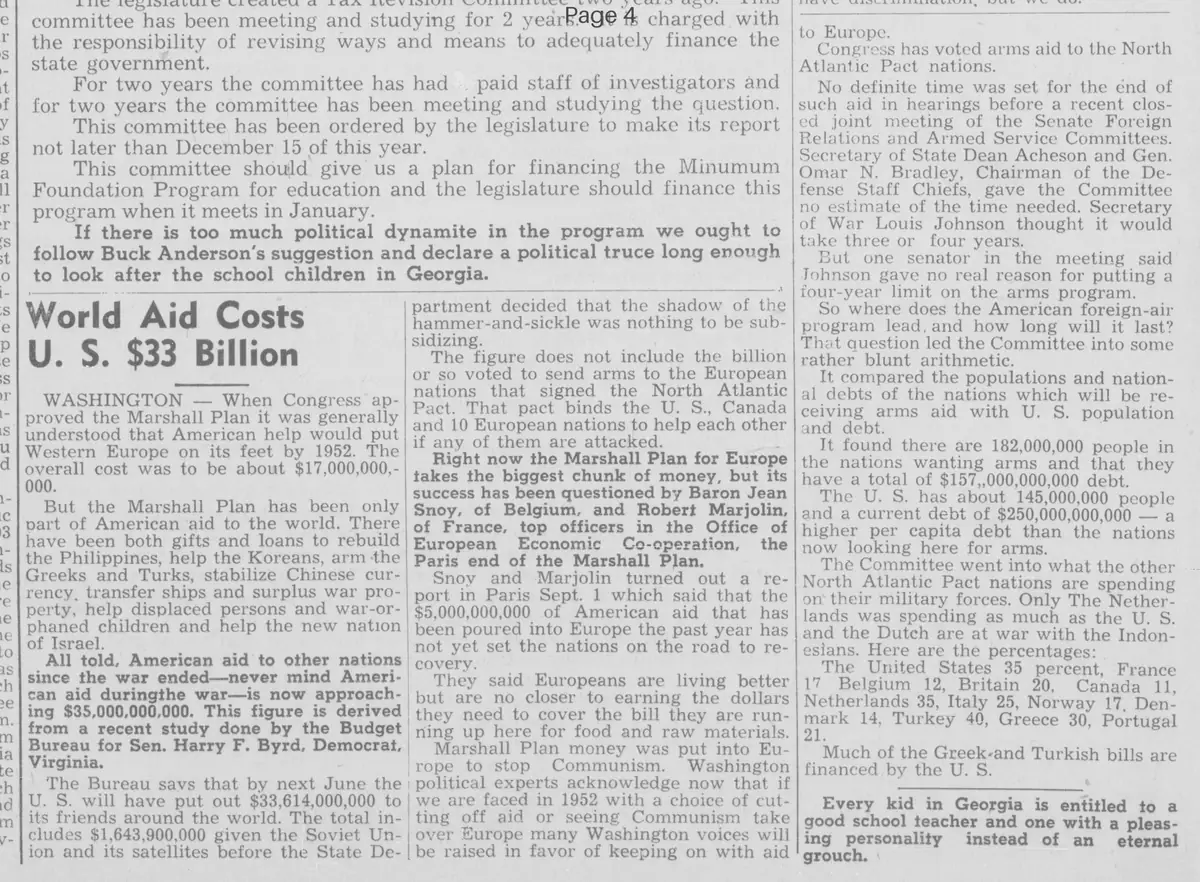
When Congress approved the Marshall Plan it was generally understood that American help would put Western Europe on its feet by 1952. The overall cost was to be about $17,000,000,000.
But the Marshall Plan has been only part of American aid to the world. There have been both gifts and loans to rebuild the Philippines, help the Koreans, arm the Greeks and Turks, stabilize Chinese currency, transfer ships and surplus war property, help displaced persons and war-orphaned children and help the new nation of Israel.
All told, American aid to other nations since the war ended—never mind American aid during the war—is now approaching $35,000,000,000. This figure is derived from a recent study done by the Budget Bureau for Sen. Harry F. Byrd, Democrat, Virginia.
The Bureau says that by next June the U. S. will have put out $33,614,000,000 to its friends around the world. The total includes $1,643,900,000 given the Soviet Union and its satellites before the State Department decided that the shadow of the hammer-and-sickle was nothing to be subsidizing.
The figure does not include the billion or so voted to send arms to the European nations that signed the North Atlantic Pact. That pact binds the U. S., Canada and 10 European nations to help each other if any of them are attacked.
Right now the Marshall Plan for Europe takes the biggest chunk of money, but its success has been questioned by Baron Jean Snoy, of Belgium, and Robert Marjolin, of France, top officers in the Office of European Economic Co-operation, the Paris end of the Marshall Plan.
Snoy and Marjolin turned out a report in Paris Sept. 1 which said that the $5,000,000,000 of American aid that has been poured into Europe the past year has not yet set the nations on the road to recovery.
They said Europeans are living better but are no closer to earning the dollars they need to cover the bill they are running up here for food and raw materials.
Marshall Plan money was put into Europe to stop Communism. Washington political experts acknowledge now that if we are faced in 1952 with a choice of cutting off aid or seeing Communism take over Europe many Washington voices will be raised in favor of keeping on with aid to Europe.
Congress has voted arms aid to the North Atlantic Pact nations.
No definite time was set for the end of such aid in hearings before a recent closed joint meeting of the Senate Foreign Relations and Armed Service Committees.
Secretary of State Dean Acheson and Gen. Omar N. Bradley, Chairman of the Defense Staff Chiefs, gave the Committee no estimate of the time needed. Secretary of War Louis Johnson thought it would take three or four years.
But one senator in the meeting said Johnson gave no real reason for putting a four-year limit on the arms program.
So where does the American foreign-aid program lead, and how long will it last?
That question led the Committee into some rather blunt arithmetic.
It compared the populations and national debts of the nations which will be receiving arms aid with U. S. population and debt.
It found there are 182,000,000 people in the nations wanting arms and that they have a total of $157,000,000,000 debt.
The U. S. has about 145,000,000 people and a current debt of $250,000,000,000—a higher per capita debt than the nations now looking here for arms.
The Committee went into what the other North Atlantic Pact nations are spending on their military forces. Only The Netherlands was spending as much as the U. S. and the Dutch are at war with the Indonesians. Here are the percentages:
The United States 35 percent. France 17 Belgium 12, Britain 20, Canada 11, Netherlands 35, Italy 25, Norway 17, Denmark 14, Turkey 40, Greece 30, Portugal 21.
Much of the Greek-and Turkish bills are financed by the U. S.
What sub-type of article is it?
What keywords are associated?
What entities or persons were involved?
Where did it happen?
Foreign News Details
Primary Location
Western Europe
Event Date
Sept. 1; By Next June
Key Persons
Outcome
us aid approaching $35,000,000,000; $5,000,000,000 to europe past year not sufficient for recovery; arms aid to nato nations without set end date; military spending percentages vary among allies
Event Details
US foreign aid since WWII end includes Marshall Plan for Western Europe recovery by 1952 at $17 billion, plus aid to Philippines, Korea, Greece, Turkey, China, Israel, displaced persons; total $33,614,000,000 by next June per Budget Bureau study; excludes NATO arms aid; Paris report Sept. 1 questions Marshall Plan success in enabling dollar earnings; aid aimed at stopping Communism; congressional hearings discuss indefinite arms aid duration; comparisons of populations, debts, military spending percentages among NATO nations