Thank you for visiting SNEWPapers!
Sign up free
The Roundup Record
Roundup, Musselshell County, Montana
What is this article about?
Dr. V. T. Cooke, State Director of Wyoming, provides do's and don'ts for dry farming, including plowing, seeding, cultivation, crop rotation, and livestock feeding advice, reprinted from the Dry Farm Bulletin.
Merged-components note: These components form a single article on 'Dr. Crooke's Do's and Don'ts' for dry farming, split due to column breaks; text flows continuously from introduction to do's list to don'ts list.
Clipping
OCR Quality
Full Text
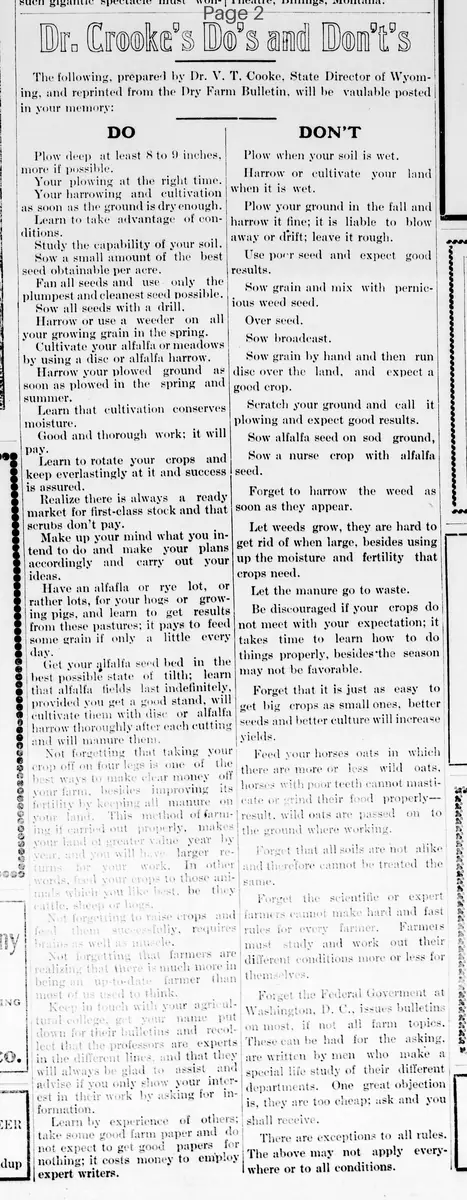
The following, prepared by Dr. V. T. Cooke, State Director of Wyoming, and reprinted from the Dry Farm Bulletin, will be valuable posted in your memory:
Do's:
Plow deep at least 8 to 9 inches, more if possible.
Plow at the right time.
Harrow and cultivate as soon as the ground is dry enough.
Learn to take advantage of conditions.
Study the capability of your soil.
Sow a small amount of the best seed obtainable per acre.
Fan all seeds and use only the plumpest and cleanest seed possible.
Sow all seeds with a drill.
Harrow or use a weeder on all your growing grain in the spring.
Cultivate your alfalfa or meadows by using a disc or alfalfa harrow.
Harrow your plowed ground as soon as plowed in the spring and summer.
Learn that cultivation conserves moisture.
Good and thorough work: it will pay.
Learn to rotate your crops and keep everlastingly at it and success is assured.
Realize there is always a ready market for first-class stock and that scrubs don't pay.
Make up your mind what you intend to do and make your plans accordingly and carry out your ideas.
Have an alfalfa or rye lot, or rather lots, for your hogs or growing pigs, and learn to get results from these pastures; it pays to feed some grain if only a little every day.
Get your alfalfa seed bed in the best possible state of tilth; learn that alfalfa fields last indefinitely, provided you get a good stand, will cultivate them with disc or alfalfa harrow thoroughly after each cutting and will manure them.
Not forgetting that taking your crop off on four legs is one of the best ways to make clear money off your farm, besides improving its fertility by keeping all manure on your land. This method of farming, if carried out properly, makes your land of greater value year by year, and you will have larger returns for your work. In other words, feed your crops to those animals which you like best, be they cattle, sheep or hogs.
Not forgetting to raise crops and feed them successfully, requires brains as well as muscle.
Not forgetting that farmers are realizing that there is much more in being an up-to-date farmer than most of us used to think.
Keep in touch with your agricultural college, get your name put down for their bulletins and recollect that the professors are experts in the different lines, and that they will always be glad to assist and advise if you only show your interest in their work by asking for information.
Learn by experience of others; take some good farm paper and do not expect to get good papers for nothing; it costs money to employ expert writers.
Don't's:
Plow when your soil is wet.
Harrow or cultivate your land when it is wet.
Plow your ground in the fall and harrow it fine; it is liable to blow away or drift; leave it rough.
Use poor seed and expect good results.
Sow grain and mix with pernicious weed seed.
Over seed.
Sow broadcast.
Sow grain by hand and then run disc over the land, and expect a good crop.
Scratch your ground and call it plowing and expect good results.
Sow alfalfa seed on sod ground.
Sow a nurse crop with alfalfa seed.
Forget to harrow the weeds as soon as they appear.
Let weeds grow, they are hard to get rid of when large, besides using up the moisture and fertility that crops need.
Let the manure go to waste.
Be discouraged if your crops do not meet with your expectation; it takes time to learn how to do things properly, besides the season may not be favorable.
Forget that it is just as easy to get big crops as small ones, better seeds and better culture will increase yields.
Feed your horses oats in which there are more or less wild oats; horses with poor teeth cannot masticate or grind their food properly--result, wild oats are passed on to the ground where working.
Forget that all soils are not alike and therefore cannot be treated the same.
Forget the scientific or expert farmers cannot make hard and fast rules for every farmer. Farmers must study and work out their different conditions more or less for themselves.
Forget the Federal Government at Washington, D. C., issues bulletins on most, if not all farm topics. These can be had for the asking, are written by men who make a special life study of their different departments. One great objection is, they are too cheap; ask and you shall receive.
There are exceptions to all rules. The above may not apply everywhere or to all conditions.
What sub-type of article is it?
What keywords are associated?
What entities or persons were involved?
Where did it happen?
Domestic News Details
Primary Location
Wyoming
Key Persons
Event Details
Dr. V. T. Cooke provides a list of do's and don'ts for successful dry farming practices, including deep plowing, timely harrowing, using quality seeds with drills, crop rotation, livestock feeding, weed control, and utilizing agricultural resources like bulletins from colleges and the federal government.