Thank you for visiting SNEWPapers!
Sign up free
Daily National Intelligencer
Washington, District Of Columbia
What is this article about?
Detailed account of General Xavier Mina's background as a Spanish guerrilla leader against the French, distinguishing him from his uncle Espoz y Mina. Mina arrived in the US on June 30 to support Latin American independence from Spain, refuting rumors and calumnies from Spanish sources.
Clipping
OCR Quality
Full Text
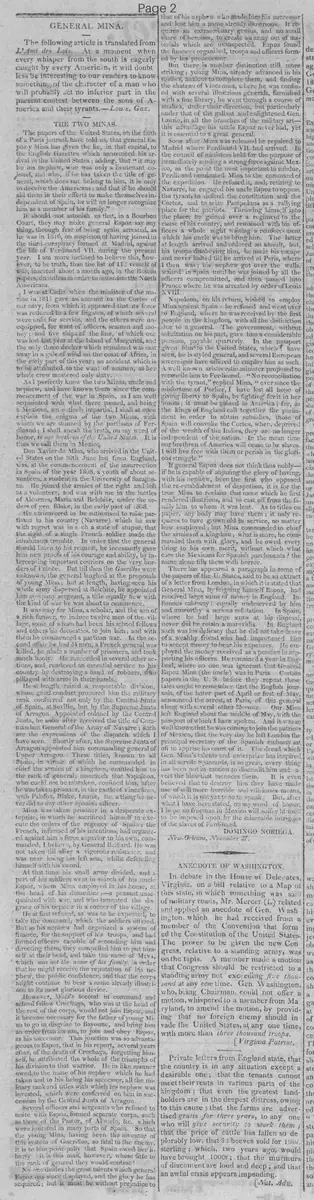
The following article is translated from L'Ami des Lois. At a moment when every whisper from the south is eagerly caught by every American, it will doubtless be interesting to our readers to know something of the character of a man who will probably act no inferior part in the present contest between the sons of America and their tyrants. — Louis. Gaz.
THE TWO MINAS.
The papers of the United States, on the faith of a Paris journal, have told us, that general Espoz y Mina has given the lie, in that capital, to the English Gazettes which announced his arrival in the United States; adding, that "it may be his nephew, who was only a lieutenant colonel, and who, if he has taken the title of general, which does not belong to him, it is only to deceive the Americans; and that if he should aid them in their efforts to make themselves independent of Spain, he will no longer recognize him as a member of his family."
It should not astonish us that, in a Bourbon Court, they may make general Espoz say anything, through fear of being again arrested, as he was in 1816, on suspicion of having joined in the third conspiracy formed at Madrid, against the life of Ferdinand VII. during the present year. I am more inclined to believe this, however, to be truth, than the list of 11 vessels of war, inserted about a month ago, in the Boston papers, doubtless in order to intimidate the North Americans.
I was at Cadiz when the minister of the marine in 1811 gave an account to the Cortes of our navy, from which it appeared that its force was reduced to a few frigates, of which several were unfit for service, and the others were unequipped, for want of officers, seamen and money; and five ships of the line, of which one was lost last year at the Island of Margarita, and the only three decker which remained was cast away in a gale of wind on the coast of Africa, in the early part of this year; an accident which is to be attributed to the want of seamen, as her whole crew mustered only sixty.
As I perfectly know the two Minas, uncle and nephew, and have known them since the commencement of the war in Spain, as I am well acquainted with what there passed, and being a Mexican, am entirely impartial, I shall at once explain the enigma of the two Minas, with which we are stunned by the partisans of Ferdinand: I shall speak the truth, on my word of honor, to our brethren of the United States. It is thus we call them in Mexico.
Don Xavier de Mina, who arrived in the United States on the 30th June last from England, was, at the commencement of the insurrection in Spain of the year 1808, a youth of about seventeen, a student in the University of Saragossa. He joined the armies of the right and left as a volunteer, and was with me in the battles of Alcorisa, Maria and Belchite, under the orders of gen. Blake, in the early part of 1808.
He endeavored to be authorised to raise partisans in his country (Navarre) which he saw with regret was in such a state of stupor, that the sight of a single French soldier made the inhabitants tremble. In order that the general should listen to his request, he incessantly gave him new proofs of his courage and ability, by intercepting important couriers on the very borders of France. But till then the Guerillas were unknown, the general laughed at the proposals of young Mina; but at length, having seen his whole army dispersed at Belchite, he appointed him company sergeant, a title equally new with the kind of war he was about to commence.
It was easy for Mina, a scholar, and the son of a rich farmer, to induce twelve men of the village, some of whom had been his school fellows and others his domestics, to join him; and with them he commenced a partisan war. In the second affair he had 34 men, a French general was killed, he made a number of prisoners, and took much booty. He succeeded in several other actions, and rendered an essential service to his country by destroying a band of robbers, who pillaged with arms in their hands.
He at length raised a respectable division, whose good conduct procured him the military rank conferred not only by the Central Junta of Spain, at Seville, but by the Supreme Junta of Arragon. Appointed colonel by the Central Junta, he soon after received the title of Commandant General of the Army of Navarre; such are the expressions of the dispatch which I have seen. Shortly after, the Supreme Junta of Arragon appointed him commanding general of Upper Arragon. These titles, known to all Spain, in virtue of which he commanded in chief the armies of a kingdom, entitled him to the rank of general; insomuch that Napoleon, who could not be mistaken, confined him, after he was taken prisoner, in the castle of Vincennes, with Palafox, Blake, Laurie, &c. a thing he never did to any other Spanish officer.
Mina was taken prisoner in a desperate enterprise, in which he sacrificed himself to execute the orders of the regency of Spain; the French, informed of his intentions, had organized against him a force superior to his own, commanded, I believe, by General Belliard. He was not taken till after a vigorous resistance, and was near losing his left arm, whilst defending himself with his sword.
At that time his small army divided, and a part of his soldiers went in search of his uncle Espoz, whom Mina employed in his house, at the head of his domestics; — a peasant unacquainted with war, and who lamented the disgrace of his nephew in a corner of the village. He at first refused, as was to be expected, to take the command, which the soldiers offered. But as his nephew had organized a system of finance, for the support of his troops, and had formed officers capable of seconding him and directing them, they compelled him to put himself at their head, and take the name of Mina, which was not the name of his family, in order that he might receive the reputation of his nephew, the public confidence, and that the corps might continue to bear a name already illustrious as its most glorious device.
However, Mina's second in command and school fellow Cruchaga, who was at the head of the rest of the corps, would not join Espoz, and it became necessary for the father of young Mina to go in disguise to Bayonne, and bring him an order from his son, to join and obey Espoz, as his successor. This junction was so advantageous to Espoz, that in his report, several years after, of the death of Cruchaga, forgetting himself, he attributed the whole of the triumphs of his division to that warrior. He in like manner owed to the name of his nephew which he had taken and to his being his successor, all the military rank and titles with which his nephew was invested, which were conferred on him in succession by the Central Junta of Arragon.
Several officers and sergeants who refused to unite with Espoz, formed separate corps, such as those of the Pastor, of Albuelo, &c. which were imitated in many parts of Spain. So that the young Mina, having been the inventor of this system of Guerillas, so fatal to the enemy, it is to him principally that Spain owed her liberty; it is this man, however, whose title to the rank of general they would contest!
No one denies the great talents which general Espoz has since displayed, and the glory he has acquired; but it must be without prejudice to that of his nephew who made him his successor and lent him a name already illustrious. It requires an extraordinary genius, and no small share of heroism, to create an army out of materials which are unsuspected. Espoz found the finances organized, troops and officers formed by his predecessor.
But there is another distinction still more striking; young Mina, already advanced in his studies, anxious to complete them, and finding the chateau of Vincennes, where he was confined with several illustrious generals, furnished with a fine library, he went through a course of studies, under their direction, but particularly under that of the gallant and enlightened Gen. Laurie, in all the branches of the military art — this advantage his uncle Espoz never had, yet it is essential to a great general.
Soon after Mina was released he repaired to Madrid where Ferdinand VII. had arrived. In the council of ministers held for the purpose of immediately sending a strong force against Mexico, as the point the most important to subdue, Ferdinand nominated Mina to the command of the expedition. He refused it, and, retiring to Navarre, he engaged his uncle Espoz to oppose the tyrant, to defend the constitution and the Cortes, and to seize Pampeluna as a rallying place for the patriots. Throwing himself into the place; he gained over a regiment to the cause of his country, and remained with his officers a whole night waiting a reinforcement which his uncle was to bring him. The latter at length arrived and ordered an assault, but, his troops disobeying him, he made his escape and never halted till he arrived at Paris, where I then was; his nephew got over the walls.
He waited in Spain until he was joined by all the officers compromised, and then passed into France where he was arrested by order of Louis XVIII.
Napoleon, on his return, wished to employ Mina against Spain: he refused and went over to England, where he was received by the first people in the kingdom, with all the distinction due to a general. The government, without solicitation on his part, gave him a considerable pension, payable quarterly. In the passport given him to the United States, which I have seen, he is styled general, and several European sovereigns have offered to employ him as such.
A well known aristocratic minister proposed to reconcile him to Ferdinand. "No reconciliation with the tyrant," replied Mina, "ever since the misfortune of Porlier, I have lost all hope of giving liberty to Spain, by fighting for it in her bosom; it must be gained in America; for, as the kings of England call together the parliament in order to obtain subsidies, those of Spain will convoke the Cortes, when, deprived of the wealth of the Indies, they are no longer independent of the nation. In the mean time our brethren of America will cease to be slaves. I will live free with them or perish in the glorious struggle."
If general Espoz does not think thus nobly — if he is capable of abjuring the glory of having, with his nephew, been the first who opposed the re-establishment of despotism, it is for the true Mina to reclaim that name which he first rendered illustrious, and to cast off from the family him to whom it was lent. As to titles on paper, anybody may have them; it only requires to have grown old in service, no matter how employed: but Mina commanded in chief the armies of a kingdom; what is more, he commanded them with glory, and he owed everything to his own merit, without which what care the Mexicans for Spanish parchments? the name alone fills them with horror.
There has appeared a paragraph in some of the papers of the U. States, said to be an extract of a letter from London, in which it is stated that General Mina, by feigning himself Espoz, had received large sums of money in England. Infamous calumny! equally undeserved by him and unworthy a serious refutation. In Spain, where he had large sums at his disposal, never did he retain a maravedis. In England such was his delicacy that he did not take leave of a wealthy friend who had importuned him to accept money to bear his expences. He employed the money received as a pension in supporting his officers. He remained a year in England, where no one was ignorant that General Espoz Mina (the uncle) was in Paris. Certain papers in the U. S. before they repeat these tales ought to remember that the English journals, of the latter part of April or first of May, announced the arrest, at Paris, of this general along with several other liberals. Our Mina left England about the middle of May, with the passport of which I have spoken. And it was so well known that he was coming to join the patriots of Mexico, that the very day he left London the principal secretary of the Spanish embassy set off to apprise his court of it. "The dread which Gen. Mina's talents and enterprize has inspired in all servile Spaniards, is so great, everything has been put in motion to discredit him and avert the blow that menaces them. It is even believed that to destroy him they have made use of still more horrible and villanous means, of which it is not yet time to speak. But, after what I have here stated, on my word of honor, I hope no freeman in Mexico will suffer himself to be imposed upon by the miserable intrigues of the slaves of Ferdinand."
DOMINGO NORIEGA.
New-Orleans, November 27.
What sub-type of article is it?
What keywords are associated?
What entities or persons were involved?
Where did it happen?
Foreign News Details
Primary Location
Spain
Event Date
30th June Last
Key Persons
Outcome
mina invented and led successful guerrilla warfare against french forces, contributing to spanish resistance; later refused command against mexico and arrived in us to aid independence efforts; uncle espoz assumed his name and command, achieving subsequent glory.
Event Details
Article by Domingo Noriega explains the backgrounds of uncle and nephew Minas, emphasizing young Xavier Mina's role as originator of guerrilla tactics in Spain from 1808, his promotions to general rank, imprisonment by Napoleon, refusal to serve Ferdinand VII against Mexico, and arrival in US on June 30 to support American independence from Spain, refuting Spanish denials and calumnies.