Thank you for visiting SNEWPapers!
Sign up free
Virginia Argus
Richmond, Virginia
What is this article about?
A court of enquiry in New York, presided by Alexander Murray, investigated the capture of the U.S. Frigate President commanded by Stephen Decatur. The report praises the crew's heroic defense against superior British forces, attributing the loss to grounding on a bar while departing port. Navy Secretary B.W. Crowninshield approves the findings and commends Decatur and his men.
Clipping
OCR Quality
Full Text
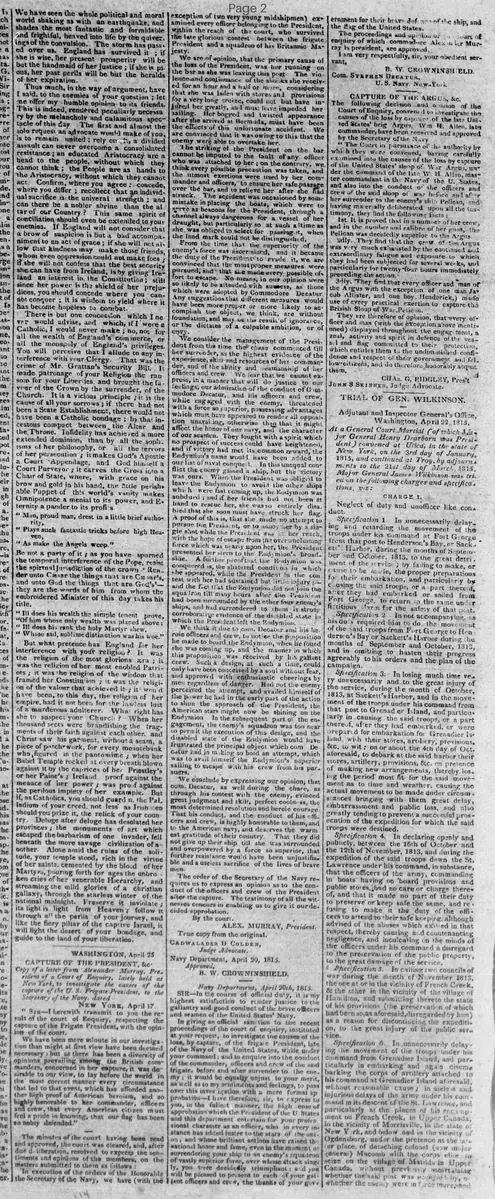
CAPTURE OF THE PRESIDENT, &c.
Copy of a letter from Alexander Murray, President of a Court of Enquiry, lately held at New York, to investigate the causes of the capture of the U. S. Frigate President, to the Secretary of the Navy, dated New York, April 17
"Sir—I herewith transmit to you the result of the court of Enquiry, respecting the capture of the Frigate President, with the opinion of the court.
We have been more minute in our investigation than might at first view have been deemed necessary : but as there has been a diversity of opinions prevailing among the British commanders, concerned in her capture, it was desirable to our view, to lay before the world in the most correct manner every circumstance that led to that event, which has afforded another high proof of American heroism, and so highly honorable to her commander, officers and crew, that every American citizen must feel a pride in knowing, that our flag has been so nobly defended."
The minutes of the court having been read and approved, the court was cleared, and, after due deliberation, resolved to express the sentiments and opinions of the members, on the matters submitted to them as follows :
In execution of the orders of the Honorable the Secretary of the Navy, we have (with the exception of two very young midshipmen) examined every officer belonging to the President, within the reach of the court, who survived the late glorious contest between the frigate President and a squadron of his Britannic Majesty's.
We are of opinion, that the primary cause of the loss of the President, was her running on the bar as she was leaving this port. The violence and continuance of the shocks she received for an hour and a half or more, considering that she was laden with stores and provisions for a very long cruise, could not but have injured her greatly, and must have impeded her sailing. Her bogged and twisted appearance after she arrived at Bermuda, must have been the effects of this unfortunate accident. We are convinced that it was owing to this that the enemy were able to overtake her.
The striking of the President on the bar cannot be imputed to the fault of any officer who was attached to her : on the contrary, we think every possible precaution was taken, and the utmost exertions were used by her commander and officers, to ensure her safe passage over the bar, and to relieve her after she had struck. The accident was occasioned by some mistake in placing the boats, which were to serve as beacons for the President, through a channel always dangerous for a vessel of her draught, but particularly so at such a time as she was obliged to select for passing it, when the land mark could not be distinguished.
From the time that the superiority of the enemy's force was ascertained, and it became the duty of the President to evade it, We are convinced that the most proper measures were pursued, and that she made every possible effort to escape. No means, in our opinion were so likely to be attended with success, as those which were adopted by Commodore Decatur Any suggestions that different measures would have been more proper or more likely to accomplish the object, we think, are without foundation, and may be the result of ignorance, or the dictates of a culpable ambition, or of envy.
We consider the management of the President from the time the chase commenced till her surrender, as the highest evidence of the experience, skill and resources of her commander, and of the ability and seamanship of her officers and crew. We fear that we cannot express, in a manner that will do justice to our feelings, our admiration of the conduct of Commodore Decatur, and his officers and crew, while engaged with the enemy, threatened with a force so superior, possessing advantages which must have appeared to render all opposition unavailing, otherwise than that it might affect the honor of our navy, and the character of our seamen. They fought with a spirit which no prospect of success could have heightened, and if victory had met its common reward, the Endymion's name would have been added to our list of naval conquest. In this unequal conflict the enemy gained a ship, but the victory was ours. When the President was obliged to leave the Endymion to avoid the other ships which were fast coming up, the Endymion was subdued ; and if her friends had not been at hand to rescue her, she was so entirely disabled that she soon must have struck her flag. A proof of this is, that she made no attempt to pursue the President, or to annoy her by a single shot while the President was in her reach, with the hope of escape from the overwhelming force which was nearly upon her, the President presented her stern to the Endymion's broadside. A further proof that the Endymion was conquered is, the shattered condition in which she appeared, while the President in the contest with her had sustained but little injury - and the fact that the Endymion did not join the squadron till many hours after the President had been surrounded by the other four enemy's ships; and had surrendered to them is strong corroborative evidence of the disabled state in which the President left the Endymion.
We think it due to Com. Decatur and his heroic officers and crew, to notice the proposition he made to board the Endymion, when he found she was coming up, and the manner in which this proposition was received by his gallant crew. Such a design; at such a time, could only have been conceived by a soul without fear, and approved with enthusiastic cheerings by men regardless of danger. Had not the enemy perceived the attempt, and availed himself of the power he had in the early part of the action to shun the approach of the President, the American stars might now be shining on the Endymion In the subsequent part of the engagement, the enemy's squadron was too near to permit the execution of this design, and the disabled state of the Endymion would have frustrated the principal object which Com Decatur had in making so bold an attempt, which was to avail himself the Endymion's superior sailing to escape with his crew from his pursuers:
We conclude by expressing our opinion; that Com. Decatur, as well during the chase, as through his contest with the enemy, evinced great judgment and skill, perfect coolness, the most determined resolution and heroic courage. That his conduct, and the conduct of his officers and crew, is highly honorable to them, and to the American navy, and deserves the warmest gratitude of their country. That they did not give up their ship till she was surrounded and overpowered by a force so superior, that further resistance would have been unjustifiable and a useless sacrifice of the lives of brave men.
The order of the Secretary of the Navy requires us to express an opinion as to the conduct of the officers and crew of the President after the capture. The testimony of all the witnesses concurs in enabling us to give it our decided approbation.
By the court.
ALEX. MURRAY, President.
True copy from the original.
CADWALLADER D. COLDEN,
Judge Advocate.
Navy Department, April 20, 1815.
Approved,
B. W. CROWNINSHIELD.
Navy Department, April 20th, 1815.
SIR—In the course of official duty, it is my highest satisfaction to render justice to the gallantry and good conduct of the brave officers and seamen of the United States' Navy.
In giving an official sanction to the recent proceedings of the court of enquiry, instituted at your request, to investigate the causes of the loss, by capture, of the frigate President, late of the Navy of the United States, while under your command; and to enquire into the conduct of the commander, officers and crew of the said frigate, before and after surrender to the enemy ; it would be equally unjust to your merit, as well as to my sentiments and feelings, to pass over this investigation with a mere formal approbation—I have therefore, sir, to express to you, in the fullest manner, the high sense of approbation which the President of the U States and this department entertain for your professional character as an officer, who in every instance has added lustre to the stars of the union ; and whose brilliant actions have raised national honor and fame, even in the moment of surrendering your ship to an enemy's squadron of vastly superior force, over whose attack singly, you were decidedly triumphant: and you will be pleased to present to each of your gallant officers and crew, the thanks of your government for their brave defence of the ship, and the flag of the United States.
The proceedings and opinion of court of enquiry of which Commodore Alexander Murray is president, are approved.
I am very respectfully, sir, your obedient servant,
B. W. CROWNINSHIELD.
Com. Stephen Decatur,
U.S. Navy. New York
What sub-type of article is it?
What keywords are associated?
What entities or persons were involved?
Where did it happen?
Domestic News Details
Primary Location
New York
Event Date
April 17, 1815
Key Persons
Outcome
the u.s. frigate president was captured by a superior british squadron after grounding on a bar while departing new york, damaging her and allowing pursuit. the crew defended honorably, subduing the endymion before surrendering to overwhelming force. no specific casualties mentioned; conduct post-capture approved.
Event Details
A court of enquiry examined officers of the U.S. Frigate President, finding the capture resulted from grounding on a bar due to a beacon placement error, impairing her speed. Commodore Decatur's evasion and combat tactics were deemed optimal and heroic, defeating the Endymion before being overpowered by the squadron. The report praises the commander's skill and the crew's bravery.