Thank you for visiting SNEWPapers!
Sign up free
Editorial
September 26, 1789
Gazette Of The United States
New York, New York County, New York
What is this article about?
This editorial argues that the Union of the States is essential and that fears of division from regional interests, religious differences, or customs are baseless, drawing comparisons to unified yet diverse Britain and France. It stresses developing national habits and reverence for the new Constitution to ensure stability.
Clipping
OCR Quality
98%
Excellent
Full Text
[No. XLVIII.]
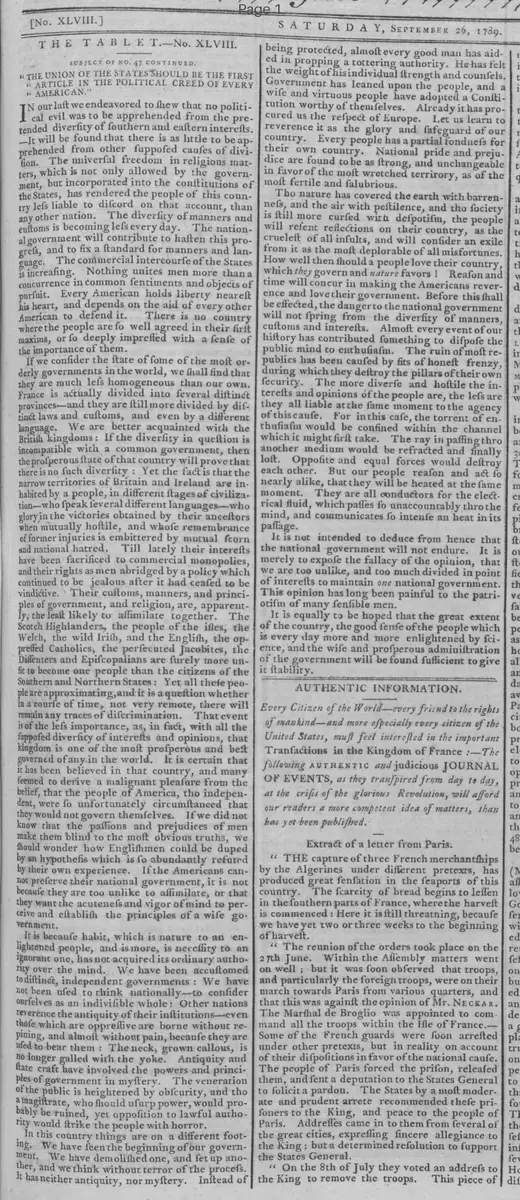
THE TABLET.—No. XLVIII.
SUBJECT OF NO. 47 CONTINUED.
"THE UNION OF THE STATES SHOULD BE THE FIRST ARTICLE IN THE POLITICAL CREED OF EVERY AMERICAN."
In our last we endeavored to show that no political evil was to be apprehended from the pretended diversity of southern and eastern interests.—It will be found that there is as little to be apprehended from other supposed causes of division. The universal freedom in religious matters, which is not only allowed by the government, but incorporated into the constitutions of the States, has rendered the people of this country less liable to discord on that account, than any other nation. The diversity of manners and customs is becoming less every day. The national government will contribute to hasten this progress, and to fix a standard for manners and language. The commercial intercourse of the States is increasing. Nothing unites men more than a concurrence in common sentiments and objects of pursuit. Every American holds liberty nearest his heart, and depends on the aid of every other American to defend it. There is no country where the people are so well agreed in their first maxims, or so deeply impressed with a sense of the importance of them.
If we consider the state of some of the most orderly governments in the world, we shall find that they are much less homogeneous than our own. France is actually divided into several distinct provinces—and they are still more divided by distinct laws and customs, and even by a different language. We are better acquainted with the British kingdoms: If the diversity in question is incompatible with a common government, then the prosperous state of that country will prove that there is no such diversity: Yet the fact is that the narrow territories of Britain and Ireland are inhabited by a people, in different stages of civilization—who speak several different languages—who glory in the victories obtained by their ancestors when mutually hostile, and whose remembrance of former injuries is embittered by mutual scorn and national hatred. Till lately their interests have been sacrificed to commercial monopolies, and their rights as men abridged by a policy which continued to be jealous after it had ceased to be vindictive. Their customs, manners, and principles of government, and religion, are, apparently, the least likely to assimilate together. The Scotch Highlanders, the people of the isles, the Welch, the wild Irish, and the English, the oppressed Catholics, the persecuted Jacobites, the Dissenters and Episcopalians are surely more unfit to become one people than the citizens of the Southern and Northern States: Yet all these people are approximating, and it is a question whether in a course of time, not very remote, there will remain any traces of discrimination. That event is of the less importance, as, in fact, with all the supposed diversity of interests and opinions, that kingdom is one of the most prosperous and best governed of any in the world. It is certain that it has been believed in that country, and many seemed to derive a malignant pleasure from the belief, that the people of America, tho independent, were so unfortunately circumstanced that they would not govern themselves. If we did not know that the passions and prejudices of men make them blind to the most obvious truths, we should wonder how Englishmen could be duped by an hypothesis which is so abundantly refuted by their own experience. If the Americans cannot preserve their national government, it is not because they are too unlike to assimilate, or that they want the acuteness and vigor of mind to perceive and establish the principles of a wise government.
It is because habit, which is nature to an enlightened people, and is more, is necessity to an ignorant one, has not acquired its ordinary authority over the mind. We have been accustomed to distinct, independent governments: We have not been used to think nationally—to consider ourselves as an indivisible whole: Other nations reverence the antiquity of their institutions—even those which are oppressive are borne without repining, and almost without pain, because they are used to bear them: The neck, grown callous, is no longer galled with the yoke. Antiquity and state craft have involved the powers and principles of government in mystery. The veneration of the public is heightened by obscurity, and tho a magistrate, who should usurp power, would probably be ruined, yet opposition to lawful authority would strike the people with horror.
In this country things are on a different footing. We have seen the beginning of our government. We have demolished one, and set up another, and we think without terror of the process. It has neither antiquity, nor mystery. Instead of
SATURDAY, SEPTEMBER 26, 1789.
being protected, almost every good man has aided in propping a tottering authority. He has felt the weight of his individual strength and counsels. Government has leaned upon the people, and a wise and virtuous people have adopted a Constitution worthy of themselves. Already it has procured us the respect of Europe. Let us learn to reverence it as the glory and safeguard of our country. Every people has a partial fondness for their own country. National pride and prejudice are found to be as strong, and unchangeable in favor of the most wretched territory, as of the most fertile and salubrious.
Tho nature has covered the earth with barrenness, and the air with pestilence, and tho society is still more cursed with despotism, the people will resent reflections on their country, as the cruellest of all insults, and will consider an exile from it as the most deplorable of all misfortunes. How well then should a people love their country, which they govern and nature favors! Reason and time will concur in making the Americans reverence and love their government. Before this shall be effected, the danger to the national government will not spring from the diversity of manners, customs and interests. Almost every event of our history has contributed something to dispose the public mind to enthusiasm. The ruin of most republics has been caused by fits of honest frenzy, during which they destroy the pillars of their own security. The more diverse and hostile the interests and opinions of the people are, the less are they all liable at the same moment to the agency of this cause. For in this case, the torrent of enthusiasm would be confined within the channel which it might first take. The ray in passing thro another medium would be refracted and finally lost. Opposite and equal forces would destroy each other. But our people reason and act so nearly alike, that they will be heated at the same moment. They are all conductors for the electrical fluid, which passes so unaccountably thro the mind, and communicates so intense an heat in its passage.
It is not intended to deduce from hence that the national government will not endure. It is merely to expose the fallacy of the opinion, that we are too unlike, and too much divided in point of interests to maintain one national government. This opinion has long been painful to the patriotism of many sensible men.
It is equally to be hoped that the great extent of the country, the good sense of the people which is every day more and more enlightened by science, and the wise and prosperous administration of the government will be found sufficient to give it stability.
THE TABLET.—No. XLVIII.
SUBJECT OF NO. 47 CONTINUED.
"THE UNION OF THE STATES SHOULD BE THE FIRST ARTICLE IN THE POLITICAL CREED OF EVERY AMERICAN."
In our last we endeavored to show that no political evil was to be apprehended from the pretended diversity of southern and eastern interests.—It will be found that there is as little to be apprehended from other supposed causes of division. The universal freedom in religious matters, which is not only allowed by the government, but incorporated into the constitutions of the States, has rendered the people of this country less liable to discord on that account, than any other nation. The diversity of manners and customs is becoming less every day. The national government will contribute to hasten this progress, and to fix a standard for manners and language. The commercial intercourse of the States is increasing. Nothing unites men more than a concurrence in common sentiments and objects of pursuit. Every American holds liberty nearest his heart, and depends on the aid of every other American to defend it. There is no country where the people are so well agreed in their first maxims, or so deeply impressed with a sense of the importance of them.
If we consider the state of some of the most orderly governments in the world, we shall find that they are much less homogeneous than our own. France is actually divided into several distinct provinces—and they are still more divided by distinct laws and customs, and even by a different language. We are better acquainted with the British kingdoms: If the diversity in question is incompatible with a common government, then the prosperous state of that country will prove that there is no such diversity: Yet the fact is that the narrow territories of Britain and Ireland are inhabited by a people, in different stages of civilization—who speak several different languages—who glory in the victories obtained by their ancestors when mutually hostile, and whose remembrance of former injuries is embittered by mutual scorn and national hatred. Till lately their interests have been sacrificed to commercial monopolies, and their rights as men abridged by a policy which continued to be jealous after it had ceased to be vindictive. Their customs, manners, and principles of government, and religion, are, apparently, the least likely to assimilate together. The Scotch Highlanders, the people of the isles, the Welch, the wild Irish, and the English, the oppressed Catholics, the persecuted Jacobites, the Dissenters and Episcopalians are surely more unfit to become one people than the citizens of the Southern and Northern States: Yet all these people are approximating, and it is a question whether in a course of time, not very remote, there will remain any traces of discrimination. That event is of the less importance, as, in fact, with all the supposed diversity of interests and opinions, that kingdom is one of the most prosperous and best governed of any in the world. It is certain that it has been believed in that country, and many seemed to derive a malignant pleasure from the belief, that the people of America, tho independent, were so unfortunately circumstanced that they would not govern themselves. If we did not know that the passions and prejudices of men make them blind to the most obvious truths, we should wonder how Englishmen could be duped by an hypothesis which is so abundantly refuted by their own experience. If the Americans cannot preserve their national government, it is not because they are too unlike to assimilate, or that they want the acuteness and vigor of mind to perceive and establish the principles of a wise government.
It is because habit, which is nature to an enlightened people, and is more, is necessity to an ignorant one, has not acquired its ordinary authority over the mind. We have been accustomed to distinct, independent governments: We have not been used to think nationally—to consider ourselves as an indivisible whole: Other nations reverence the antiquity of their institutions—even those which are oppressive are borne without repining, and almost without pain, because they are used to bear them: The neck, grown callous, is no longer galled with the yoke. Antiquity and state craft have involved the powers and principles of government in mystery. The veneration of the public is heightened by obscurity, and tho a magistrate, who should usurp power, would probably be ruined, yet opposition to lawful authority would strike the people with horror.
In this country things are on a different footing. We have seen the beginning of our government. We have demolished one, and set up another, and we think without terror of the process. It has neither antiquity, nor mystery. Instead of
SATURDAY, SEPTEMBER 26, 1789.
being protected, almost every good man has aided in propping a tottering authority. He has felt the weight of his individual strength and counsels. Government has leaned upon the people, and a wise and virtuous people have adopted a Constitution worthy of themselves. Already it has procured us the respect of Europe. Let us learn to reverence it as the glory and safeguard of our country. Every people has a partial fondness for their own country. National pride and prejudice are found to be as strong, and unchangeable in favor of the most wretched territory, as of the most fertile and salubrious.
Tho nature has covered the earth with barrenness, and the air with pestilence, and tho society is still more cursed with despotism, the people will resent reflections on their country, as the cruellest of all insults, and will consider an exile from it as the most deplorable of all misfortunes. How well then should a people love their country, which they govern and nature favors! Reason and time will concur in making the Americans reverence and love their government. Before this shall be effected, the danger to the national government will not spring from the diversity of manners, customs and interests. Almost every event of our history has contributed something to dispose the public mind to enthusiasm. The ruin of most republics has been caused by fits of honest frenzy, during which they destroy the pillars of their own security. The more diverse and hostile the interests and opinions of the people are, the less are they all liable at the same moment to the agency of this cause. For in this case, the torrent of enthusiasm would be confined within the channel which it might first take. The ray in passing thro another medium would be refracted and finally lost. Opposite and equal forces would destroy each other. But our people reason and act so nearly alike, that they will be heated at the same moment. They are all conductors for the electrical fluid, which passes so unaccountably thro the mind, and communicates so intense an heat in its passage.
It is not intended to deduce from hence that the national government will not endure. It is merely to expose the fallacy of the opinion, that we are too unlike, and too much divided in point of interests to maintain one national government. This opinion has long been painful to the patriotism of many sensible men.
It is equally to be hoped that the great extent of the country, the good sense of the people which is every day more and more enlightened by science, and the wise and prosperous administration of the government will be found sufficient to give it stability.
What sub-type of article is it?
Constitutional
What keywords are associated?
Union Of States
National Government
Diversity Of Interests
Religious Freedom
American Liberty
British Comparison
Constitutional Reverence
What entities or persons were involved?
Southern And Northern States
British Kingdoms
National Government
American People
Editorial Details
Primary Topic
Union Of The States
Stance / Tone
Strongly Supportive Of National Union
Key Figures
Southern And Northern States
British Kingdoms
National Government
American People
Key Arguments
No Political Evil From Diversity Of Southern And Eastern Interests
Religious Freedom Reduces Discord
Diversity Of Manners And Customs Decreasing
Commercial Intercourse Unites States
All Americans Value Liberty
Comparison To Britain Shows Unity Despite Greater Diversity
Lack Of Habit To National Thinking Is Challenge
Reverence For New Constitution Needed
Danger Not From Diversity But Shared Enthusiasm
Government Will Endure Through Reason And Time