Thank you for visiting SNEWPapers!
Sign up free
Rutland Herald
Rutland, Rutland County, Vermont
What is this article about?
Reports on US Congressional proceedings in late February and early March 1847, including Senate votes on the Wilmot Proviso attached to the Three Million Bill (defeated 29-27 and 24 yeas), House actions on Naval and other appropriation bills, passage of a resolution for frigate Raritan to aid starving Ireland, and Washington correspondence criticizing Democratic tactics on tariff, Ireland relief, and bribery bills.
Merged-components note: Continuation of congressional proceedings and Washington correspondence, with sequential reading orders and connected bboxes spanning columns.
Clipping
OCR Quality
Full Text
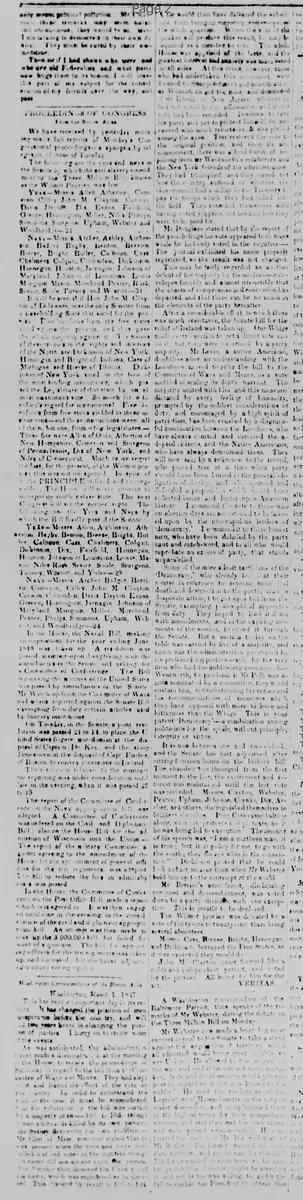
From the National Intelligencer.
We have received by yesterday morning's mail full reports of Monday's Congressional proceedings--a synopsis tell especially of those on the Wilmot Proviso.
The following are the yeas and nays in the Senate, on the Wilmot Proviso as lost to the Three Million Bill, having
Yeas--Messrs. Allen, Atherton, Cameron, Cass, Clayton, John M. Clayton, Corwin, Davis, Dayton, Dixon, Evans, Fairfield, Hannegan, Johnson of Louisiana, Lewis, Mangum, Miller, Niles, Pearce, Phillips, Rives, Simmons, Sturgeon, Tunnery, Upham, Webster and Woodbury--27.
Nays--Messrs. Archer, Ashley, Atchison, Baldwin, Benton, Berrien, Bright, Butler, Calhoun, Cass, Chalmers, Colquitt, Dickinson, Fairfield, Hannegan, Houston, Johnson of Louisiana, Lewis, Mason, Niles, Rives, Rusk, Sevier, Sturgeon, Tunnery, Walker, Yulee--29.
Nays--Messrs. Archer, Badger, Berrien, Calhoun, Cilley, John M. Clayton, Corwin, Crittenden, Davis, Dayton, Evans, Greene, Underwood, Johnson of Maryland, Mangum, Miller, Morehead, Pearce, Phillips, Simmons, Upham, Webster and Woodbridge--24.
In the House, the Naval Bill, making appropriations for the year ending June 1848, was taken up. A resolution was passed, insisting upon disagreeing with the Senate and asking for a Committee of Conference. The Bill was then passed, as passed by amendments to the Senate.
Mr. Winthrop, from the Committee of Ways and Means, reported against the Senate Bill exempting from duty certain articles used by literary institutions.
On Thursday, in the Senate, a joint resolution was passed 21 to 14, to place the United States frigate Raritan, under command of the disposal of Capt. Forbes, on a mission to convey provisions to Ireland and her starving people, in reply to the contract for reporting was under consideration until late in the evening, when it was passed 27 to 19.
The report of the Committee of Conference on the Navy appropriation bill was adopted. A Committee of Conference was ordered on the Civil and Diplomatic Bill, also on the House Bill for the admission of Wisconsin into the Union.
The report of the Military Committee, against agreeing to the amendment of the House for the appointment of general officers for the ten regiments, was reported. A Bill to reduce the fees in admiralty courts was passed.
In the House, the Committee of Conference on the Post Office Bill, made a report which was agreed to, and the House then engaged until nine in the evening to the consideration of the civil and diplomatic appropriation bill. An attempt was then made to take up the $3,000,000 bill but failed for want of a quorum. The bill (making offices for the ten regiments) was taken up and discussed till late.
Washington Correspondence of the Boston Atlas.
Washington, March 1, 1847.
This has been an unfortunate day in its results. It has changed the position of men conspicuous before the country, and will have more before in changing the position of parties. I hasten on to recite some of the events.
As was anticipated, the administration press made a demonstration at the meeting of the House to rescind the proceedings of Saturday in regard to the tariff bill of the Committee of Ways and Means. They had slyly feared the effect of the vote on the Wilmot Proviso. In order to understand the merits of the case it must be remembered that the bill was carried by a majority of from 10 to 13 through the dogged perseverance of its own partisans. The Saturday evening in an rude inn.
Mr. Palfrey of Mass. arose and stated what prevented a vote on the ocean mail to what extent and renewed the motion to adjourn.
It is said ten States declared the onus of the entire vote appeared by the journal, while he had only voted in the negative. The journal exhibited his name properly registered, so the result was not changed.
This may be fairly regarded as another defeat of the tariff by themselves--it develops so fully and almost irresistibly that the charm of compromise and concession has departed, and that there can be no union in the elements of the party hereafter.
After a considerable effort, to which there was much resistance, the Senate took up the bill for the relief of Ireland. Our Whigs made every exertion to get a direct vote upon it, but they were overruled by a party majority. Mr. Lewis, a native American, doubtless after an understanding with the Locofocos, moved to refer the bill to the Committee of Ways and Means, as a sure method of sealing its death warrant. The majority united with him and this measure, dictated by every feeling of humanity, prompted by the noblest considerations of duty, and encouraged by a high spirit of patriotism, has been crushed by a disgraceful combination between the Locofocos, who have always courted and caressed the adopted citizens, and the Native Americans, who have always denounced them. They will now see, by a reference to the record, who proved true at a time when party ties should have been laid in the general obligation of charity, and who sanctioned and defended a proscription which would have reflected honor and luster upon American legislation. I commend to vote those who on election days are accustomed to be fawned upon by the unscrupulous leaders of 'democracy.' I commend it to those honest men, who have been deluded by the party cant and catch-words, and to all who would reprobate an excess of party, that stands unparalleled.
Some of the more adroit tacticians of the Democrats, who already see that their course in reference to revenue must end in death and destruction to the party, make a desperate attempt to get up a bill in the Senate, exempting scientific apparatus from duty. They hoped to load it down with amendments, and in the expiring moments of the session, to crowd it through the Senate. But a motion to lay on the table was carried by five of a majority, and again was the administration prostrated by its supporters--by those very men who had the unabashed assurance from Mr. Polk that if Mr. P. was nominated by a convention, they would sustain him, notwithstanding his vetoes and his recommendations of measures which they have opposed with more violence and bitterness than the Whigs. This is your patent Democracy--a combination of politicians for the spoils, without principle, integrity or virtue.
It is now between one and two o'clock, and the Senate has just adjourned, after sitting fourteen hours on the bribery bill. The chamber was thronged from the first moment to the last; the excitement and interest was maintained until the last vote was recorded. Messrs. Clayton, Webster, Pearce, Upham, Johnson, Corwin, Dix, Archer, and others, distinguished themselves in brilliant speeches. Gen. Cass came off second best alone, with his sophistries and puns, as if he was being led to execution. The amount of his speech was, 'I am a northern man, it is true; but it is policy for me to go with the south; they must win in the contest.' Polk's nerves were so shattered that he could not measure than when Mr. Webster held him up to the contempt of the world.
Mr. Benton's amendment, disclaiming confidence and remembrance, was voted down by a large majority, with one exception. This is greatly to be deplored.
The Wilmot proviso was defeated by a vote of thirty-one to twenty-one, there being several absentees. Messrs. Cass, Breese, Bright, Hannegan, and Johnson, betrayed the Free States, as it was expected they would do.
John M. Clayton came forward like a noble and independent patriot, and voted for the proviso. All honor to him for the act.
VERITAS.
A Washington correspondent of the Baltimore Patriot, thus speaks of the remarks of Mr. Webster, during the debate on the Three Million Bill on Monday.
'Mr. Webster was made a brief but most eloquent appeal to the Senate to take a stand against a continental war, all admitted would bring neither honor nor gain to this nation. He had the thanks of the Legislature of Massachusetts that they had addressed in the highest terms for their enterprise. He had the thanks of the Legislature of Massachusetts that they had addressed in the highest terms for their enterprise.'
What sub-type of article is it?
What keywords are associated?
What entities or persons were involved?
Where did it happen?
Domestic News Details
Primary Location
Washington
Event Date
Monday's Congressional Proceedings; Thursday; Washington, March 1, 1847
Key Persons
Outcome
wilmot proviso defeated in senate 29-27 and 24 yeas; naval bill passed with amendments; joint resolution for frigate raritan to aid ireland passed 21-14 and 27-19; ireland relief bill referred to committee and crushed; tariff bill defeated; scientific apparatus bill laid on table; bribery bill debated 14 hours; wilmot proviso defeated 31-21; benton's amendment voted down.
Event Details
Senate votes on Wilmot Proviso attached to Three Million Bill resulted in defeat; House considered Naval Bill, passed resolution for conference, and passed bill; Reported against Senate bill exempting duties for literary institutions; Senate passed resolution for US frigate Raritan to convey provisions to Ireland; Committees of conference ordered on various bills; Military Committee reported against House amendment; Bill to reduce admiralty court fees passed; House agreed to Post Office Bill conference report, considered civil and diplomatic bill, failed quorum on $3,000,000 bill, discussed regiment officers bill; Correspondence details House attempt to rescind tariff proceedings, defeat of tariff, referral of Ireland relief bill, defeat of scientific apparatus bill, 14-hour debate on bribery bill, defeat of Wilmot Proviso, and Webster's appeal against continental war.