Thank you for visiting SNEWPapers!
Sign up free
Story
November 21, 1823
Richmond Enquirer
Richmond, Richmond County, Virginia
What is this article about?
Kentucky legislature assembles in Frankfort on November 3, 1823; speakers elected. Governor Adair's message reviews state finances and criticizes U.S. Supreme Court and state Court of Appeals for invalidating relief laws as impairing contracts, urging action to protect state sovereignty and citizens' rights.
Clipping
OCR Quality
95%
Excellent
Full Text
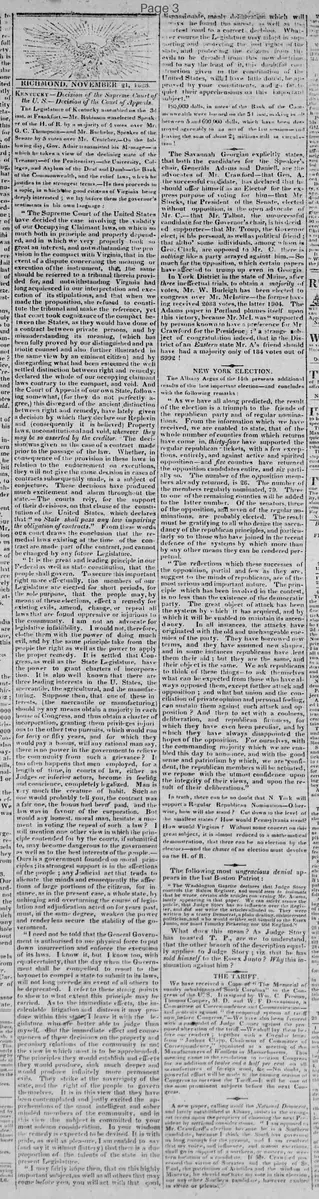
RICHMOND, NOVEMBER 21, 1823.
Kentucky—Decision of the Supreme Court of the U. S.—Decision of the Court of Appeals.
The Legislature of Kentucky assembled on the 3d inst. at Frankfort.—Mr. Robinson was elected Speaker of the H. of R. by a majority of 4 votes over Mr. G. C. Thompson—and Mr. Bachelor, Speaker of the Senate by 5 votes over Mr. Crutcher,—On the following day, Gov. Adair transmitted his Message—in which he takes a view of the declining state of the Treasury—of the Penitentiary—the University, Colleges, and Asylum of the Deaf and Dumb—the Bank of the Commonwealth, and the relief laws, which he justifies in the strongest terms.—He then proceeds to a topic, in which the good citizens of Virginia being deeply interested ; we lay before them the governor's sentiments in his own language :
" The Supreme Court of the United States have decided the case involving the validity of our Occupying Claimant laws, on which so much both in principle and property depended, and in which we very properly took so great an interest, and notwithstanding the provision in the compact with Virginia, that in the event of a dispute concerning the meaning or execution of the instrument, that the same should be referred to a tribunal therein provided for, and notwithstanding Virginia had long acquiesced in our interpretation and execution of its stipulations, and that when we made the proposition, she refused to constitute the tribunal and make the reference, yet that court took cognizance of the compact between the States, as they would have done of a contract between private persons, and by misunderstanding its meaning, (which has been fully proved by our distinguished and patriotic counsel and also further illustrated in the same view by an eminent citizen) and by disregarding what had been esteemed the well settled distinction between right and remedy, declared the whole of our occupying claimant laws contrary to the compact, and void. And the Court of Appeals of our own State, following somewhat, (for they do not perfectly agree,) this disregard of the ancient distinction between right and remedy, have lately given a decision by which they declare our Replevin and (consequently it is believed) Property laws, unconstitutional and void, whenever they may be so asserted by the creditor. — The decision was given in the case of a contract made prior to the passage of the law. Whether, in consequence of the provision in these laws in relation to the endorsement on executions, they will not give the same decision in cases of contracts subsequently made, is a subject of conjecture. These decisions have produced much excitement and alarm throughout the state.—The courts rely, for the support of their decisions, on that clause of the constitution of the United States, which declares that " no State shall pass any law impairing the obligation of contracts." From these words our court draws the conclusion that the remedial laws existing at the time of the contract are made part of the contract, and cannot be changed by any future Legislature.
" It is the great and leading principle in our Federal as well as state constitution, that the people shall govern. To secure this important right more effectually, the members of our Legislature are elected for short periods, for the sole purpose, that the people may, by means of these elections, effect a remedy for existing evils, amend, change, or repeal all laws that are found oppressive or injurious to the community. I am not an advocate for legislative infallibility. I would not, therefore, clothe them with the power of doing much evil, and by the same principle take from the people the right as well as the power to apply the proper remedy. It is settled that Congress, as well as the State Legislature, have the power to grant charters of incorporation. It is also well known that there are three leading interests in the U. States, the mercantile, the agricultural, and the manufacturing. Suppose then, that one of these interests, (the mercantile or manufacturing) should by any means obtain a majority in each house of Congress, and thus obtain a charter of incorporation, granting them privileges injurious to the other two pursuits, which would run for forty or fifty years, and for which they would pay a bonus, will any rational man say, there is no power in the government to relieve the community from such a grievance? It too often happens that men employed, for a length of time, in courts of law, either as Judges or inferior actors, become in feeling and conscience, completely legalized. Man is very much the creature of habit. Such a one would probably tell you, the contract was a fair one, the bonus had been paid, and the law was in favour of the corporation. But would any honest, moral man, hesitate a moment in voting the repeal of such a law? I will mention one other view in which the principle contended for by the courts, if submitted to, may become dangerous to the government as well as to the best interests of the people.— Ours is a government founded on moral principles ; its strongest support is in the affections of the people ; any Judicial act that tends to alienate the minds and consequently the affections of large portions of the citizens, for instance, as in the present case, a whole state, by unhinging and overturning the course of legislation and adjudication acted on for years past, must, in the same degree, weaken the power and render less secure the stability of the government.
" I need not be told that the General Government is authorised to use physical force to put down insurrection and enforce the execution of its laws. I know it. but I know too, with equal certainty, that the day when the Government shall be compelled to resort to the bayonet to compel a state to submit to its laws, will not long precede an event of all others to be deprecated. I refer to these strong points to shew to what extent this principle may be carried. As to the immediate effects, the incalculable litigation and distress it may produce within this state: I leave it with the Legislature who are better able to judge than myself. But the immediate effect and consequences of these decisions on the property and pecuniary relations of the community is not the view in which most is to be apprehended. 'The principles they would establish and effects they would produce, sink much deeper and would produce infinitely more permanent evils. They strike at the sovereignty of the state, and the right of the people to govern themselves. It is in this view that they have been contemplated and justly excited the apprehensions of the most intelligent and sober minded members of the community, and in this view the subject is committed to your most solemn consideration. In your wisdom the remedy is expected to be devised. It is with pride, as well as pleasure, I am enabled to say (and say it without flattery) that there is a due proportion of the talents of the state in the present Legislature.
" I may fairly hope then, that on this highly important subject, as well as all others that may come before you, you will act with that dispassionate, manly deliberation which will always be found the surest, as well as the shortest road to a correct decision. Whatever course the Legislature may adopt in supporting and protecting the just rights of the state, and protecting the citizens from the evils to be dreaded from this new doctrine and to say the least of it, this dauntless construction given to the constitution of the United States, will, I have but little doubt, be approved by your constituents, and go far to quiet their apprehensions on this important subject."
Kentucky—Decision of the Supreme Court of the U. S.—Decision of the Court of Appeals.
The Legislature of Kentucky assembled on the 3d inst. at Frankfort.—Mr. Robinson was elected Speaker of the H. of R. by a majority of 4 votes over Mr. G. C. Thompson—and Mr. Bachelor, Speaker of the Senate by 5 votes over Mr. Crutcher,—On the following day, Gov. Adair transmitted his Message—in which he takes a view of the declining state of the Treasury—of the Penitentiary—the University, Colleges, and Asylum of the Deaf and Dumb—the Bank of the Commonwealth, and the relief laws, which he justifies in the strongest terms.—He then proceeds to a topic, in which the good citizens of Virginia being deeply interested ; we lay before them the governor's sentiments in his own language :
" The Supreme Court of the United States have decided the case involving the validity of our Occupying Claimant laws, on which so much both in principle and property depended, and in which we very properly took so great an interest, and notwithstanding the provision in the compact with Virginia, that in the event of a dispute concerning the meaning or execution of the instrument, that the same should be referred to a tribunal therein provided for, and notwithstanding Virginia had long acquiesced in our interpretation and execution of its stipulations, and that when we made the proposition, she refused to constitute the tribunal and make the reference, yet that court took cognizance of the compact between the States, as they would have done of a contract between private persons, and by misunderstanding its meaning, (which has been fully proved by our distinguished and patriotic counsel and also further illustrated in the same view by an eminent citizen) and by disregarding what had been esteemed the well settled distinction between right and remedy, declared the whole of our occupying claimant laws contrary to the compact, and void. And the Court of Appeals of our own State, following somewhat, (for they do not perfectly agree,) this disregard of the ancient distinction between right and remedy, have lately given a decision by which they declare our Replevin and (consequently it is believed) Property laws, unconstitutional and void, whenever they may be so asserted by the creditor. — The decision was given in the case of a contract made prior to the passage of the law. Whether, in consequence of the provision in these laws in relation to the endorsement on executions, they will not give the same decision in cases of contracts subsequently made, is a subject of conjecture. These decisions have produced much excitement and alarm throughout the state.—The courts rely, for the support of their decisions, on that clause of the constitution of the United States, which declares that " no State shall pass any law impairing the obligation of contracts." From these words our court draws the conclusion that the remedial laws existing at the time of the contract are made part of the contract, and cannot be changed by any future Legislature.
" It is the great and leading principle in our Federal as well as state constitution, that the people shall govern. To secure this important right more effectually, the members of our Legislature are elected for short periods, for the sole purpose, that the people may, by means of these elections, effect a remedy for existing evils, amend, change, or repeal all laws that are found oppressive or injurious to the community. I am not an advocate for legislative infallibility. I would not, therefore, clothe them with the power of doing much evil, and by the same principle take from the people the right as well as the power to apply the proper remedy. It is settled that Congress, as well as the State Legislature, have the power to grant charters of incorporation. It is also well known that there are three leading interests in the U. States, the mercantile, the agricultural, and the manufacturing. Suppose then, that one of these interests, (the mercantile or manufacturing) should by any means obtain a majority in each house of Congress, and thus obtain a charter of incorporation, granting them privileges injurious to the other two pursuits, which would run for forty or fifty years, and for which they would pay a bonus, will any rational man say, there is no power in the government to relieve the community from such a grievance? It too often happens that men employed, for a length of time, in courts of law, either as Judges or inferior actors, become in feeling and conscience, completely legalized. Man is very much the creature of habit. Such a one would probably tell you, the contract was a fair one, the bonus had been paid, and the law was in favour of the corporation. But would any honest, moral man, hesitate a moment in voting the repeal of such a law? I will mention one other view in which the principle contended for by the courts, if submitted to, may become dangerous to the government as well as to the best interests of the people.— Ours is a government founded on moral principles ; its strongest support is in the affections of the people ; any Judicial act that tends to alienate the minds and consequently the affections of large portions of the citizens, for instance, as in the present case, a whole state, by unhinging and overturning the course of legislation and adjudication acted on for years past, must, in the same degree, weaken the power and render less secure the stability of the government.
" I need not be told that the General Government is authorised to use physical force to put down insurrection and enforce the execution of its laws. I know it. but I know too, with equal certainty, that the day when the Government shall be compelled to resort to the bayonet to compel a state to submit to its laws, will not long precede an event of all others to be deprecated. I refer to these strong points to shew to what extent this principle may be carried. As to the immediate effects, the incalculable litigation and distress it may produce within this state: I leave it with the Legislature who are better able to judge than myself. But the immediate effect and consequences of these decisions on the property and pecuniary relations of the community is not the view in which most is to be apprehended. 'The principles they would establish and effects they would produce, sink much deeper and would produce infinitely more permanent evils. They strike at the sovereignty of the state, and the right of the people to govern themselves. It is in this view that they have been contemplated and justly excited the apprehensions of the most intelligent and sober minded members of the community, and in this view the subject is committed to your most solemn consideration. In your wisdom the remedy is expected to be devised. It is with pride, as well as pleasure, I am enabled to say (and say it without flattery) that there is a due proportion of the talents of the state in the present Legislature.
" I may fairly hope then, that on this highly important subject, as well as all others that may come before you, you will act with that dispassionate, manly deliberation which will always be found the surest, as well as the shortest road to a correct decision. Whatever course the Legislature may adopt in supporting and protecting the just rights of the state, and protecting the citizens from the evils to be dreaded from this new doctrine and to say the least of it, this dauntless construction given to the constitution of the United States, will, I have but little doubt, be approved by your constituents, and go far to quiet their apprehensions on this important subject."
What sub-type of article is it?
Historical Event
What themes does it cover?
Justice
Moral Virtue
What keywords are associated?
Kentucky Legislature
Supreme Court Decision
Relief Laws
State Sovereignty
Governor Adair Message
What entities or persons were involved?
Mr. Robinson
Mr. G. C. Thompson
Mr. Bachelor
Mr. Crutcher
Gov. Adair
Where did it happen?
Frankfort, Kentucky
Story Details
Key Persons
Mr. Robinson
Mr. G. C. Thompson
Mr. Bachelor
Mr. Crutcher
Gov. Adair
Location
Frankfort, Kentucky
Event Date
November 1823
Story Details
Kentucky legislature assembles; Governor Adair's message defends relief laws against U.S. Supreme Court and state Court of Appeals rulings declaring them unconstitutional for impairing contracts, warns of threats to state sovereignty and calls for legislative remedy.