Thank you for visiting SNEWPapers!
Sign up free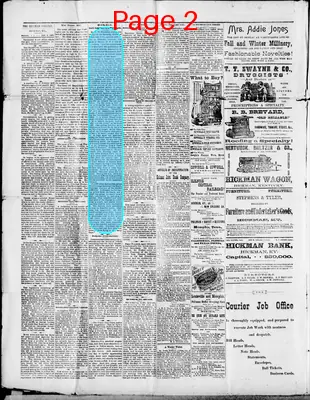
Story
January 9, 1891
The Hickman Courier
Hickman, Fulton County, Kentucky
What is this article about?
Travel writer G. W. Shockley describes his visit to Hickman, KY, highlighting its Mississippi River location, businesses, Civil War history, and the devastating 1878 yellow fever outbreak that killed 154 residents.
Clipping

OCR Quality
95%
Excellent
Full Text
As it Appears to a Stranger.
Mr. G. W. Shockley, one of the editors of the Saturday Globe, of Oskaloosa, Iowa, spent a week or two in Hickman recently, the guest of Messrs. D. W. C. and H. C. Amberg. Upon his return home he commenced the publication of a series of articles descriptive of his visit, entitled "Southward Ho!" The following is an extract taken from his paper of last week:
"Hickman is located in southwestern Kentucky, about three miles from the Tennessee line. It is an old town, having been settled at a very early day, and contains about 1700 population. The business portion is situated along the river, while the best residence portion is "over the hill and far away." We are inclined to draw short breaths yet when we think of climbing those hills. In order to reach the court house from the business portion of the town, besides a gradual ascent of about two blocks, you have to climb 125 wooden steps. The inhabitants get used to it, however, and don't mind it, so they tell us. Once on top, however, the view is fine. The "Father of Waters" rolls grandly on toward the sea just below. Up the river a view of ten miles can be had. Down the river Island No. 8 looms up eight miles in the distance. "Island No. 10" will be remembered as the scene of active operations during the war, having been strongly fortified. It is about fifteen miles down the river—or rather was, for it is an island no more, having "slid into the river," so we were told. Just across the river from Hickman is Island No. 6, but it is an island no longer, as the channel of the river has so changed as to leave no water on one side of it. A huge sand bar stretches along the beach nearest Hickman. At a future time we may tell you something about the beauties of a tramp across this sand bar at 2 a. m., returning from a "coon hunt" in Missouri. Hickman does a very large business in the mercantile line, drawing trade for many miles around, there not being so many small towns to draw trade from the county seat. A large factory for the manufacture of road wagons is located here, these wagons having a very large sale through the South. A box factory also does a very large business. There is nothing particularly historical about the old town. During the war, while the inhabitants suffered from guerrillas from both sides, yet no active hostilities occurred in the immediate vicinity.
In 1878 when the terrible yellow fever scourge darkened the South, Hickman was one of the terrible sufferers. A steamer landed having yellow fever on board, and a small boy going on board to sell fruit, contracted it, and thus it spread. One hundred and fifty-four died of the disease in a little over a month, and almost every one who stayed in town contracted it. The doctors were powerless to stay its dreadful march. Business was suspended. All who could well get away, went. A great many camped out in the woods. A gentleman told us that at one time there were only six able-bodied men in the town. Of eight physicians who were practicing during this terrible epidemic, only one survived it. The family where we visited had lost four members, three of them dying in that many days."
Mr. G. W. Shockley, one of the editors of the Saturday Globe, of Oskaloosa, Iowa, spent a week or two in Hickman recently, the guest of Messrs. D. W. C. and H. C. Amberg. Upon his return home he commenced the publication of a series of articles descriptive of his visit, entitled "Southward Ho!" The following is an extract taken from his paper of last week:
"Hickman is located in southwestern Kentucky, about three miles from the Tennessee line. It is an old town, having been settled at a very early day, and contains about 1700 population. The business portion is situated along the river, while the best residence portion is "over the hill and far away." We are inclined to draw short breaths yet when we think of climbing those hills. In order to reach the court house from the business portion of the town, besides a gradual ascent of about two blocks, you have to climb 125 wooden steps. The inhabitants get used to it, however, and don't mind it, so they tell us. Once on top, however, the view is fine. The "Father of Waters" rolls grandly on toward the sea just below. Up the river a view of ten miles can be had. Down the river Island No. 8 looms up eight miles in the distance. "Island No. 10" will be remembered as the scene of active operations during the war, having been strongly fortified. It is about fifteen miles down the river—or rather was, for it is an island no more, having "slid into the river," so we were told. Just across the river from Hickman is Island No. 6, but it is an island no longer, as the channel of the river has so changed as to leave no water on one side of it. A huge sand bar stretches along the beach nearest Hickman. At a future time we may tell you something about the beauties of a tramp across this sand bar at 2 a. m., returning from a "coon hunt" in Missouri. Hickman does a very large business in the mercantile line, drawing trade for many miles around, there not being so many small towns to draw trade from the county seat. A large factory for the manufacture of road wagons is located here, these wagons having a very large sale through the South. A box factory also does a very large business. There is nothing particularly historical about the old town. During the war, while the inhabitants suffered from guerrillas from both sides, yet no active hostilities occurred in the immediate vicinity.
In 1878 when the terrible yellow fever scourge darkened the South, Hickman was one of the terrible sufferers. A steamer landed having yellow fever on board, and a small boy going on board to sell fruit, contracted it, and thus it spread. One hundred and fifty-four died of the disease in a little over a month, and almost every one who stayed in town contracted it. The doctors were powerless to stay its dreadful march. Business was suspended. All who could well get away, went. A great many camped out in the woods. A gentleman told us that at one time there were only six able-bodied men in the town. Of eight physicians who were practicing during this terrible epidemic, only one survived it. The family where we visited had lost four members, three of them dying in that many days."
What sub-type of article is it?
Journey
Historical Event
What themes does it cover?
Catastrophe
Misfortune
What keywords are associated?
Hickman Kentucky
Yellow Fever Epidemic
Civil War Island
River Town Description
Travel Visit
What entities or persons were involved?
G. W. Shockley
D. W. C. Amberg
H. C. Amberg
Where did it happen?
Hickman, Kentucky
Story Details
Key Persons
G. W. Shockley
D. W. C. Amberg
H. C. Amberg
Location
Hickman, Kentucky
Event Date
1878
Story Details
Visitor G. W. Shockley describes Hickman, an old river town of 1700 people with hilly terrain, river views including former Island No. 10 from the Civil War, thriving businesses in wagons and boxes; recounts the 1878 yellow fever epidemic that killed 154 via a steamer, decimating the town with only six able-bodied men left and one surviving doctor.