Thank you for visiting SNEWPapers!
Sign up free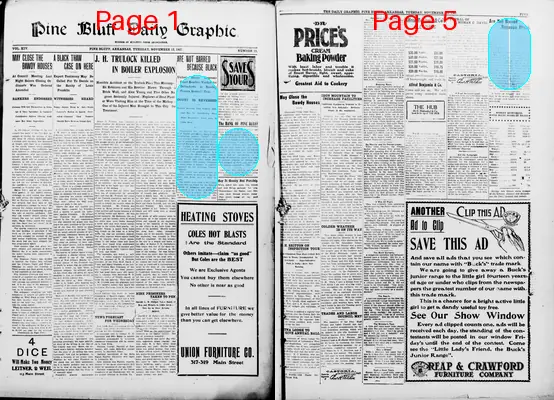
Pine Bluff Daily Graphic
Pine Bluff, Jefferson County, Arkansas
What is this article about?
US Supreme Court reverses conviction of C.B. Boyett and others for intimidating Black workers at Arkansas Lumber Company in Bradley County, AR, in 1905, ruling federal courts lack jurisdiction over such state matters, based on Hodges v. US precedent.
Merged-components note: Continuation of Supreme Court case story on Bradley County sawmill and negro intimidation, indicated by '(Continued on Page Five.)' and matching content despite OCR garbling; relabeled from domestic_news to story as it is a full narrative legal article.
Clippings
1 of 2
OCR Quality
Full Text
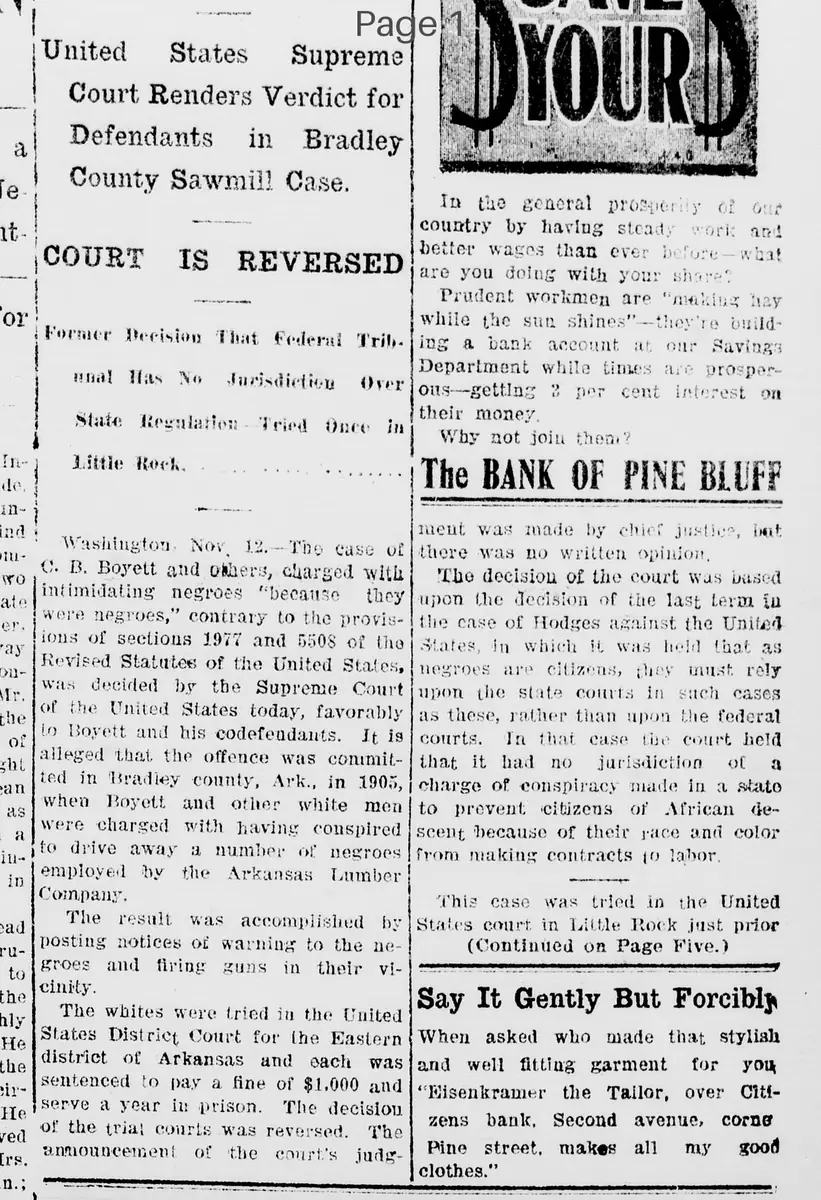
COURT IS REVERSED
Former Decision That Federal Tribunal Has No Jurisdiction Over State Regulation Tried Once in Little Rock.
Washington Nov 12. -The case of C. B. Boyett and others, charged with intimidating negroes 'because they were negroes,' contrary to the provisions of sections 1977 and 5508 of the Revised Statutes of the United States, was decided by the Supreme Court of the United States today, favorably to Boyett and his codefendants. It is alleged that the offence was committed in Bradley county, Ark., in 1905, when Boyett and other white men were charged with having conspired to drive away a number of negroes employed by the Arkansas Lumber Company.
The result was accomplished by posting notices of warning to the negroes and firing guns in their vicinity.
The whites were tried in the United States District Court for the Eastern district of Arkansas and each was sentenced to pay a fine of $1,000 and serve a year in prison. The decision of the trial courts was reversed. The announcement of the court's judgment was made by chief justice, but there was no written opinion
The decision of the court was based upon the decision of the last term in the case of Hodges against the United States, in which it was held that as negroes are citizens, they must rely upon the state courts in such cases as these, rather than upon the federal courts. In that case the court held that it had no jurisdiction of a charge of conspiracy made in a state to prevent citizens of African descent because of their race and color from making contracts to labor.
This case was tried in the United States court in Little Rock just prior
(Continued on Page Five.)
Are Not Barred Because Black
In the case on Monday state supreme court the government. C. B. Boyett and others were charged with having intimidated negroes in Bradley county, preventing their working at the Warren sawmill. It was alleged at the trial that the white men of that particular section of this state were especially bitter against any person possessing African blood, and that the statement was made a number of times that no negro could work at the Warren sawmill. Attorney James H. Harrod of Little Rock represented Boyett in his trial in the United States District Court in that city, and perfected the appeal to the United States Supreme Court.
What sub-type of article is it?
What themes does it cover?
What keywords are associated?
What entities or persons were involved?
Where did it happen?
Story Details
Key Persons
Location
Bradley County, Ark.; Little Rock; Washington
Event Date
1905
Story Details
White men led by C.B. Boyett conspired to intimidate and drive away Black workers from Arkansas Lumber Company by posting warnings and firing guns; convicted in federal court but Supreme Court reversed, holding no federal jurisdiction over state racial labor conspiracies, per Hodges v. US.