Thank you for visiting SNEWPapers!
Sign up free
Alexandria Daily Advertiser
Alexandria, Virginia
What is this article about?
A severe storm and hurricane battered Madras from Wednesday to Friday before December 16, causing massive flooding, destruction of homes, boats, and infrastructure. Thousands of natives feared dead, with widespread devastation including unroofed buildings and uprooted trees.
Clipping
OCR Quality
Full Text
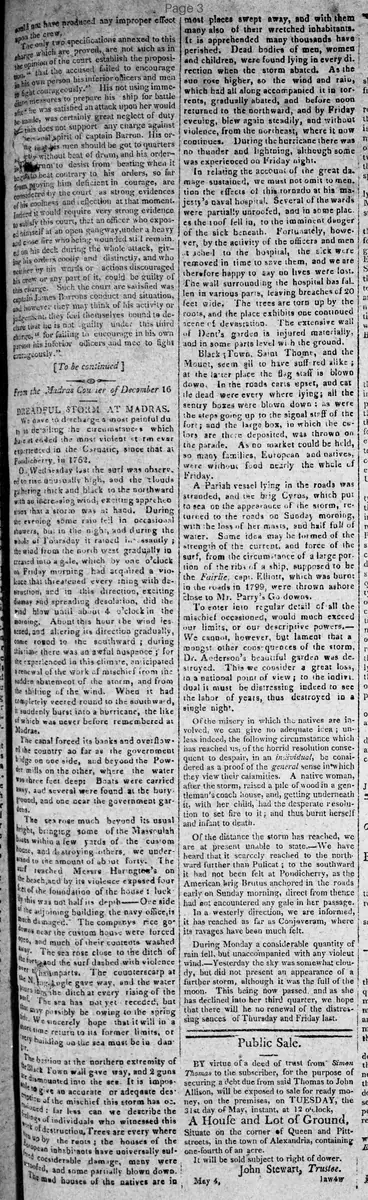
DREADFUL STORM AT MADRAS.
We have to discharge a most painful duty in detailing the circumstances which have attended the most violent storm ever experienced in the Carnatic, since that at Pondicherry, in 1762.
On Wednesday last the surf was observed to rise unusually high, and the clouds gathering thick and black to the northward with an increasing wind, exciting apprehensions that a storm was at hand. During the evening some rain fell in occasional showers, but in the night, and during the whole of Thursday it rained incessantly; the wind from the north west gradually increased into a gale, which by one o'clock on Friday morning had acquired a violence that threatened every thing with destruction, and in this direction, exciting dismay and spreading desolation, did the wind blow until about 4 o'clock in the morning. About this hour the wind lulled, and altering its direction gradually, came round to the southward; during this time there was an awful suspense; for the experienced in this climate, anticipated a renewal of the work of mischief from the sudden abatement of the storm, and from the shifting of the wind. When it had completely veered round to the south west, it suddenly burst into a hurricane, the like of which was never before remembered at Madras.
The canal forced its banks and overflowed the country as far as the government bridge on one side, and beyond the Powder mills on the other, where the water was three feet deep: Boats were carried away, and several were found at the burying ground, and one near the government gardens.
The sea rose much beyond its usual height, bringing some of the Masulah boats within a few yards of the custom house, and destroying others, we understand to the amount of about forty. The surf reached Messrs. Harrington's on the beach, and by its violence exposed four feet of the foundation of the house: luckily this was not half its depth--One side of the adjoining building, the navy office, is much damaged.
The company's rice godowns near the custom house were forced open, and much of their contents washed away.
The sea rose close to the ditch of the fort and the surf dashed with violence over the ramparts.
The counterscarp wall gave way and the water poured in the ditch at every rising of the sea. The sea has not yet receded but that may possibly be owing to the spring tide. We sincerely hope that it will in short time return to its former limits, or every building to the sea must be in danger.
The bastion at the northern extremity of the Black Town wall gave way, and 2 guns were dismounted into the sea. It is impossible to give an accurate description of the mischief this storm has occasioned: far less a feeling of individuals who witnessed this devastation. Trees are everywhere up by the roots, and cannot we describe the European inhabitants have universally suffered considerable damage, many were unroofed, and some partially blown down.
The mud houses of the natives are in most places swept away, and with them many also of their wretched inhabitants.
It is apprehended many thousands have perished. Dead bodies of men, women and children, were found lying in every direction when the storm abated. As the sun rose higher, so the wind and rain, which had all along accompanied it in torrents, gradually abated, and before noon returned to the northward. and by Friday evening, blew again steadily, and without violence. from the northeast. where it now continues. During the hurricane there was no thunder and lightning, although some was experienced on Friday night.
In relating the account of the great damage sustained, we must not omit to mention the effects of this tornado at his majesty's naval hospital. Several of the wards were partially unroofed, and in some places the roof fell in, to the imminent danger of the sick beneath. Fortunately, however, by the activity of the officers and men attached to the hospital, the sick were removed in time to save them, and we are therefore happy to say no lives were lost.
The wall surrounding the hospital has fallen in various parts, leaving breaches of 20 feet wide. The trees are torn up by the roots, and the place exhibits one continued scene of devastation. The extensive wall of Dent's garden is injured materially. and in some parts level with the ground.
Black Town, Saint Thome, and the Mount, seem all to have suffered alike; at the latter place the flag staff is blown down. In the roads carts upset, and cattle dead were every where lying; all the sentry boxes were blown down : as were the steps going up to the signal staff of the fort; and the large box, in which the cottons are there deposited, was thrown on the parade. As no market could be held, so many families, European and natives, were without food nearly the whole of Friday.
A Pariah vessel lying in the roads was stranded, and the brig Cyrus, which put to sea on the appearance of the storm, returned to the roads on Sunday morning, with the loss of her masts, and half full of water. Some idea may be formed of the strength of the current. and force of the surf. from the circumstance of a large portion of the ribs of a ship, supposed to be the Fairlie. capt. Elliott, which was burnt in the roads in 1799, were thrown ashore close to Mr. Parry's Godowns.
To enter into regular detail of all the mischief occasioned, would much exceed our limits, or our descriptive powers.-- We cannot, however, but lament that amongst other consequences of the storm. Dr. Anderson's beautiful garden was destroyed. This we consider a great loss, in a national point of view; to the individual it must be distressing indeed to see the labor of years, thus destroyed in a single night.
Of the misery in which the natives are involved, we can give no adequate idea; unless indeed, the following circumstance which has reached us, of the horrid resolution consequent to despair, in an individual, be considered as a proof of the general sense in which they view their calamities. A native woman, after the storm, raised a pile of wood in a gentleman's coach house, and, getting underneath it, with her child, had the desperate resolution to set fire to it: and thus burnt herself and infant to death.
Of the distance the storm has reached, we are at present unable to state.--We have heard that it scarcely reached to the northward further than Pulicat ; to the southward it had not been felt at Pondicherry, as the American brig Brutus anchored in the roads early on Sunday morning, direct from thence had not encountered any gale in her passage.
In a westerly direction, we are informed, it has reached as far as Conjeveram, where its ravages have been much felt.
During Monday a considerable quantity of rain fell, but unaccompanied with any violent wind.--Yesterday the sky was somewhat cloudy, but did not present an appearance of a further storm, although it was the full of the moon. This being now passed, and as she has declined into her third quarter, we hope that there will be no renewal of the distressing scenes of Thursday and Friday last.
What sub-type of article is it?
What keywords are associated?
What entities or persons were involved?
Where did it happen?
Foreign News Details
Primary Location
Madras
Event Date
Wednesday Last To Friday, Reported December 16
Key Persons
Outcome
many thousands feared perished, including men, women, and children; about 40 masulah boats destroyed; widespread destruction of houses, trees, walls, and infrastructure; no lives lost at naval hospital due to timely evacuation; native woman and child died by self-immolation in despair.
Event Details
A violent storm began on Wednesday last with high surf and rain, escalating into a gale on Thursday and a hurricane from the southwest on Friday morning until 4 AM, then shifting. Flooding from canal overflow reached government bridge and powder mills; sea surge destroyed boats, damaged buildings like Harrington's house and navy office, rice godowns, fort ramparts, Black Town wall; unroofed European houses, swept away native mud houses; devastated naval hospital, Dent's garden, Dr. Anderson's garden; stranded vessels including Pariah vessel and brig Cyrus; debris from 1799 shipwreck washed ashore; affected areas up to Pulicat north, Conjeveram west, not Pondicherry south.