Thank you for visiting SNEWPapers!
Sign up free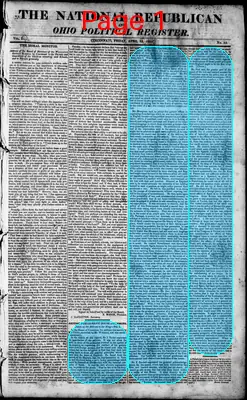
The National Republican And Ohio Political Register
Cincinnati, Hamilton County, Ohio
What is this article about?
In the British House of Commons on Feb. 4, debate on the Address to the King focused on approving non-interference in Spain's internal affairs amid French threats, upholding principles from 1793 and 1821, and potential British support for Spain and Portugal against aggression, with calls for naval preparedness and neutrality hopes.
Clipping
OCR Quality
Full Text
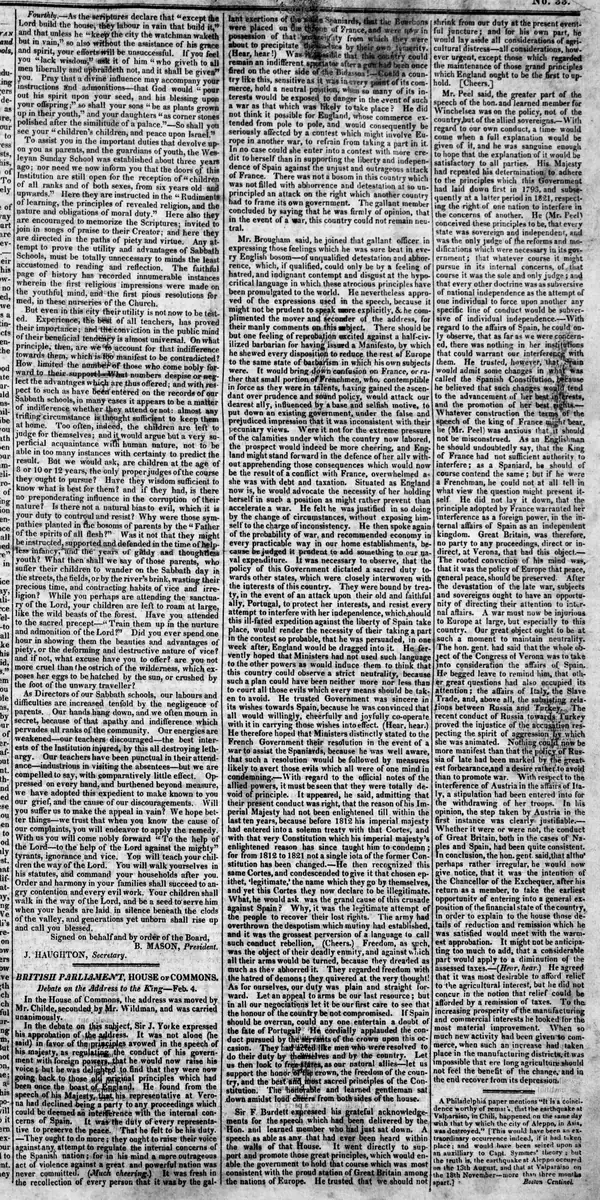
Debate on the Address to the King Feb. 4.
In the House of Commons, the address was moved by Mr. Childe, seconded by Mr. Wildman, and was carried unanimously.
In the debate on this subject, Sir J. Yorke expressed his approbation of the address. It was not alone (he said) in favor of the principles avowed in the speech of his majesty, as regulating the conduct of his government with foreign powers, that he would now raise his voice; but he was delighted to find that they were now going back to those old original principles which had been once the boast of England. He found from the speech of his Majesty, that his representative at Verona had declined being a party to any proceedings which could be deemed an interference with the internal concerns of Spain.
It was the duty of every representative to preserve the peace. That he felt to be his duty. They ought to do more; they ought to raise their voice against any attempt to regulate the internal concerns of the Spanish nation; for in his mind a more outrageous act of violence against a great and powerful nation was never committed. (Much cheering.) It was fresh in the recollection of every person that it was by the gallant exertions of the Spaniards, that the Bourbons were placed on the throne of France, and were now in possession of that regality from which they were about to precipitate themselves by their own temerity. (Hear, hear!) Was it possible that this country could remain an indifferent spectator after a gun had been once fired on the other side of the Bidassoa! Could a country like this, sensitive as it was in every point of its commerce, hold a neutral position, when so many of its interests would be exposed to danger in the event of such a war as that which was likely to take place? He did not think it possible for England, whose commerce extended from pole to pole, and would consequently be seriously affected by a contest which might involve Europe in another war, to refrain from taking a part in it. In no case could she enter into a contest with more credit to herself than in supporting the liberty and independence of Spain against the unjust and outrageous attack of France. There was not a bosom in this country which was not filled with abhorrence and detestation at so unprincipled an attack on the right which another country had to frame its own government. The gallant member concluded by saying that he was firmly of opinion, that in the event of a war, this country could not remain neutral.
Mr. Brougham said, he joined that gallant officer in expressing those feelings which he was sure beat in every English bosom—of unqualified detestation and abhorrence, which, if qualified, could only be by a feeling of hatred, and indignant contempt and disgust at the hypocritical language in which these atrocious principles have been promulgated to the world. He nevertheless approved of the expressions used in the speech, because it might not be prudent to speak more explicitly, & he complimented the mover and seconder of the address, for their manly comments on this subject. There should be but one feeling of reprobation excited against a half-civilized barbarian for having issued a Manifesto, by which he shewed every disposition to reduce the rest of Europe to the same state of barbarism in which his own subjects were. It would bring down confusion on France, or rather that small portion of Frenchmen, who, contemptible in force as they were in talents, having gained the ascendant over prudence and sound policy, would attack our dearest ally, influenced by a base and selfish motive, to put down an existing government, under the false and prejudiced impression that it was inconsistent with their pecuniary views. Were it not for the extreme pressure of the calamities under which the country now labored, the prospect would indeed be more cheering, and England might stand forward in the defence of her ally without apprehending those consequences which would now be the result of a conflict with France, overwhelmed as she was with debt and taxation. Situated as England now is, he would advocate the necessity of her holding herself in such a position as might rather prevent than accelerate a war. He felt he was justified in so doing by the change of circumstances, without exposing himself to the charge of inconsistency. He then spoke again of the probability of war, and recommended economy in every practicable way in our home establishments, because he judged it prudent to add something to our naval expenditure. It was necessary to observe, that the policy of this Government dictated a sacred duty towards other states, which were closely interwoven with the interests of this country. They were bound by treaty, in the event of an attack upon their old and faithful ally, Portugal, to protect her interests, and resist every attempt to interfere with her independence, which, should this ill-fated expedition against the liberty of Spain take place, would render the necessity of their taking a part in the contest so probable, that he was persuaded, in one week after, England would be dragged into it. He fervently hoped that Ministers had not used such language to the other powers as would induce them to think that this country could observe a strict neutrality, because such a plan could have been neither more nor less than to court all those evils which every means should be taken to avoid. He trusted Government was sincere in its wishes towards Spain, because he was convinced that all would willingly, cheerfully and joyfully co-operate with it in carrying those wishes into effect. (Hear, hear.) He therefore hoped that Ministers distinctly stated to the French Government their resolution in the event of a war to assist the Spaniards, because he was well aware, that such a resolution would be followed by measures likely to avert those evils which all were of one mind in condemning.—With regard to the official notes of the allied powers, it must be seen that they were totally devoid of principle. It appeared, he said, admitting that their present conduct was right, that the reason of his Imperial Majesty had not been enlightened till within the last ten years, because before 1812 his imperial majesty had entered into a solemn treaty with that Cortes, and with that very Constitution which his imperial majesty's enlightened reason has since taught him to condemn; for from 1812 to 1821 not a single iota of the former Constitution has been changed. He then recognized this same Cortes, and condescended to give it that chosen epithet 'legitimate,' the name which they go by themselves, and yet this Cortes they now declare to be illegitimate. What, he would ask, was the grand cause of this crusade against Spain? Why, it was the legitimate attempt of the people to recover their lost rights. The army had overthrown the despotism which mutiny had established, and it was the grossest perversion of language to call such conduct rebellion, (Cheers.) Freedom, as such, was the object of their deadly enmity, and against which all their arms would be turned, because they dreaded as much as they abhorred it. They regarded freedom with the hatred of demons; they quivered at the very thought! As for ourselves, our duty was plain and straight forward. Let an appeal to arms be our last resource; but in all our negociations let it be our first care to see that the honour of the country be not compromised. If Spain should be overrun, could any one entertain a doubt of the fate of Portugal? He cordially applauded the conduct pursued by the servants of the crown upon this occasion. They had acted like men who were resolved to do their duty by themselves and by the country. Let us then look to free states, as our natural allies—let us support the honor of the crown, the freedom of the country, and the best and most sacred principles of the Constitution. The honorable and learned gentleman sat down amidst loud cheers from both sides of the house.
Sir F. Burdett expressed his grateful acknowledgments for the speech which had been delivered by the Hon. and learned member who had just sat down. A speech as able as any that had ever been heard within the walls of that House. It went directly to support and promote those great principles, which would enable the government to hold that course which was most consistent with the proud station of Great Britain among the nations of Europe. He trusted that we should not shrink from our duty at the present eventful juncture: and for his own part, he would lay aside all considerations of agricultural distress—all considerations, however urgent, except those which regarded the maintenance of those grand principles which England ought to be the first to uphold. [Cheers.]
Mr. Peel said, the greater part of the speech of the hon. and learned member for Winchelsea was on the policy, not of the country, but of the allied sovereigns. With regard to our own conduct, a time would come when a full explanation would be given of it, and he was sanguine enough to hope that the explanation of it would be satisfactory to all parties. His Majesty had repeated his determination to adhere to the principles which this Government had laid down first in 1793, and subsequently at a latter period in 1821, respecting the right of one nation to interfere in the concerns of another. He (Mr. Peel) conceived these principles to be, that every state was sovereign and independent, and was the only judge of the reforms and modifications which were necessary in its government; that whatever course it might pursue in its internal concerns, of that course it was the sole and only judge; and that every other doctrine was as subversive of national independence as the attempt of one individual to force upon another any specific line of conduct would be subversive of individual independence.—With regard to the affairs of Spain, he could only observe, that as far as we were concerned, there was nothing in her institutions that could warrant our interference with them. He trusted, however, that Spain would admit some changes in what was called the Spanish Constitution, because he believed that such changes would tend to the advancement of her best interests, and the promotion of her best rights.—Whatever construction the terms of the speech of the king of France might bear, he (Mr. Peel) was anxious that it should not be misconstrued. As an Englishman he should undoubtedly say, that the King of France had not sufficient authority to interfere: as a Spaniard, he should of course contend the same; but if he were a Frenchman, he could not at all tell in what view the question might present itself. He did not lay it down, that the principle adopted by France warranted her interference as a foreign power, in the internal affairs of Spain as an independent kingdom. Great Britain, was therefore, no party to any proceedings, direct or indirect, at Verona, that had this object.—The rooted conviction of his mind was, that it was the policy of Europe that peace, general peace, should be preserved. After the devastation of the late war, subjects and sovereigns ought to have an opportunity of directing their attention to internal affairs. A war must now be injurious to Europe at large, but especially to this country. Our great object ought to be at such a moment to maintain neutrality. The hon. gent. had said that the whole object of the Congress of Verona was to take into consideration the affairs of Spain. He begged leave to remind him, that other great questions had also occupied its attention; the affairs of Italy the Slave Trade, and, above all, the subsisting relations between Russia and Turkey The recent conduct of Russia towards Turkey proved the injustice of the accusation respecting the spirit of aggression by which she was animated. Nothing could now be more manifest than that the policy of Russia of late had been marked by the greatest forbearance, and a desire rather to avoid than to promote war. With respect to the interference of Austria in the affairs of Italy, a stipulation had been entered into for the withdrawing of her troops. In his opinion, the step taken by Austria in the first instance was clearly justifiable.—Whether it were or were not, the conduct of Great Britain, both in the cases of Naples and Spain, had been quite consistent. In conclusion, the hon. gent. said, that although perhaps rather irregular, he would now give notice, that it was the intention of the Chancellor of the Exchequer, after his return as a member, to take the earliest opportunity of entering into a general exposition of the financial state of the country, in order to explain to the house those details of reduction and remission which he was satisfied would meet with the warmest approbation. It might not be anticipating too much to add, that a considerable part would apply to a diminution of the assessed taxes. (Hear, hear.) He agreed that it was most desirable to afford relief to the agricultural interest, but he did not concur in the notion that relief could be afforded by a remission of taxes. To the increasing prosperity of the manufacturing and commercial interests he looked for the most material improvement. When so much new activity had been given to commerce, when such an increase had taken place in the manufacturing districts, it was impossible that ere long agriculture should not feel the benefit of the change, and in the end recover from its depression.
What sub-type of article is it?
What keywords are associated?
What entities or persons were involved?
Where did it happen?
Foreign News Details
Primary Location
Spain
Event Date
Feb. 4
Key Persons
Outcome
address carried unanimously; expressions of support for spanish independence and non-interference; hopes for peace and neutrality while preparing naval forces.
Event Details
Debate in the House of Commons on the Address to the King, with speakers including Sir J. Yorke, Mr. Brougham, Sir F. Burdett, and Mr. Peel, approving the government's stance against interference in Spain's internal affairs at the Congress of Verona, condemning potential French aggression, emphasizing duties to Portugal, and discussing principles of national sovereignty from 1793 and 1821.