Thank you for visiting SNEWPapers!
Sign up free
The Helena Independent
Helena, Lewis And Clark County, Montana
What is this article about?
On January 27, 1891, in Washington, the U.S. Senate handled credentials for new senators from California and South Carolina, passed an anti-counterfeiting bill, and debated apportionment. The House received a veto on Oklahoma bonds, passed a Missouri River bridge bill, and discussed the military academy amid criticism of the recent Indian war and Wounded Knee massacre.
Clipping
OCR Quality
Full Text
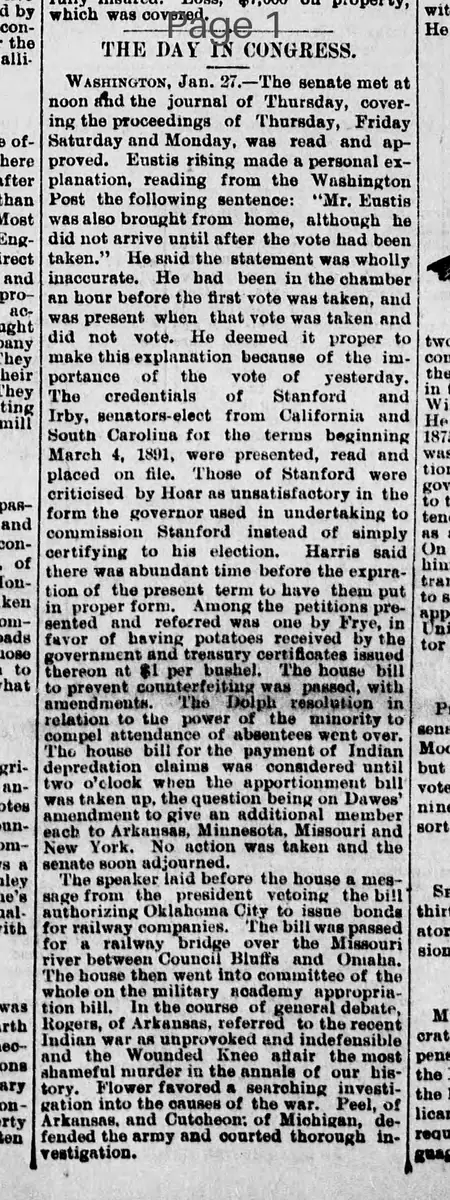
WASHINGTON, Jan. 27. - The senate met at noon and the journal of Thursday, covering the proceedings of Thursday, Friday Saturday and Monday, was read and approved. Eustis rising made a personal explanation, reading from the Washington Post the following sentence: "Mr. Eustis was also brought from home, although he did not arrive until after the vote had been taken." He said the statement was wholly inaccurate. He had been in the chamber an hour before the first vote was taken, and was present when that vote was taken and did not vote. He deemed it proper to make this explanation because of the importance of the vote of yesterday. The credentials of Stanford and Irby, senators-elect from California and South Carolina for the terms beginning March 4, 1891, were presented, read and placed on file. Those of Stanford were criticised by Hoar as unsatisfactory in the form the governor used in undertaking to commission Stanford instead of simply certifying to his election. Harris said there was abundant time before the expiration of the present term to have them put in proper form. Among the petitions presented and referred was one by Frye, in favor of having potatoes received by the government and treasury certificates issued thereon at $1 per bushel. The house bill to prevent counterfeiting was passed, with amendments. The Dolph resolution in relation to the power of the minority to compel attendance of absentees went over. The house bill for the payment of Indian depredation claims was considered until two o'clock when the apportionment bill was taken up, the question being on Dawes' amendment to give an additional member each to Arkansas, Minnesota, Missouri and New York. No action was taken and the senate soon adjourned.
The speaker laid before the house a message from the president vetoing the bill authorizing Oklahoma City to issue bonds for railway companies. The bill was passed for a railway bridge over the Missouri river between Council Bluffs and Omaha. The house then went into committee of the whole on the military academy appropriation bill. In the course of general debate, Rogers, of Arkansas, referred to the recent Indian war as unprovoked and indefensible and the Wounded Knee affair the most shameful murder in the annals of our history. Flower favored a searching investigation into the causes of the war. Peel, of Arkansas, and Cutcheon, of Michigan, defended the army and courted thorough investigation.
What sub-type of article is it?
What keywords are associated?
What entities or persons were involved?
Where did it happen?
Domestic News Details
Primary Location
Washington
Event Date
1891 01 27
Key Persons
Outcome
senate passed house bill to prevent counterfeiting with amendments; considered but no action on apportionment bill; house received presidential veto on oklahoma city bonds bill, passed railway bridge bill over missouri river, debated military academy appropriation including indian war and wounded knee.
Event Details
The Senate met at noon, approved journal, Eustis clarified his presence during a vote; credentials of Stanford (California) and Irby (South Carolina) presented and filed, with criticism of Stanford's form; petition for potato payments referred; house bill to prevent counterfeiting passed with amendments; Dolph resolution deferred; Indian depredation claims bill considered; apportionment bill debated on Dawes' amendment. The House received presidential veto message on Oklahoma City bonds for railways; passed bill for railway bridge between Council Bluffs and Omaha; entered committee on military academy appropriation, debating Indian war and Wounded Knee with Rogers criticizing, Flower calling for investigation, Peel and Cutcheon defending the army.