Thank you for visiting SNEWPapers!
Sign up free
The National Intelligencer And Washington Advertiser
Washington, District Of Columbia
What is this article about?
William Cobbett defends British maritime rights in the dispute with America over the seizure of enemy colonial produce shipped via American ports. He argues against concessions, critiques American claims, and dismisses fears of reprisals from British merchants.
Merged-components note: These components form a single coherent piece: a quoted foreign commentary (Cobbett's remarks on US-British disputes) directly continued into the newspaper's own editorial response and analysis. The overall content is opinionated commentary on foreign relations, best labeled as editorial.
Clippings
1 of 2
OCR Quality
Full Text
ON THE
DISPUTE WITH AMERICA.
(CONCLUDED.)
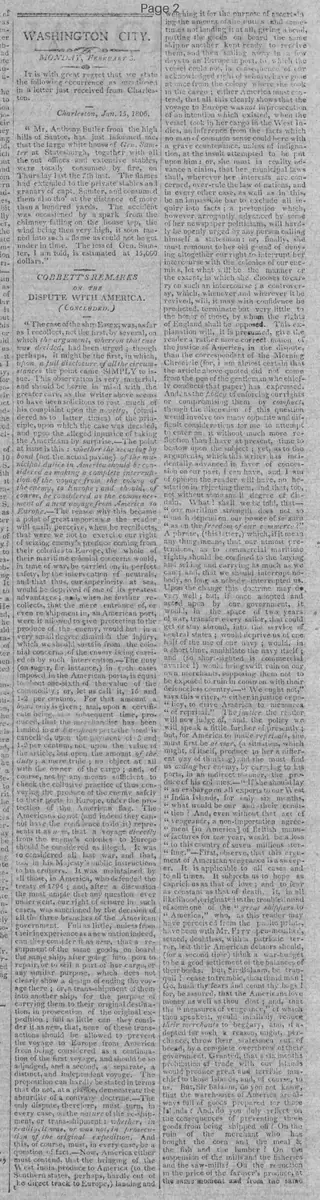
"The case of the ship Essex, was, as far as I recollect, not the first, by several, on which the argument, whereon that case was decided, had been urged; though perhaps, it might be the first, in which, upon a full disclosure of all the circumstances the point came SIMPLY to issue. This observation is very material, and should be borne in mind with the greater care, as the writer above seems to have been solicitous to rest much of his complaint upon the novelty, (considered as to latter times) of the principle, upon which the case was decided, and upon the alleged injustice of taking the Americans by surprise.—The point at issue is this: whether the securing by bond (not the actual paying) of the municipal duties in America should be considered as making a complete interruption of the voyage from the colony of the enemy, to Europe: and should, of course, be considered as the commencement of a new voyage from America to Europe.—The reason why this became a point of great importance the reader will easily perceive, when he recollects, that were we not to exercise our right of seizing enemy's produce coming from their colonies to Europe, the whole of their maritime colonial concerns would, in time of war, be carried on, in perfect safety, by the intervention of neutrals, and that thus, our superiority at sea, would be deprived of one of its greatest advantages; and, when he further recollects, that the mere entrance of, or even re-shipment in, an American port, were it allowed to give protection to the produce of the enemy, would but in a very small degree diminish the injury, which we should sustain from the colonial concerns of the enemy being carried on by such intervention.—The duty (on sugar, for instance,) in such cases imposed in the American ports, is equal to about one-sixth of the value of the commodity; or, let us call it, 16 and 1-2 per centum. For that amount a bond only is given; and, upon a certificate being, at a subsequent time, produced, that the merchandise has been landed in an European port, the bond is cancelled, upon the payment of 8 and 1-2 per centum, not upon the value of the article, but upon the amount of the duty; a mere trifle; no object at all with the owner of the cargo; and, of course, not by any means sufficient to check the collusive practice of thus conveying the produce of the enemy safely to their ports in Europe, under the protection of the American flag. The Americans do not (and indeed they cannot have the confidence to do it) represent it as new, that a voyage directly from the enemy's colonies to Europe should be considered as illegal. It was so considered all last war, and that, too, in his Majesty's public instructions to his cruisers. It was maintained by all those, in America, who defended the treaty of 1794; and, after a discussion the most ample that any question ever underwent, our right of seizure in such cases, was sanctioned by the decision of all the three branches of the American government. Full as little, unless from their inexperience as a new nation indeed, can they consider it as new, that a re-shipment of the same goods, on board the same ship, after going into port to repair, or to sell a part of her cargo, or any similar purpose, which does not clearly show a design of ending the voyage there; or, a trans-shipment of them into another ship, for the purpose of carrying them to their original destination, in prosecution of the original expedition; full as little can they consider it as new, that, none of these transactions should be allowed to prevent the voyage to Europe from America from being considered as a continuation of the first voyage, and should be so adjudged, and a second, a separate, a distinct, and independent voyage. The proposition can hardly be stated in terms that do not, at a glance, demonstrate the absurdity of a contrary doctrine.—The only dispute, therefore, must turn, in every case, on the nature of the re-shipment, or trans-shipment: whether, in reality, it was, or was not, in prosecution of the original expedition. And this, of course, must, in every case, be a question of fact.—Now, America either must contend, that the bringing of the West India produce to America (to the Southern states, perhaps, hardly out of the direct track to Europe,) landing and weighing it for the purpose of ascertaining the amount of the duties and sometimes not landing it at all, giving a bond, putting the goods on board the same ship or another kept ready to receive them, and then sailing away in a few days to an European port, to which the vessel could not, in consequence of our acknowledged right of seizure, have gone at once from the colony where she took in the cargo; either America must contend, that all this clearly shows that the voyage to Europe was not in prosecution of an intention which existed, when the vessel took in her cargo in the West Indies, an inference from the facts which no man of common sense could here with a grave countenance, unless of indignation, at the insult attempted to be put upon him: or, she must in reality advance a claim, that her municipal laws shall, wherever her interests are concerned, over-rule the law of nations, and in every other case, as well as in this, be an impassible bar to exclude all inquiry into facts; a pretension which, however arrogantly advanced by some of her newspaper politicians, will hardly be openly urged by any person calling himself a statesman: or, finally, she must remount to her old ground of denying altogether our right to interrupt her intercourse with the colonies of our enemies, let what will be the manner or the extent, in which she chooses to carry on such an intercourse: a controversy, which, whenever and wherever it be revived, will, it may with confidence be predicted, terminate but very little to the honor of those, by whom the rights of England shall be opposed. This explanation will, it is presumed, give the reader a rather more correct notion of the justice of America, in the dispute, than the correspondent of the Morning Chronicle (for, I am almost certain that the article above quoted did not come from the pen of the gentleman who chiefly conducts that paper) has expressed. And, as to the policy of enforcing our rights or compromising them by compact, though the discussion of this question would involve too many opposite and difficult considerations for me to attempt to enter on it without much more reflection than I have at present, time to bestow upon the subject; yet, as to the arguments, which this writer has incidentally advanced in favor of concession on our part, I can have, and I am of opinion the reader will have, no hesitation in rejecting them, and that, too, not without some small degree of disdain. What! shall we be told, that— "our maritime strength does not so "much depend on our power of seizure "as on the freedom of our commerce?" A phrase, (this latter,) which, if it mean any thing, means, that our utmost pretensions, as to commercial maritime rights, should be confined to the buying and selling and carrying as much as we can; and, that we should interrupt nobody, so long as nobody interrupted us. Upon the change this doctrine may do very well; but, if once adopted and acted upon by our government, it would, in the space of two years of war, transfer every sailor, that could get or stay abroad, into the service of neutral states; would deprive us of one half of the use of our navy; would, in a short time, annihilate the navy itself; and (so short-sighted is commercial avarice!) would bring swift ruin on our own merchants, supposing them not to be exposed to ruin in common with their defenceless country.—"We ought not," says this writer, "either in justice or po- "licy, to drive America to measures "of reprisal." The justice the reader will now judge of, and the policy we will speak a little further of presently; but, for America to make reprisals, she, must first be at war, (a situation, which might, of itself, produce in her a different way of thinking) and she must find us aiding her enemy, by carrying to his ports, in an indirect manner, the produce of his colonies.—"If she should lay "an embargo on all exports to our West "India Islands, for only six months, "what would be our and their cond- "ition? And, even without that act of "vengeance, a non-importation agree- "ment [in America] of British manu- "factures for one year, would be a loss "to this country of seven millions ster- "ling." First, observe, that this argument of American vengeance is a sweeper. It is applicable to all cases and to all times. It subjects us to hope as capricious as that of love; and to fear as constant as that of death. It, in all likelihood, originated in the troubled mind of some one of the "great shippers to "America," who, as this reader may have perceived from the public prints, have been with Mr. Pitt pen-mouthed, seized, doubtless, with a patriotic terror, lest their American debtors should, (for a second time) think a war-taxes to be a good settlement of the balances of their books. But, Sir Balaam, be tranquil! cease to tremble, thou timid man! Go, hush thy fears and count thy bags! for, be assured, that the Americans love money as well as thou dost; and, that the "measures of vengeance," of which thou speakest, would infallibly reduce their merchants to beggary, and, if adopted for such a reason, might, per- chance, throw their statesmen out of bread, by a complete overthrow of their government. Granted, that a six months prohibition of trade with our islands would produce great and terrible mischief to those Islands, and, of course, to us. But, Sir Balaam, do you not know, that the warehouses of America are al- ways full of goods prepared for those Islands! And, do you duly reflect on the consequences of preventing those goods from being shipped off? On the ruin of the merchant who has bought the corn and the meal & the fish and the lumber? On the suspension of the mills and the fisheries and the saw-mills? On the reduction in the price of the farmer's produce, at the same moment and from the same
cause, that the price of his coffee (drunk daily even by laborers) and his rum the common drink of the country) and his molasses (of general use) and his sugar are all augmented in price? And as to "the non-importation agreement," at the bare possibility of which you seem so terrified, do you think, that it would have no terrors for America? (Granted, that you and your brethren ship seven millions worth of British manufactures annually to America, yet, unless they be all rotten, except it be all for profit, a non-importation agreement for a year could not possibly produce seven millions worth of loss. Your brain is disturbed, Sir Balaam, or you would not forget, that a non-importation agreement would triple the price of British manufactures, the coats and the shirts of the men and the gowns and the petticoats of the women, all those things, in short, which make them differ in appearance from their savage neighbors. "Your brain is certainly turned, Balaam, or you would remember, that the taxes, by which the general government is supported, and by which Mr. Jefferson has been enabled to take off the internal taxes, and thereby to obtain his popularity, are derived chiefly from the importation of British manufactures: and, if you overlook, Mr. Jefferson will not, the probable, and almost inevitable consequences of imposing heavy internal taxes (for he must prepare for war) upon the farmers, at the very time that their produce is lowered and their wearing apparel and hardware are augmented in price three or four fold. -I do not say, that a gross injury, or even insult, would not induce the Americans to submit to such sacrifices, and I would be amongst the last of those, who would try to from in any way; but, rest assured, Balaam, that they would not make any sacrifice at all to humour the caprice or the malignity of any one of their statesmen ; no, nor of all their statesmen put together. And, as to their paying you with a sponge, fear it not; for, though such a mode of payment might perfectly well square with the morality of some of them ; yet, if my observation has not been very superficial, there are good sense and integrity enough left in the country to prevent any general measure of that sort from being adopted ; unless in case of some provocation so outrageous as to excite a degree of resentment sufficient to bear down and to smother all other feelings. -Again, therefore, I say, Balaam, hush your fears and count your bags, or rather your slips of paper ; for, be convinced, that Mr. Pitt wants no councillors on the side of temporising ; that when the object is to give up (any thing except his place,) he wants no one to back him : and, trust, you may rely upon it, that, if he make a stand for the rights and the honors of England, though the dealers in American stock and shippers of goods to America should forsake him, he will have the support of a great majority of the nation, whom, Balaam, as you may have perceived, danger has taught to begin, at least, to think less of the funds and more of their country than they used to do. I am aware, that some ill-natured wit will say, that, upon this American Case, I am writing con amore; in answer to which insinuation, I shall appeal to all the sentiments that I have ever expressed upon the subject, both on this and on the other side of the Atlantic. When there, I frequently had occasion to deprecate the humble tone of our negotiators and our ministers ; and, if a different tone be taken now. I shall rejoice in having to applaud it, hear it from whomsoever I may. In the mean time, I cannot refrain from taking the liberty to beg the public as well as the ministers to be upon their guard against the representations of the owners of American funds & American lands and the traders to America. "These (and they are very numerous) have all strong bias toward that country, as, indeed, they naturally must have. There are some honorable exceptions ; but, generally speaking, their representations are to be received with great caution; to say nothing of their ignorance of the real interests of either country."
What sub-type of article is it?
What keywords are associated?
What entities or persons were involved?
Editorial Details
Primary Topic
British Maritime Rights In Seizure Of Enemy Colonial Produce Via American Ports
Stance / Tone
Strongly Pro British Rights, Dismissive Of American Claims And Concession Advocates
Key Figures
Key Arguments