Thank you for visiting SNEWPapers!
Sign up free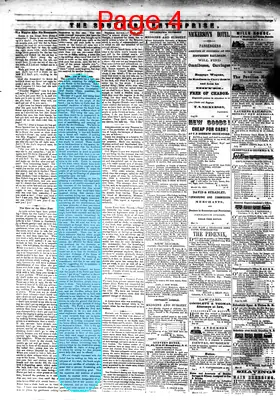
Domestic News
September 4, 1867
The Southern Enterprise
Greenville, Greenville County, South Carolina
What is this article about?
The Galveston News advocates for Southern acceptance of aid from the American Freedmen's Union Commission, led by Chief Justice Chase, to educate freedmen, emphasizing cooperation between North and South to overcome prejudice and promote peace post-Civil War.
Clipping

OCR Quality
98%
Excellent
Full Text
Education of Freedmen.
The Galveston News has a very sensible article respecting the obligations of the South to the freedmen. Referring to the operations of the "American Freedmen's Union Commission," Chief Justice Chase, president, the News remarks as follows:
We hear of a good deal being done for the education of the freedmen at various places by the people of the South; yet we have no doubt that the unsettled condition of affairs and the general poverty prevent the South from giving this subject a sufficient share of attention. This being the case, perhaps there would be no impropriety in accepting the offer of aid from the society above named, solely for the purpose of establishing and carrying on schools for the freedmen. We have no doubt that any community which desires a school for freedmen could contribute something to that end, furnishing a house and teacher, if nothing more, and that representations to that effect would secure the additional aid that might be needed. There should be no backwardness in this matter, because we all admit that the freedmen must be educated, that the South should contribute as much as possible to that object, and that there is no reason why the benevolent in all parts of this country and of Europe should not unite in the work. Union in matters of this kind, which should have nothing to do with politics, might do much to break down prejudice, to make the people of all sections better acquainted, and to bring the blessings of peace and prosperity upon the land.
The South has nothing to lose by pursuing a conciliatory and high minded course on all matters connected with the interests of the freedmen. It is universally admitted that they served quite as well as they could have been expected during their slavery; that their conduct during war was not only unexceptionable but highly praiseworthy, and that their bearing since then, considering all the circumstances, has not been unworthy of their past record. True, political excitement has injured them, but not yet to the extent that might have been expected, and the heinous crimes recently committed by some of the more depraved should not be permitted to injure our estimation of the race. But we need not write on this subject as though there were any necessity for exhortation or argument so far as the welfare of the colored people is concerned. There can be no doubt whatever that the white people of the South are the true friends of the freedmen. Nothing has happened to destroy the affection for them which was produced by the domestic relations of the past, and we believe there is nothing which our people would not do to help the freedmen in the proper discharge of the duties of their new situation. If anything be lacking, it is wholly the result of circumstances; and this is our only reason for suggesting the co-operation to which we have referred.
It is generally believed, we know, that the people of the North and South cannot "get along" together in the education of the freedmen, and that the Southern people would do better in that matter if the Northern people were to leave it alone. This, however, is not to be expected. The North will concern itself on the subject, whether we do or not, and we therefore submit that it might be sound policy for us, both with reference to our relations, to the freedmen and to the other sections of the Union, to take the ground that the co-operative is the right method of doing the work. The North is perfectly able to contribute; it is alike her duty and her pleasure to do so; and even if some unpleasant results were to arise in some instances from our co-operation, it is altogether likely that there would be as nothing compared with the better efforts which may reasonably be expected to follow. This is the age of associated effort, and it is only in proportion as men overcome apathy and prejudice in favor of this policy, that they need expect to prevent the most serious evils. Nothing can be effected by aloofness, or standing on dignity; but almost everything may be accomplished by the benevolent energy which fulfills its desire of doing good to others by seizing for that purpose every help that may be offered.
We are strongly impressed with the belief that by waking up fully on all subjects of this kind, the South might, without any sacrifice of principle, do a great deal to prevent threatening evils and effect corresponding good. Thus the asperities and passions of politics would be soothed down, misconceptions and prejudices, antagonism of race and section, full of bad portent, would be removed, and all the blessings of peace and order secured in the place of agitation, anarchy and destruction.
The Galveston News has a very sensible article respecting the obligations of the South to the freedmen. Referring to the operations of the "American Freedmen's Union Commission," Chief Justice Chase, president, the News remarks as follows:
We hear of a good deal being done for the education of the freedmen at various places by the people of the South; yet we have no doubt that the unsettled condition of affairs and the general poverty prevent the South from giving this subject a sufficient share of attention. This being the case, perhaps there would be no impropriety in accepting the offer of aid from the society above named, solely for the purpose of establishing and carrying on schools for the freedmen. We have no doubt that any community which desires a school for freedmen could contribute something to that end, furnishing a house and teacher, if nothing more, and that representations to that effect would secure the additional aid that might be needed. There should be no backwardness in this matter, because we all admit that the freedmen must be educated, that the South should contribute as much as possible to that object, and that there is no reason why the benevolent in all parts of this country and of Europe should not unite in the work. Union in matters of this kind, which should have nothing to do with politics, might do much to break down prejudice, to make the people of all sections better acquainted, and to bring the blessings of peace and prosperity upon the land.
The South has nothing to lose by pursuing a conciliatory and high minded course on all matters connected with the interests of the freedmen. It is universally admitted that they served quite as well as they could have been expected during their slavery; that their conduct during war was not only unexceptionable but highly praiseworthy, and that their bearing since then, considering all the circumstances, has not been unworthy of their past record. True, political excitement has injured them, but not yet to the extent that might have been expected, and the heinous crimes recently committed by some of the more depraved should not be permitted to injure our estimation of the race. But we need not write on this subject as though there were any necessity for exhortation or argument so far as the welfare of the colored people is concerned. There can be no doubt whatever that the white people of the South are the true friends of the freedmen. Nothing has happened to destroy the affection for them which was produced by the domestic relations of the past, and we believe there is nothing which our people would not do to help the freedmen in the proper discharge of the duties of their new situation. If anything be lacking, it is wholly the result of circumstances; and this is our only reason for suggesting the co-operation to which we have referred.
It is generally believed, we know, that the people of the North and South cannot "get along" together in the education of the freedmen, and that the Southern people would do better in that matter if the Northern people were to leave it alone. This, however, is not to be expected. The North will concern itself on the subject, whether we do or not, and we therefore submit that it might be sound policy for us, both with reference to our relations, to the freedmen and to the other sections of the Union, to take the ground that the co-operative is the right method of doing the work. The North is perfectly able to contribute; it is alike her duty and her pleasure to do so; and even if some unpleasant results were to arise in some instances from our co-operation, it is altogether likely that there would be as nothing compared with the better efforts which may reasonably be expected to follow. This is the age of associated effort, and it is only in proportion as men overcome apathy and prejudice in favor of this policy, that they need expect to prevent the most serious evils. Nothing can be effected by aloofness, or standing on dignity; but almost everything may be accomplished by the benevolent energy which fulfills its desire of doing good to others by seizing for that purpose every help that may be offered.
We are strongly impressed with the belief that by waking up fully on all subjects of this kind, the South might, without any sacrifice of principle, do a great deal to prevent threatening evils and effect corresponding good. Thus the asperities and passions of politics would be soothed down, misconceptions and prejudices, antagonism of race and section, full of bad portent, would be removed, and all the blessings of peace and order secured in the place of agitation, anarchy and destruction.
What sub-type of article is it?
Education
Slave Related
Politics
What keywords are associated?
Freedmen Education
American Freedmens Union Commission
North South Cooperation
Post Civil War Reconciliation
Southern Obligations
What entities or persons were involved?
Chief Justice Chase
Where did it happen?
South
Domestic News Details
Primary Location
South
Key Persons
Chief Justice Chase
Event Details
The Galveston News article discusses the need for educating freedmen in the South, suggests accepting aid from the American Freedmen's Union Commission for establishing schools, and advocates for North-South cooperation to reduce prejudice and promote peace.