Thank you for visiting SNEWPapers!
Sign up free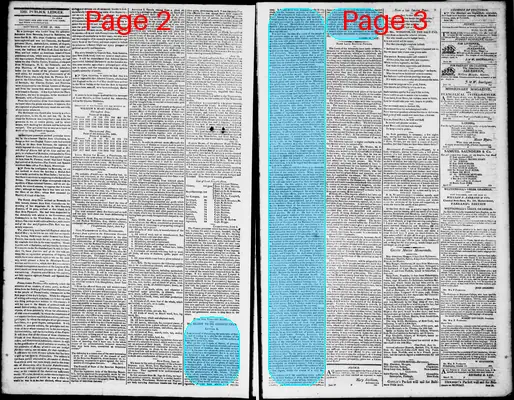
Norfolk Gazette And Publick Ledger
Norfolk, Virginia
What is this article about?
In Letter X, James Elliot defends himself against accusations of abandoning liberty and plotting to divide the Union, advocating for a northern political union to secure fair representation and preserve the constitutional balance against southern dominance, while upholding republican principles.
Merged-components note: The component on page 3 is a direct textual continuation of the letter to the editor from page 2 (ending mid-word 'republi-' and resuming with 'cans.'); sequential reading order across pages.
Clippings
1 of 2
OCR Quality
Full Text
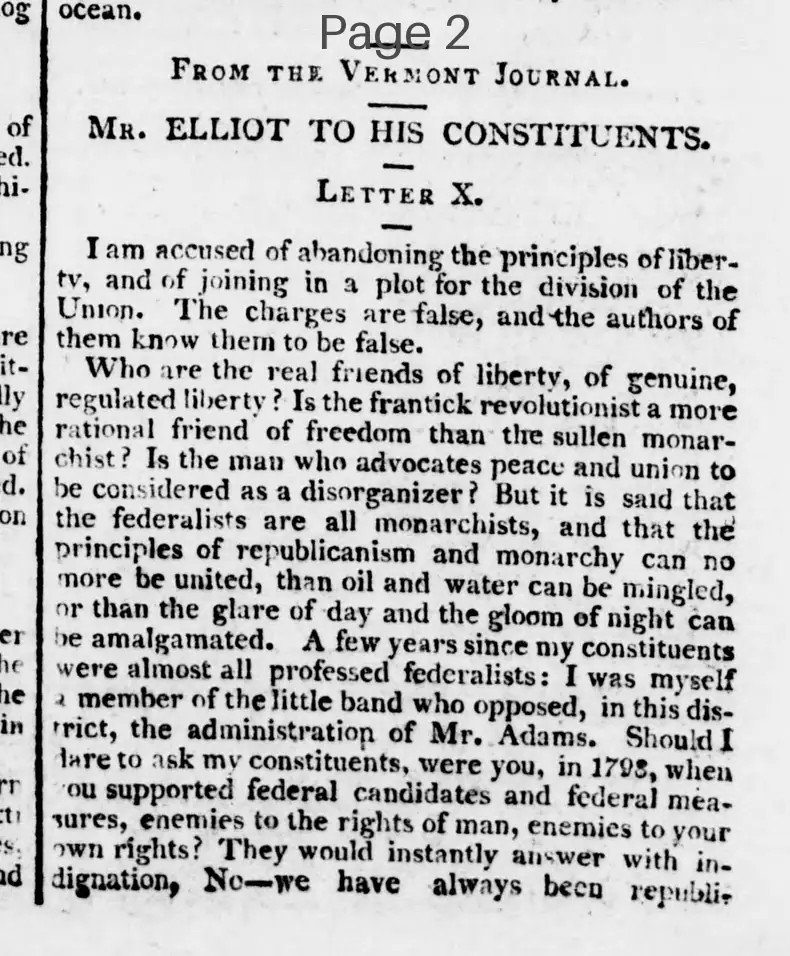
MR. ELLIOT TO HIS CONSTITUENTS.
Letter X.
I am accused of abandoning the principles of liberty, and of joining in a plot for the division of the Union. The charges are false, and the authors of them know them to be false.
Who are the real friends of liberty, of genuine, regulated liberty? Is the frantic revolutionist a more rational friend of freedom than the sullen monarchist? Is the man who advocates peace and union to be considered as a disorganizer? But it is said that the federalists are all monarchists, and that the principles of republicanism and monarchy can no more be united, than oil and water can be mingled, or than the glare of day and the gloom of night can be amalgamated. A few years since my constituents were almost all professed federalists: I was myself a member of the little band who opposed, in this district, the administration of Mr. Adams. Should I dare to ask my constituents, were you, in 1798, when you supported federal candidates and federal measures, enemies to the rights of man, enemies to your own rights? They would instantly answer with indignation,
No we have always been republicans. Is it then more than common charity to conclude that the immense majority of those who still profess the principles of federalism are also republicans? Among the many thousands who have left the federal standard, how many have told us that they had been concerned in a plot for the destruction of liberty? Not one. Monarchical principles are confined to a few individuals in our country; and among those individuals may be placed some of our most ardent republicans!
It is said that the idea of a union of the people of the northern states in one great political interest must produce a division of the Union: and those who say this look with perfect complacency upon that gigantic mass of influence which a similar union in the southern states has already created. In other words, to preserve the Union, the southern states must be united as one man, and the northern must be divided and distracted. Miserable sophism! Absurd and foolish dogma! Let me here repeat that a perfect union among ourselves would induce us to demand no more than our due share of political weight, which would then be yielded to us, and the Union would be preserved, and even rendered more secure.
Various are the opinions of men of reflection in relation to the probable effects of the acquisition of Louisiana. Upon no subject have I found it more difficult to form an opinion for myself. Some believe that a commercial connexion will take place between the eastern and the western states; that the people of New-England will carry to those of the Mississippi the productions of other parts of the world, and export for them their own productions; and that this commercial connexion will produce a political one, favourable to us, and unfavourable to the southern states. Others argue that the inhabitants of the west will be a shipbuilding and agricultural people; that their vicinity to the West India markets will enable them to supersede us in some of the most profitable branches of our commerce; and that the idea of a political connexion with them, though splendid, is perfectly delusive. The prospect indeed is rather gloomy. But putting Louisiana out of the question, the number of representatives in congress to which the southern states are entitled, on account of their slaves, must forever secure them a majority in the councils of the Union. The slaves are not represented, but three fifths of their number are added to the number of free persons, and this determines the number of representatives from the state. Were the slaves made free, we could not refuse, upon our own principles, to allow them representatives; but, deprived as they are of all civil rights, and considered merely as property, it would be as just that the Vermont farmer should be entitled to a representation for his cattle, as the Virginian planter for his negroes. No northern man who has caught a single spark of freedom's flame from the altar of patriotism, but must wish that these things were not so. Such, however, is the constitution of our country, that sacred instrument, which I hope never to see violated in any of its essential principles; and as it is not to be expected that the people of the southern states will ever agree to an alteration fraught with ruin to their interests, it is to be hoped that the subject will not again be agitated.
We are continually told that there is no dissimilarity of interests between the people of the northern and those of the southern states. When we prove that clashing interests do exist, we are lulled to sleep by siren songs and melodious eulogies upon southern magnanimity. We are told that our southern brethren will take better care of us than we could take of ourselves. On this subject, the contempt with which northern representatives are treated, the trifling attention paid to any measures which they propose, the attempts to extinguish the state balances, to abolish the loan offices, and to reject the Georgia claims, the additional duties upon commerce, the late alteration of the constitution, and the other alterations which are contemplated, speak a language more expressive than all the thunders of eloquence.
As the dernier resort of the alarmists, we are told that the immortal Washington cautioned the people against those who should attempt to create geographical parties. He did so. He had in view the great and general interest of the nation, the constitution itself, and not those minor interests which exist in the very nature of things; for, in the high character of President of the National Convention, he had before told us that "the constitution is the result of a spirit of amity, and of that mutual deference and concession which the peculiarity of our political situation rendered indispensable." If, however, the sagacious mind of Washington did not anticipate the present state of things, that circumstance can form no argument against our accommodating our conduct to the events and prospects of the times.
It cannot be too often repeated that "man is man." Did the northern states possess power, their political system would probably be analogous to that which now governs the southern. But power is departed from us; and I hope that we shall never attempt to regain it by any other than honest means. The Editor of the principal paper published at the seat of government, an honest and candid man, has not been able to conceal his exultation at the prospect of northern humiliation. Admitting that the northern states no longer possess political weight, he asks, with an air of triumph, "And why does the South rule the North? Because the South is united and the North is divided." I have just said the same myself. The North gives up, and the South keeps not back.
There are men who are less honest on this subject than the Editor of the National Intelligencer. I am assured, from unquestionable authority, that it is part of the system of some young and ambitious politicians of the south, to add fuel to the flame of party spirit in the north, that they may divide and govern us, as the Romans divided and governed the Greeks.
It may be arrogant in me to declare that the opinions which I now avow will one day command the universal assent of the people in the northern quarter of the union: But as I always make it a point to say what I think, I shall hazard the assertion.
If at a future day new parties should arise in our country, and we should be divided into northern men and southern men, instead of federalists and democrats, would any one doubt the propriety and patriotism of supporting the northern interest in all its constitutional and reasonable rights? Should we be divided into large state and small state parties, would it be contended that the people of the north ought not to embrace the interest of the small states? Vermont, New-Hampshire, Rhode-Island, and Connecticut, by an irrevocable law of nature, must always be small states. Georgia, Kentucky, Tennessee, and Ohio, though now small, will very soon be in the first class of large states. Hence the absurdity of the triumph of the friends of the late amendment of the constitution, upon its unanimous adoption by the small states of the south and west.
Should we be divided in a constitutional, and an unconstitutional party, would any one censure a "union of honest men" for the purpose of preserving the constitution? As well might it be contended that men of different political parties ought not to unite, to stop the progress of a destructive fire or inundation, or to repulse an invading enemy! And it requires no prophetical powers to predict the existence of all these different parties in our country, in a greater or less degree, within the course of a very few years.
Few individuals of the republican party suffered more, in their feelings at least, from federal persecution, than myself. I am willing, however, to sacrifice even my just resentments upon the altar of my country. But I will never sacrifice my principles.
Some of those who declaim the most violently against me at this moment, were federalists while federalism was fashionable. My constituents will remember that important fact when they hear the future declamations of those gentlemen. Others have changed. I remain unaltered. I repeat it, I advocate the northern union with a view to the preservation instead of the destruction of the constitution. And I advocate it upon republican principles alone. I will oppose it whenever it is attempted to be established upon principles favourable to aristocracy or monarchy.
JAMES ELLIOT.
What sub-type of article is it?
What themes does it cover?
What keywords are associated?
What entities or persons were involved?
Letter to Editor Details
Author
James Elliot
Recipient
His Constituents
Main Argument
james elliot refutes charges of disunionism and monarchism, arguing that a united northern interest would secure fair political representation, counter southern dominance via slave-based apportionment, and preserve the union on republican principles without violating the constitution.
Notable Details