Thank you for visiting SNEWPapers!
Sign up free
The Lancaster Ledger
Lancaster, Lancaster County, South Carolina
What is this article about?
U.S. Congressional proceedings in Washington from December 4-6 amid the secession crisis: Senate debates President's Message, House forms special committee on secession; Southern members refuse to vote or serve, signaling deepening divide and potential Union dissolution.
Clipping
OCR Quality
Full Text
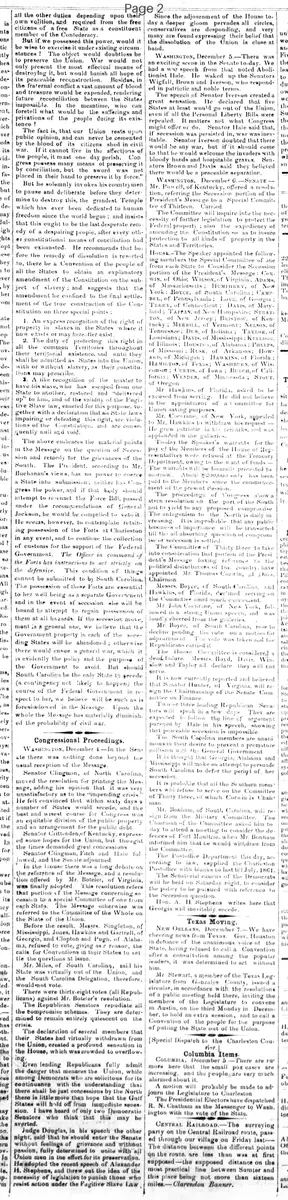
Washington, December 4.—In the Senate there was nothing done beyond the usual reception of the Message.
Senator Clingman, of North Carolina, moved the resolution for printing the Message, adding his opinion that it was very unsatisfactory as to the "impending crisis"
He felt convinced that within sixty days a number of States would secede, and the best and wisest course for Congress was an equitable division of the public property and an arrangement for the public debt.
Senator Crittenden, of Kentucky, expressed some hopes for the Union, but thought the times demanded great concessions
Senator Clingman, Fitch and Hale followed, and the Senate adjourned
In the House there was a long debate on the reference of the Message, and a resolution offered by Mr. Boteler, of Virginia, was finally adopted This resolution refers that portion of the Message concerning secession to a special Committee of one from each State. The Message otherwise was referred to the Committee of the Whole on the State of the Union,
Before the result, Messrs. Singleton, of Mississippi, Jones, Hawkins and Gartrell, of Georgia, and Clopton and Pugh. of Alabama, refused to vote, giving as reason, the call for Conventions in their States to settle the questions at issue.
Mr. Miles, of South Carolina, said his State was virtually out of the Union, and the South Carolina Delegation, therefore, would not vote.
There were thirty-eight votes (all Republicans) against Mr. Boteler's resolution.
The Republican Senators repudiate all the compromise schemes. They are determined to remain entirely quiescent on the crisis.
The declaration of several members that their States had virtually withdrawn from the Union, created a profound sensation in the House, which was crowded to overflowing.
Even leading Republicans fully admit the danger that menaces the Union, while among Democrats who are solicitous for its continuance with the understanding that there shall be just concessions by the North there is little more than hope that the Gulf States will hold off from immediate secession. I have heard of only two Democratic Senators who think that this may be averted.
Judge Douglas, in his speech the other night, said that he should enter the Senate without feelings of grievance and without passion, fully determined to unite with all Union men in the effort for its preservation.
He adopted the recent speech of Alexander H. Stephens, and threw out the idea of the necessity of legislation to punish those who resist action under the Fugitive Slave Law,
Since the adjournment of the House to-day a deeper gloom pervades all circles, conservatives are desponding, and very many are found expressing their belief that the dissolution of the Union is close at hand.
Washington, December 5.—There was an exciting scene in the Senate to-day. We had a war speech from that noted Abolitionist Hale. He waked up the Senators Wigfall, Brown and Iverson, who responded in patriotic and noble terms.
The speech of Senator Iverson created a great sensation. He declared that five States at least would go out of the Union, even if all the Personal Liberty Bills were repealed. It matters not what Congress might offer or do. Senator Hale said that, if secession was persisted in, war was inevitable. Senator Iverson doubted that there would be any war, but if it should come to that he would welcome the invaders with bloody hands and hospitable graves. Senators Brown and Davis said they believed there would be a peaceable separation.
Washington, December 6.—Senate—
Mr. Powell, of Kentucky, offered a resolution, referring the Secession portion of the President's Message to a Special Committee of Thirteen. Carried
The Committee will inquire into the necessity of further legislation to protect the Federal property; also the expediency of amending the Constitution so as to insure protection to all kinds of property in the States and Territories.
House.—The Speaker appointed the following members the Special Committee of one from each State to Consider the Secession portion of the President's Message: Corwin, of Ohio; Wilson, of Virginia; Adams, of Massachusetts; Humphrey, of New York; Boyce, of South Carolina; Campbell, of Pennsylvania; Love, of Georgia; Terry, of Connecticut; Davis, of Maryland; Tappan, of New Hampshire; Stratton, of New Jersey; Bristow, of Kentucky; Merrill, of Vermont; Nelson, of Tennessee; Dunn, of Indiana; Taylor, of Louisiana; Davis, of Mississippi; Kellogg, of Illinois; Houston, of Alabama; Phelps, of Missouri; Rusk, of Arkansas; Howard, of Michigan; Hawkins, of Florida; Hamilton, of Texas; Washburn, of Wisconsin; Curtis, of Iowa; Burch, of California; Windom, of Minnesota; Stout, of Oregon
Mr. Hawkins, of Florida, asked to be excused from serving. He did not believe in the appointment of a committee for Union saving purposes.
Mr. Cochrane, of New York, appealed to Mr. Hawkins to withdraw his request—
He grew patriotic in his remarks, and was applauded in the galleries.
To-day the Speaker's warrants for the pay of the Members of the House of Representatives were refused at the Treasury Department, owing to the want of funds—
The warrants will be formally protested to-morrow. About $200,000 only has been paid to the Members since the commencement of the present session.
The proceedings of Congress show a stern resolution on the part of the South not to yield to any proposed compromise
The antagonism to the North is daily increasing. It is improbable that any public business of importance will be transacted till the all absorbing question of compromise or secession is settled.
The Committee of Thirty three, to take into consideration that portion of the President's Message having reference to the political disturbances of the country, have appointed Mr. Thomas Corwin, temporary Chairman
Messrs. Boyce, of South Carolina, and Hawkins, of Florida, declined serving on the Committee amid much excitement.
Mr. John Cochrane, of New York, followed in a strong Union speech, and was loudly cheered from the galleries.
Mr. Boyce, of South Carolina, rose to decline pending the vote on a motion for adjournment The vote was taken and the Republicans carried it
The House Committee is considered a dead failure. Messrs. Boyd, Davis, Winston and Taylor all declare they will not serve.
It is now currently reported and believed that Senator Hunter, of Virginia, will resign the Chairmanship of the Senate Committee on Finance
Two or three leading Republican Senators will speak in a few days They are expected to follow the line of argument pursued by Hale in his speech, showing that peaceable secession is impossible
The South Carolina members are unanimous in their desire to prevent a premature collision with the General Government
It is thought that Georgia, Alabama and Mississippi will make an attempt to persuade South Carolina to defer the period of her secession
It is probable that all the Southern members will refuse to serve on the Committee of Thirty three, of which Corwin is Chairman
Mr. Bonham, of South Carolina, will resign from the Military Committee. The Chairman of the Committee asked him to-day to attend a meeting to consider the defences of Fort Moultrie, when Mr. Bonham informed him that he would withdraw from the Committee
The Post Office Department this day, according to law, supplied the Charleston Post Office with blanks to last till July, 1861.
The Senatorial caucus of the Democrats will be held on Saturday night, to consider the policy to be pursued with reference to the Secession question.
Hon. A. H. Stephens writes here that Georgia will inevitably secede.
What sub-type of article is it?
What keywords are associated?
What entities or persons were involved?
Where did it happen?
Domestic News Details
Primary Location
Washington
Event Date
December 4 6
Key Persons
Outcome
southern members refuse to vote or serve on committees; resolutions passed for special committees on secession; deepening gloom and belief in imminent union dissolution; pay warrants refused due to lack of funds.
Event Details
Senate receives President's Message, debates its inadequacy on crisis, with calls for property division and concessions; House debates reference of Message, adopts resolution for special committee on secession; exciting Senate speeches on war and separation; formation of Committee of Thirteen and Committee of Thirty-Three, with Southern refusals; reports of state secessions and resignations.