Thank you for visiting SNEWPapers!
Sign up free
United Automobile Worker
Detroit, Wayne County, Michigan
What is this article about?
In July 1945, parts companies object to George Romney's plans to extend the Automotive Council for War Production into postwar times under a new name, amid clashing interests with GM and resistance from associations like the Automotive and Aircraft Parts Manufacturers Association, while highlighting the council's anti-UAW role.
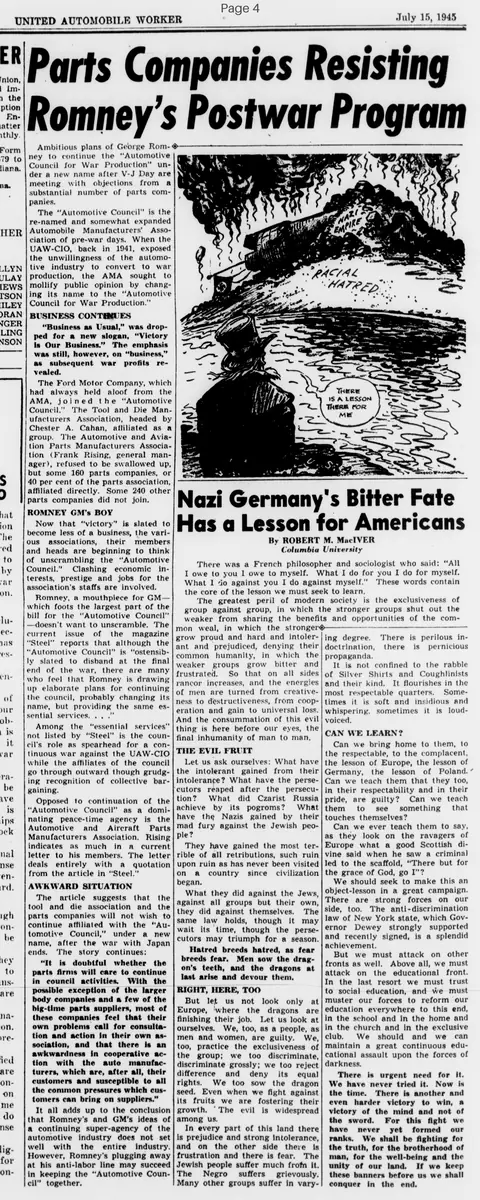
Merged-components note: Image overlaps spatially with the story bbox and is consecutive in reading order; likely illustrates the Automotive Council article.
Clipping
OCR Quality
Full Text
July 15, 1945
Parts Companies Resisting Romney's Postwar Program
Ambitious plans of George Romney to continue the "Automotive Council for War Production" under a new name after V-J Day are meeting with objections from a substantial number of parts companies.
The "Automotive Council" is the re-named and somewhat expanded Automobile Manufacturers' Association of pre-war days. When the UAW-CIO, back in 1941, exposed the unwillingness of the automotive industry to convert to war production, the AMA sought to mollify public opinion by changing its name to the "Automotive Council for War Production."
BUSINESS CONTINUES
"Business as Usual," was dropped for a new slogan, "Victory is Our Business."
The emphasis was still, however, on "business," as subsequent war profits revealed.
The Ford Motor Company, which had always held aloof from the AMA, joined the "Automotive Council." The Tool and Die Manufacturers Association, headed by Chester A. Cahan, affiliated as a group. The Automotive and Aviation Parts Manufacturers Association (Frank Rising, general manager), refused to be swallowed up, but some 160 parts companies, or 40 per cent of the parts association, affiliated directly. Some 240 other parts companies did not join.
ROMNEY GM's BOY
Now that "victory" is slated to become less of a business, the various associations, their members and heads are beginning to think of unscrambling the "Automotive Council."
Clashing economic interests, prestige and jobs for the association's staffs are involved.
Romney, a mouthpiece for GM which foots the largest part of the bill for the "Automotive Council" -- doesn't want to unscramble.
The current issue of the magazine "Steel" reports that although the "Automotive Council" is ostensibly slated to disband at the final end of the war, there are many who feel that Romney is drawing up elaborate plans for continuing the council, probably changing its name, but providing the same essential services.
Among the "essential services" not listed by "Steel" is the council's role as spearhead for a continuous war against the UAW-CIO while the affiliates of the council go through outward though grudging recognition of collective bargaining.
Opposed to continuation of the "Automotive Council" as a dominating peace-time agency is the Automotive and Aircraft Parts Manufacturers Association. Rising indicates as much in a current letter to his members. The letter deals entirely with a quotation from the article in "Steel."
AWKWARD SITUATION
The article suggests that the tool and die association and the parts companies will not wish to continue affiliated with the "Automotive Council," under a new name, after the war with Japan ends.
The story continues:
"It is doubtful whether the parts firms will care to continue in council activities. With the possible exception of the larger body companies and a few of the big-time parts suppliers, most of these companies feel that their own problems call for consultation and action in their own association, and that there is an awkwardness in cooperative action with the auto manufacturers, which are, after all, their customers and susceptible to all the common pressures which customers can bring on suppliers."
It all adds up to the conclusion that Romney's and GM's ideas of a continuing super-agency of the automotive industry does not set well with the entire industry.
However, Romney's plugging away at his anti-labor line may succeed in keeping the "Automotive Council" together.
What sub-type of article is it?
What themes does it cover?
What keywords are associated?
What entities or persons were involved?
Story Details
Key Persons
Event Date
1945
Story Details
Parts companies resist George Romney's plans to continue the Automotive Council for War Production postwar, amid clashing interests with GM and anti-UAW activities, as reported in Steel magazine.