Thank you for visiting SNEWPapers!
Sign up free
Staunton Spectator, And General Advertiser
Staunton, Virginia
What is this article about?
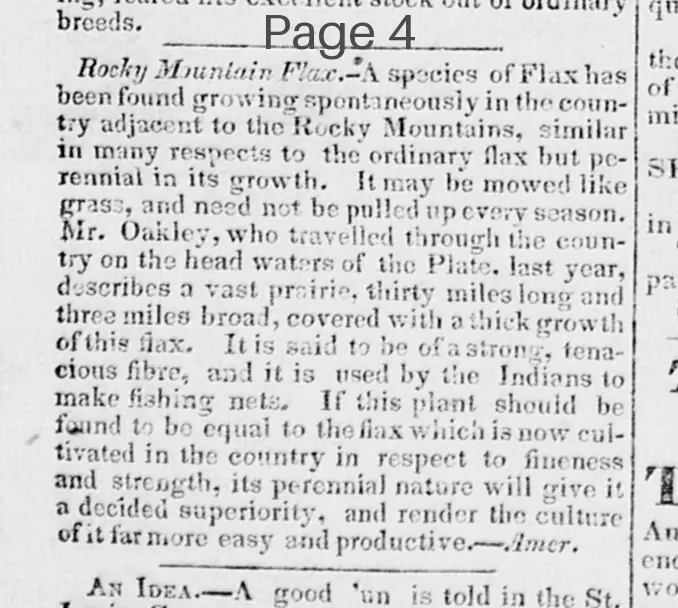
A perennial species of flax, similar to ordinary flax, found growing spontaneously near the Rocky Mountains on the head waters of the Platte. Described by Mr. Oakley as covering a vast prairie; used by Indians for fishing nets; potential superiority for cultivation if equal in quality.
Clipping
OCR Quality
Full Text
What sub-type of article is it?
What keywords are associated?
What entities or persons were involved?
Where did it happen?
Domestic News Details
Primary Location
Country Adjacent To The Rocky Mountains, Head Waters Of The Platte
Event Date
Last Year
Key Persons
Event Details
A species of Flax has been found growing spontaneously in the country adjacent to the Rocky Mountains, similar in many respects to the ordinary flax but perennial in its growth. It may be mowed like grass, and need not be pulled up every season. Mr. Oakley, who travelled through the country on the head waters of the Platte, last year, describes a vast prairie, thirty miles long and three miles broad, covered with a thick growth of this flax. It is said to be of a strong, tenacious fibre, and it is used by the Indians to make fishing nets. If this plant should be found to be equal to the flax which is now cultivated in the country in respect to fineness and strength, its perennial nature will give it a decided superiority, and render the culture of it far more easy and productive.