Thank you for visiting SNEWPapers!
Sign up free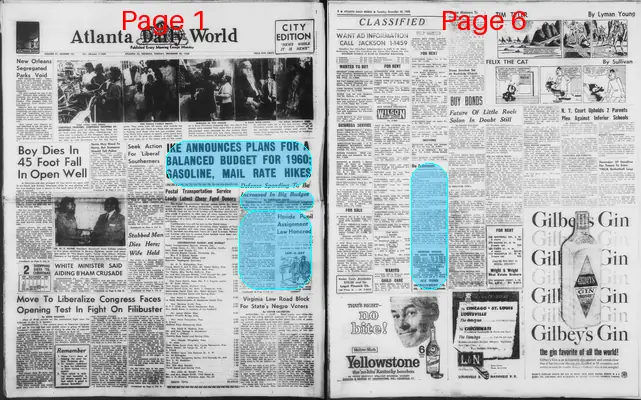
Atlanta Daily World
Atlanta, Fulton County, Georgia
What is this article about?
President Eisenhower announced a balanced 1960 budget of $77 billion, with increased defense spending, higher gasoline and postal rates, but no general tax hike, challenging Congress to avoid new spending programs.
Merged-components note: Merged headline, initial body, and continuation across pages of Eisenhower budget story.
Clippings
1 of 2
OCR Quality
Full Text
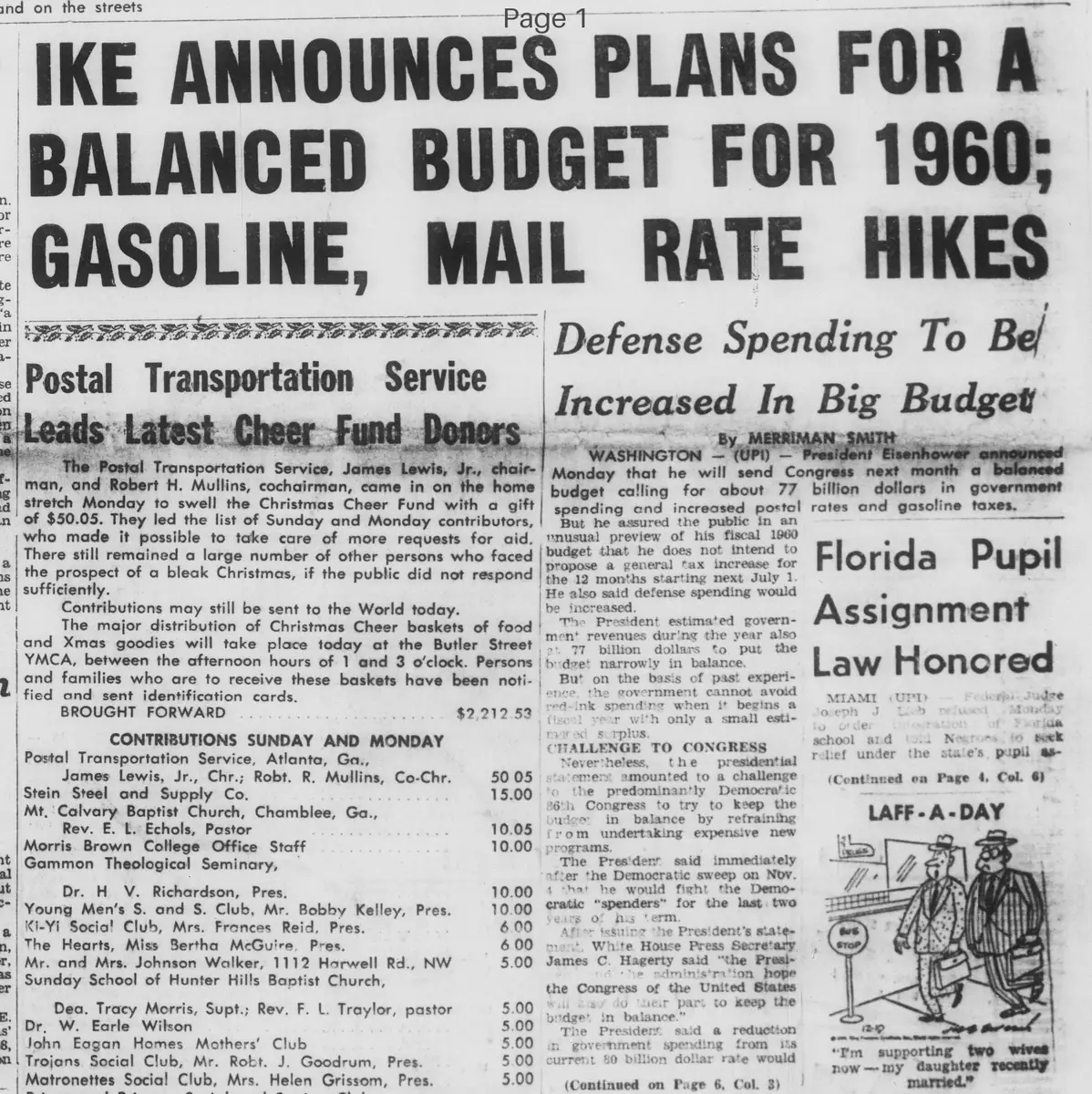
GASOLINE MAIL RATE HIKES
Defense Spending To Be Increased
Increased In Big Budget
By MERRIMAN SMITH
WASHINGTON - (UPI) - President Eisenhower announced Monday that he will send Congress next month a balanced budget calling for about 77 billion dollars in government spending and increased postal rates and gasoline taxes.
But he assured the public in an unusual preview of his fiscal 1960 budget that he does not intend to propose a general tax increase for the 12 months starting next July 1.
He also said defense spending would be increased.
The President estimated government revenues during the year also at 77 billion dollars to put the budget narrowly in balance.
But on the basis of past experience the government cannot avoid red-ink spending when it begins a fiscal year with only a small estimated surplus.
CHALLENGE TO CONGRESS
Nevertheless, the presidential statement amounted to a challenge to the predominantly Democratic 86th Congress to try to keep the budget in balance by refraining from undertaking expensive new programs.
The President said immediately after the Democratic sweep on Nov. 4 that he would fight the Democratic "spenders" for the last two years of his term.
After issuing the President's statement, White House Press Secretary James C. Hagerty said "the President's administration hopes the Congress of the United States will do her part to keep the budget in balance."
The President said a reduction in government spending from its current 80 billion dollar rate would (Continued on Page 6, Col. 3)
Ike Announces (Continued from Page One)
be achieved in part by the "ending of temporary programs in agriculture, unemployment insurance, and housing."
GAS GOING UP Despite the overall cut in government spending, the President said, "the budget will provide higher expenditures than ever before in time of peace for national defense." Defense spending has been running this year at a slightly less than 41 billion dollar rate.
The President did not go into details of his contemplated proposals for higher postal rates and increased gasoline taxes.
However, Treasury sources said last Saturday that the President would propose that the federal gasoline tax be increased from its present three cents a gallon to 4½ cents.
The added revenue, estimated at between $50 and $90 million dollars, would not be included in any estimate of federal revenues. It would be earmarked for the 41,000-mile federal highway system.
Republican leaders also said after a recent White House conference that the President was thinking of renewing his proposal for an increase in letter mailing rates from its current 4 cents to 5 cents an ounce.
DECEMBER SPECIALS ON HOME REMODELING ROOM low as $595.00 PORCH ENCL. low as $495.00 ROOFS (20-yrs.) low as $195.00 LOW PRICES ON ANY OTHER REPAIRS - REMODELING UNDERPINNING - SIDING AND PLUMBING FREE ESTIMATES NO DOWN PAYMENT FIRST PAYMENT 120 DAYS PAY AS LOW AS $1 A WEEK ACE HOME IMPROVEMENT CO. JA. 3-7718-Anytime
What sub-type of article is it?
What keywords are associated?
What entities or persons were involved?
Where did it happen?
Domestic News Details
Primary Location
Washington
Event Date
Monday, After Nov. 4
Key Persons
Outcome
balanced budget of 77 billion dollars in spending and revenues; increased defense spending; proposed increases in gasoline tax to 4½ cents per gallon and postal rates to 5 cents per ounce; no general tax increase proposed.
Event Details
President Eisenhower announced a balanced fiscal 1960 budget with 77 billion dollars in spending and revenues, increased defense spending, higher postal rates, and increased gasoline taxes, without a general tax increase. He challenged Congress to maintain balance by avoiding new programs. Reductions achieved by ending temporary programs in agriculture, unemployment insurance, and housing.