Thank you for visiting SNEWPapers!
Sign up free
Literary
October 14, 1831
Wilmington Expositor
Wilmington, New Castle County, Delaware
What is this article about?
An essay on self-respect, emphasizing that personal conscience and dignity should guide actions more than fear of public opinion, illustrated by a quote from Cassius in Shakespeare's Julius Caesar.
Clipping
OCR Quality
98%
Excellent
Full Text
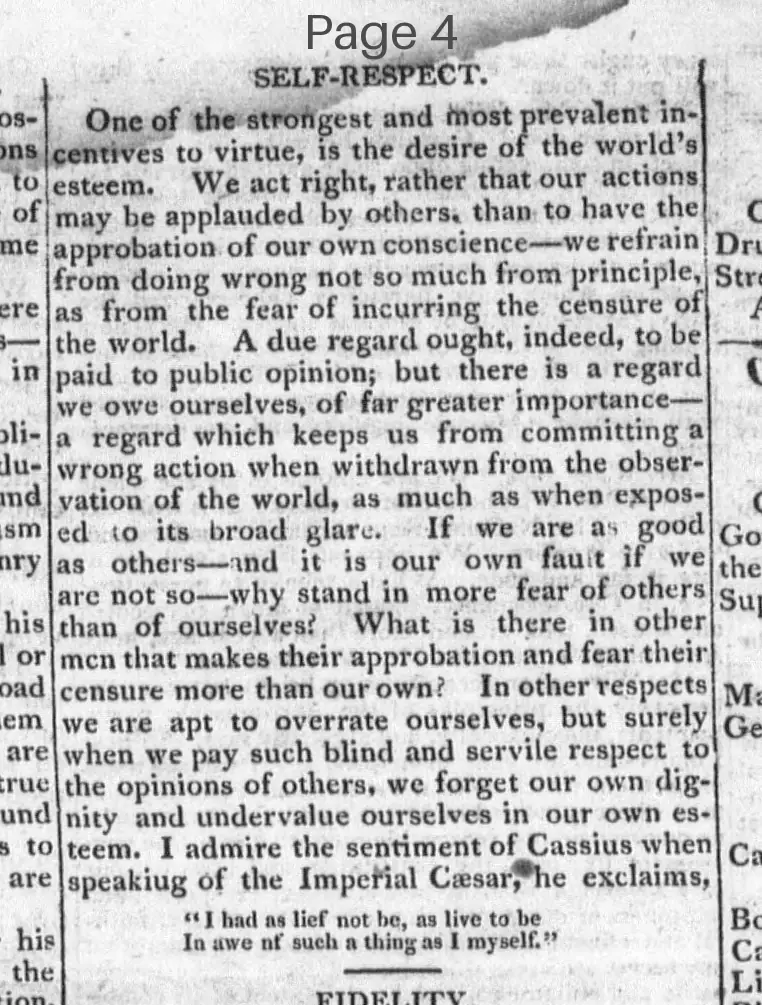
SELF-RESPECT.
One of the strongest and most prevalent incentives to virtue, is the desire of the world's esteem. We act right, rather that our actions may be applauded by others, than to have the approbation of our own conscience—we refrain from doing wrong not so much from principle, as from the fear of incurring the censure of the world. A due regard ought, indeed, to be paid to public opinion; but there is a regard we owe ourselves, of far greater importance—a regard which keeps us from committing a wrong action when withdrawn from the observation of the world, as much as when exposed to its broad glare. If we are as good as others—and it is our own fault if we are not so—why stand in more fear of others than of ourselves? What is there in other men that makes their approbation and fear their censure more than our own? In other respects we are apt to overrate ourselves, but surely when we pay such blind and servile respect to the opinions of others, we forget our own dignity and undervalue ourselves in our own esteem. I admire the sentiment of Cassius when speaking of the Imperial Caesar, he exclaims,
" I had as lief not be, as live to be
In awe of such a thing as I myself."
One of the strongest and most prevalent incentives to virtue, is the desire of the world's esteem. We act right, rather that our actions may be applauded by others, than to have the approbation of our own conscience—we refrain from doing wrong not so much from principle, as from the fear of incurring the censure of the world. A due regard ought, indeed, to be paid to public opinion; but there is a regard we owe ourselves, of far greater importance—a regard which keeps us from committing a wrong action when withdrawn from the observation of the world, as much as when exposed to its broad glare. If we are as good as others—and it is our own fault if we are not so—why stand in more fear of others than of ourselves? What is there in other men that makes their approbation and fear their censure more than our own? In other respects we are apt to overrate ourselves, but surely when we pay such blind and servile respect to the opinions of others, we forget our own dignity and undervalue ourselves in our own esteem. I admire the sentiment of Cassius when speaking of the Imperial Caesar, he exclaims,
" I had as lief not be, as live to be
In awe of such a thing as I myself."
What sub-type of article is it?
Essay
What themes does it cover?
Moral Virtue
Liberty Freedom
What keywords are associated?
Self Respect
Virtue
Public Opinion
Conscience
Dignity
Literary Details
Title
Self Respect.
Key Lines
" I Had As Lief Not Be, As Live To Be
In Awe Of Such A Thing As I Myself."
One Of The Strongest And Most Prevalent Incentives To Virtue, Is The Desire Of The World's Esteem.