Thank you for visiting SNEWPapers!
Sign up free
Lynchburg Virginian
Lynchburg, Virginia
What is this article about?
A Whig committee in Virginia defends William Henry Harrison against Democratic accusations of Federalism and Abolitionism, challenging specific claims from an address in the Enquirer, demanding publication of evidence, and refuting charges with historical context and references to figures like Jefferson and Monroe.
Clipping
OCR Quality
Full Text
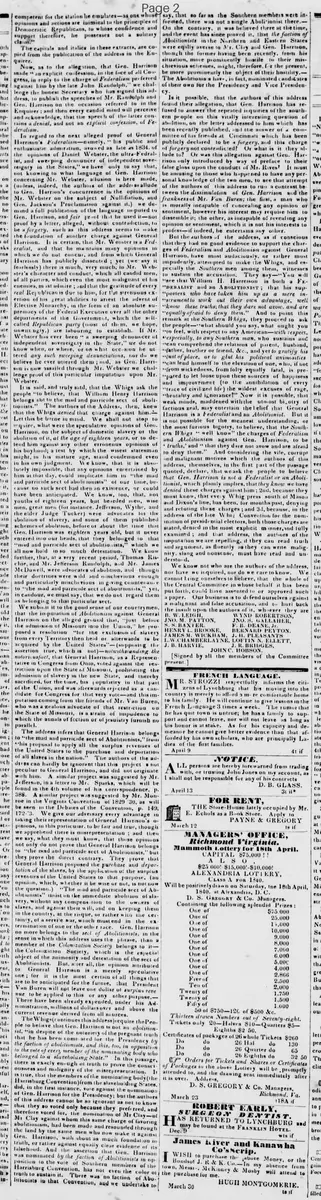
Now, as to the allegation, that Gen. Harrison made "an explicit confession, in the face of all Congress, in reply to the charge of Federalism preferred against him by the late John Randolph," we challenge the honest Secretary who has signed this address, to publish the speeches of Mr. Randolph and Gen. Harrison on the occasion referred to in the Enquirer; and then every candid mind will perceive and acknowledge, that the speech of the latter contains a denial, and not an explicit confession, of Federalism.
In regard to the next alleged proof of General Harrison's Federalism—namely, "his public and enthusiastic admiration, avowed as late as 1834, of the opinions of Daniel Webster, the ultra-Federalist, and sweeping denouncer of independent sovereignty in the States," we have only to say that, not knowing to what language of Gen. Harrison concerning Mr. Webster, allusion is here made, (unless, indeed, the authors of the address allude to Gen. Harrison's concurrence in the opinions of Mr. Webster on the subject of Nullification, and Gen. Jackson's Proclamation against it,) we demand a full publication of the language imputed to Gen. Harrison, and fair proof that he used it—not proof by a letter, alleged, without contradiction, to be a forgery, such as this address seems to make the foundation of another charge against General Harrison. It is certain, that Mr. Webster is a Federalist, and that he maintains many opinions in which we do not concur, and from which General Harrison has publicly dissented; yet (we say it fearlessly) there is much, very much, in Mr. Webster's character and conduct, which all candid men, of all parties, which even the most malignant of his enemies, must admire; and that the gratitude of every real Republican is due to him, for the strenuous exertion of his great abilities to arrest the advent of Elective Monarchy, in the form of an absolute supremacy of the Federal Executive over all the other departments of the Government, which the self-called Republican party (most of them, we hope, unwittingly,) are labouring to establish. If Mr. Webster has ever been "a sweeping denouncer of independent sovereignty in the State," we do not know when, or where, or on what occasion he uttered any such sweeping denunciations, nor do we believe he ever uttered them; and, as Gen. Harrison is now assailed through Mr. Webster we challenge proof of this particular imputation upon Mr. Webster.
It is said, and truly said, that the Whigs ask the people "to believe, that William Henry Harrison belongs not to the mad and parricide sect of abolitionists." The authors of the Address, then, knew that the Whigs denied that charge against him. Let this be borne in mind. We shall not stop to enquire, what were the speculative opinions of Gen. Harrison, on the subject of domestic slavery or the abolition of it, at the age of eighteen years, or to defend him against any other erroneous opinions of his boyhood; a test by which the wisest statesman might, in his mature age, stand condemned even in his own judgment. We know, that it is absolutely impossible, that any opinions entertained by him at that day, could implicate him in "the mad and parricide sect of abolitionists" of our time, because no such sect had then an existence, or could have been anticipated. We know, too, that, not youths of eighteen years, but bearded men, wise men, great men (for instance, Jefferson, Wythe, and the elder Judge Tucker) were advocates for the abolition of slavery, and some of them published schemes of abolition, before or about the time that Gen. Harrison was eighteen years old, but it never entered into our heads, that they belonged to that "mad and parricide sect of abolitionists," which we all now hold in so much detestation. We know further, that, at a very recent period, Thomas Ritchie, and Mr. Jefferson Randolph, and Mr. James McDowell, were advocates of abolition, and though their doctrines were wild and mischievous enough and particularly mischievous in giving countenance to "the mad and parricide sect of abolitionists," yet, in candour, we must say, that we do not regard them as belonging to that particular sect.
We submit to the good sense of our countrymen, that the imputation of Abolitionism against General Harrison on the alleged ground that, "just before the admission of Missouri into the Union," he penned a resolution "for the exclusion of slavery from every Territory then held or afterwards to be acquired by the United States"—(supposing the assertion true, which it is not)—notwithstanding the notorious fact, that General Harrison, as a Representative in Congress from Ohio, voted against the restriction upon the State of Missouri, prohibiting the admission of slavery in the new State, and thereby sacrificed, for the time, his popularity in that part of the Union, and was afterwards rejected as a candidate for Congress for that very vote—and this imputation coming from the friends of Mr. Van Buren, who was a zealous advocate of that restriction on the State of Missouri, is a strain of impudence to which the annals of faction or of jesuitry furnish no parallel.
The address infers that General Harrison belongs to "the mad and parricide sect of Abolitionists," from "his proposal to apply all the surplus revenues of the United States to the purchase and deportation of all slaves in the nation." The authors of the address can hardly be ignorant that this project is not peculiar to General Harrison, and did not originate with him. A similar project was suggested by Mr. Jefferson, in a letter to Mr. Sparks, which will be found in the 4th volume of his correspondence, p. 385. A similar project was suggested by Mr. Monroe in the Virginia Convention of 1829-'30, as will be seen in the Debates of the Convention, p. 149, 172-'3. We give our adversaries every advantage in taking their representation of General Harrison's opinions, in this particular, to be fair and true, though we apprehend there is misrepresentation; and then we say, what they must know, that those opinions not only do not prove that General Harrison belongs to "the mad and parricide sect of Abolitionists," but they prove the direct contrary. They prove that General Harrison proposed the purchase and deportation of the slaves, by the application of the surplus revenues of the United States to that purpose, (an opinion, which, whether it be wise or not, is not now the question.) "The mad and parricide sect of Abolitionists" insist on the immediate abolition of slavery, without any compensation to the owners of slaves, and against their will, and on keeping them in the country, at the risque, or rather with the certainty, of a servile war, which must end in the extermination of one or the other race. Gen. Harrison no more belongs to the sect of Abolitionists, in the sense in which this address uses the phrase, than a member of the Colonization Society belongs to it—the Colonization Society, which is the especial object of the animosity and detestation of the sect of Abolitionists. But, after all, the opinion attributed to General Harrison is a merely speculative one; for it is the most certain of all things that are to be anticipated for the future, that President Van Buren will not leave one dollar of surplus revenue to be applied to this or any other purpose. There have been already expended, under his Administration, millions of dollars over and above the current revenue derived from all sources.
The Whigs (continues this address) require the People to believe that Gen. Harrison is not an abolitionist, "in despite of the notoriety of the pregnant truth that he has been nominated for the Presidency by the faction of abolitionists, and this, too, in opposition to the vote of every member of the nominating body who belonged to a slaveholding State." In this passage, there is exactly enough of truth to prove the consciousness and malignity of the misrepresentation. It is true, that the members of the nominating body (the Harrisburg Convention) from the slaveholding States, did, in the first instance, vote against the nomination of Gen. Harrison for the Presidency; but the authors of this address cannot be so ignorant as not to know that they so voted only because they preferred, and therefore voted for, the nomination of Mr. Clay—of Mr. Clay against whom this same charge of favoring abolitionism, had been made and resounded through the land by the same men who now make it against Gen. Harrison, with about as much foundation in truth, or rather against equally clear evidence of its falsehood. And the assertion that Gen. Harrison was nominated by the faction of Abolitionists in opposition to the vote of Southern members of the Harrisburg Convention, has not even the color of truth to sustain it. There was no faction of Abolitionists in that Convention, and we undertake to say, that so far as the Southern members were informed, there was not a single Abolitionist there. On the contrary, It was believed there at the time, and the event has since proved it, that the faction of Abolitionists in the Northern and Eastern States were equally averse to Mr. Clay and Gen. Harrison, though the former having been recently, from his situation, more prominently hostile to their mischievous schemes, might, therefore, for the present, be more prominently the object of their hostility. The Abolitionists have, in fact, nominated candidates of their own for the Presidency and Vice Presidency.
Is it possible, that the authors of this address found their allegation, that Gen. Harrison has refused to answer the repeated inquiries of the southern people on this vitally interesting question of abolition, on the letter addressed to him which has been recently published, and the answer of a committee of his friends at Cincinnati which has been publicly declared to be a forgery, and this charge of forgery not contradicted? Or what is it they allude to? "Or was this allegation against Gen. Harrison only introduced by way of preface to their false gloss upon the conduct of Mr. Rives? It must be amusing to those who happened to have any personal knowledge of the two men, to see that attempt of the authors of this address to run a contrast between the dissimulation of Gen. Harrison and the frankness of Mr. Van Buren; the first, a man who is morally incapable of concealing any opinion or sentiment, however his interest may require him to dissemble it; the other, as incapable of revealing any opinion or sentiment, which it is not his interest to profess—if indeed, he entertains any other.
But the authors of the address, as if conscious that they had no good evidence to support the charges of Federalism and Abolitionism against General Harrison, have most audaciously, or rather most impudently, attempted to make the Whigs, and especially the Southern men among them, witnesses to sustain the accusation. They say—"You will see that William H. Harrison is both a FEDERALIST and an ABOLITIONIST; that his supporters who have taken him up as a mere instrument to work out their own advantage, well know these truths; that they dare not avow, and are equally afraid to deny them." And to point this remark at the Southern Whigs, they proceed to ask the people—"what should you say, what ought you to feel, with respect to any American—with respect, especially, to any Southern man, who sustains and can comprehend the relations of parent, husband, father, brother or friend, &c., and yet to gratify his lust of place, or to glut his political animosities can lend himself to the elevation of one, who, if not from wickedness, from folly equally fatal, is prepared to let loose upon these sources of happiness and improvement (to the annihilation of every trace of civilized life) the wildest excesses of rage, brutality and ignorance?" Now it is possible, that weak minds, maddened with the utmost bigotry of factious zeal, may entertain the belief that General Harrison is a Federalist and an Abolitionist. But it is not possible for the meanest understanding, or the most furious bigotry, to believe, that the Southern Whigs "well know" the charges of Federalism and Abolitionism against Gen. Harrison, to be truths,' and "that they dare not avow and are afraid to deny them." And considering the vile, corrupt and malignant motives which the authors of this address, themselves, in the first part of the passage quoted, declare, that we ask the people to believe that Gen. Harrison is not a Federalist or an Abolitionist, which plainly implies, that they know we have denied these charges against him; 2nd, because they must know, that every Whig press south of Mason and Dixon's line, has been, for months past, denying and refuting these charges; and 3d, because, in the address of the late Whig Convention for the nomination of presidential electors, both those charges are stated, denied in the most explicit manner, and fully examined; and that address, the authors of the imputation we are repelling, if they can read truth and argument, as fluently as they can write malignity, slang and nonsense, must have read and understood.
We know not who are the authors of the address, nor have we inquired, nor do we care to know. We cannot bring ourselves to believe, that the whole of the Central Committee in whose behalf it has been put forth, could have assented to or approved such a paper. Our business is to defend ourselves against a malignant and false accusation, and to hurl back the insult upon the authors of it, whoever they are
B. W. LEIGH
WYND ROBERTSON,
JNO. M. PATTON
JNO. S. GALLAHER,
S. S. BAXTER
E. B. DEANE, Jr.
HENRY L. BROOKE
BERNARD PEYTON
JAMES M. WICKHAM. J. H. PLEASANTS
L. W. CHAMBERLAYNE, LOFTIN N. ELLETT,
J. B. HARVIE,
J. R. BRIDGES,
JOHN C. HOBSON.
[Signed by all the members of the Committee present.]
What sub-type of article is it?
What themes does it cover?
What keywords are associated?
What entities or persons were involved?
Letter to Editor Details
Author
B. W. Leigh, Wynd Robertson, Jno. M. Patton, Jno. S. Gallaher, S. S. Baxter, E. B. Deane, Jr., Henry L. Brooke, Bernard Peyton, James M. Wickham, J. H. Pleasants, L. W. Chamberlayne, Loftin N. Ellett, J. B. Harvie, J. R. Bridges, John C. Hobson (Whig Committee Members)
Main Argument
william henry harrison is neither a federalist nor an abolitionist; the accusations in the democratic address are false and malicious, lacking evidence, and the whigs demand proof while refuting each claim with historical facts and context.
Notable Details