Thank you for visiting SNEWPapers!
Sign up free
Daily National Intelligencer
Washington, District Of Columbia
What is this article about?
Historical commentary on Napoleon Bonaparte's rise, his coronation by Pope Pius VII, alliances with European monarchs like Prussia, Russia, and Austria, and resistance from Sweden's King Gustaf Adolph, portraying him as a usurper initially embraced by potentates to suppress republicanism.
Clipping
OCR Quality
Full Text
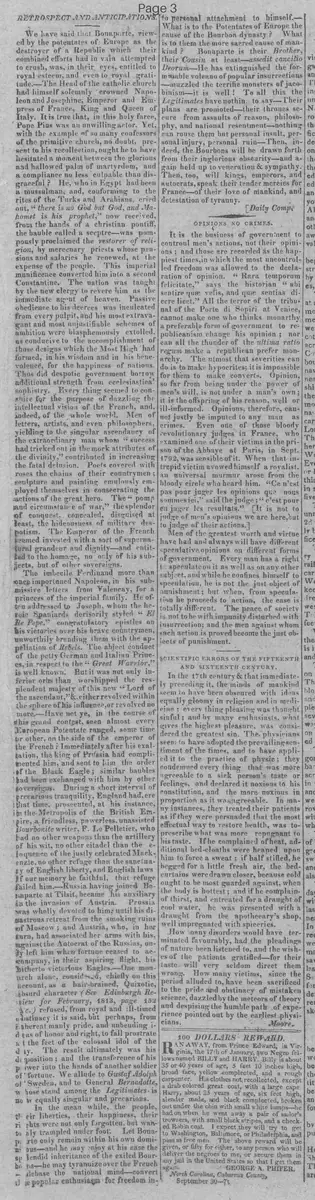
We have said that Bonaparte, viewed by the potentates of Europe as the destroyer of a Republic which their combined efforts had in vain attempted to crush, was, in their eyes, entitled to royal esteem, and even to royal gratitude. The Head of the catholic church had himself solemnly crowned Napoleon and Josephine; Emperor and Empress of France, King and Queen of Italy. It is true that, in this holy farce, Pope Pius was an unwilling actor. Yet, with the example of so many confessors of the primitive church, no doubt, present to his recollection, ought he to have hesitated a moment between the glorious and hallowed palm of martyrdom, and a compliance no less culpable than disgraceful? He, who in Egypt had been a mussulman, and, conforming to the rites of the Turks and Arabians, cried out, "there is no God but God, and Mahomet is his prophet," now received, from the hands of a christian pontiff, the bauble called a sceptre—was pompously proclaimed the restorer of religion, by mercenary priests whose pensions and salaries he renewed, at the expense of the people. This imperial munificence converted him into a second Constantine. The nation was taught by the new clergy to revere him as the immediate agent of heaven. Passive obedience to his decrees was inculcated from every pulpit, and his most extravagant and most unjustifiable schemes of ambition were blasphemously extolled, as conducive to the accomplishment of those designs which the Most High had formed, in his wisdom and in his benevolence, for the happiness of nations. Thus did despotic government borrow additional strength from ecclesiastical sophistry. Every thing seemed to conspire for the purpose of dazzling the intellectual vision of the French, and, indeed, of the whole world. Men of letters, artists, and even philosophers, yielding to the singular ascendancy of the extraordinary man whom "success had tricked out in the mock attributes of the divinity," contributed in increasing the fatal delusion. Poets covered with roses the chains of their countrymen; sculpture and painting emulously employed themselves in consecrating the actions of the great hero. The "pomp and circumstance of war," the splendor of conquest, concealed, disguised at least, the hideousness of military despotism. The Emperor of the French seemed invested with a sort of supernatural grandeur and dignity—and entitled to the homage, not only of his subjects, but, of other sovereigns. The imbecile Ferdinand more than once importuned Napoleon, in his submissive letters from Valencay, for a princess of the imperial family. He often addressed to Joseph, whom the heroic Spaniards derisorily styled "El Re Pepe," congratulatory epistles on his victories over his brave countrymen, unworthily branding them with the appellation of Rebels. The abject conduct of the petty German and Italian Princes, in respect to the "Great Warrior," is well known. But it was not only inferior orbs that worshipped the resplendent majesty of this new "Lord of the ascendant," & either revolved within the sphere of his influence, or revolved no more. Have not ye, in the course of this grand contest, seen almost every European Potentate ranged, some time or other, on the side of the emperor of the French? Immediately after his exaltation, the king of Prussia had complimented him, and sent to him the order of the Black Eagle; similar baubles had been exchanged with him by other sovereigns. During a short interval of precarious tranquility, England had, ere that time, prosecuted, at his instance, in the Metropolis of the British Empire, a friendless, powerless, unassisted Bourbonite writer, F. Le Pelletier, who had no other weapons than the artillery of his wit, no other citadel than the eloquence of the justly celebrated Mackenzie, no other refuge than the sanctuary of English liberty, and English laws; if our memory be faithful, that refuge failed him. Russia having joined Bonaparte at Tilsit, became his auxiliary in the invasion of Austria. Prussia was wholly devoted to him; until his disastrous retreat from the smoking ruins of Moscow; and Austria, who, in her turn, had associated her arms with his, against the Autocrat of the Russias, only left him when fortune ceased to accompany, in their aspiring flight, his hitherto victorious Eagles. One monarch alone, considered, chiefly on this account, as a hair-brained, Quixotic, absurd character (See Edinburgh Review for February, 1813, page 152) refused, from royal and ill-timed obstinacy it is said, but perhaps, from coherent manly pride, and unbending ideas of honor and right, to fall prostrate at the feet of the colossal idol of the day. The result ultimately was his deposition; and the transference of his power into the hands of another soldier of fortune. We allude to Gustaf Adolph of Sweden, and to General Bernadotte, whose stand among the Legitimates is now equally singular and precarious. In the mean while, the people, their liberties, their happiness, their rights were not only forgotten, but wantonly trampled under foot: Let Bonaparte only remain within his own dominions—and he may enjoy at his ease the splendid inheritance of the exiled Bourbons—he may tyrannize over the French, debase the national mind—convert the popular enthusiasm for freedom into personal attachment to himself. What is to the Potentates of Europe the cause of the Bourbon dynasty & What is to them the more sacred cause of mankind? Bonaparte is their Brother their Cousin at least—asdedit cancitio Deorum—He has extinguished the formidable volcano of popular insurrections—muzzled the terrific monsters of jacobinism—it is well! To all this the Legitimates have nothing to say. Their plans are promoted—their thrones secure from assaults of reason, philosophy, and national resentment—nothing can rouse them but personal insult, personal injury, personal ruin—Then, indeed, the Bourbons will be drawn forth from their inglorious obscurity—and again held up to veneration & sympathy. Then, too, will kings, emperors, and autocrats, speak their tender mercies for France—of their love of mankind, and detestation of tyranny.
[Daily Companion]
What sub-type of article is it?
What keywords are associated?
What entities or persons were involved?
Where did it happen?
Foreign News Details
Primary Location
Europe
Key Persons
Outcome
deposition of gustaf adolph of sweden; shifting alliances among european powers leading to napoleon's eventual isolation.
Event Details
Retrospective on Napoleon's rise, coronation by unwilling Pope Pius, embrace by European monarchs as suppressor of republicanism, including Prussia's order of the Black Eagle, Russia's alliance at Tilsit, Austria's participation against Russia, and Spain's Ferdinand's submissions; contrasted with Sweden's resistance resulting in deposition and Bernadotte's rise; critique of potentates prioritizing thrones over liberty.