Thank you for visiting SNEWPapers!
Sign up free
Norfolk Gazette And Publick Ledger
Norfolk, Virginia
What is this article about?
In Kentucky federal court, U.S. Attorney J.H. Davies moves against Aaron Burr for high misdemeanors, alleging preparations for a military expedition against Spanish Mexico. Court overrules but summons grand jury. Gen. Eaton details Burr's plot to revolutionize the West, separate from the Union, and conquer Mexico.
Merged-components note: Continuous narrative articles detailing the legal proceedings and details of Aaron Burr's alleged treason.
Clipping
OCR Quality
Full Text
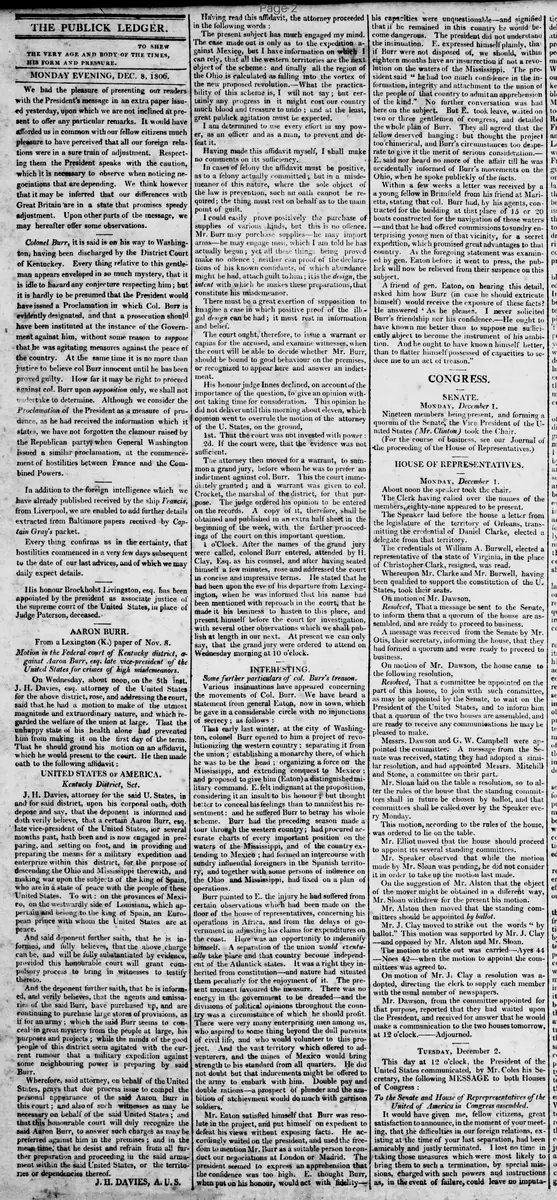
From a Lexington (K.) paper of Nov. 8.
Motion in the Federal court of Kentucky district, against Aaron Burr, Esq. late vice-president of the United States for crimes of high misdemeanors.
On Wednesday, about noon, on the 5th inst. J. H. Davies, Esq. attorney of the United States for the above district, rose, and addressing the court, said that he had a motion to make of the utmost magnitude and extraordinary nature, and which regarded the welfare of the union at large. That the unhappy state of his health alone had prevented him from making it on the first day of the term. That he should ground his motion on an affidavit, which he would present to the court. He then made oath to the following affidavit:
UNITED STATES OF AMERICA.
Kentucky District, Sct.
J. H. Davies, attorney for the said U. States, in and for said district, upon his corporal oath, doth depose and say, that the deponent is informed and doth verily believe, that a certain Aaron Burr, Esq. late vice-president of the United States, for several months past, hath been and is now engaged in preparing, and setting on foot, and in providing and preparing the means for a military expedition and enterprize within this district, for the purpose of descending the Ohio and Mississippi therewith, and making war upon the subjects of the king of Spain, who are in a state of peace with the people of these United States. To wit: on the provinces of Mexico, on the westwardly side of Louisiana, which appertain and belong to the king of Spain, an European prince with whom the United States are at peace.
And said deponent further saith, that he is informed, and fully believes, that the above charge can be, and will be fully substantiated by evidence, provided this honourable court will grant compulsory process to bring in witnesses to testify thereto.
And the deponent further saith, that he is informed, and verily believes, that the agents and emissaries of the said Burr, have purchased up, and are continuing to purchase large stores of provisions, as if for an army; which the said Burr seems to conceal in great mystery from the people at large, his purposes and projects; while the minds of the good people of this district seem agitated with the current rumour that a military expedition against some neighbouring power is preparing by said Burr.
Wherefore, said attorney, on behalf of the United States, prays that due process issue to compel the personal appearance of the said Aaron Burr in this court; and also of such witnesses as may be necessary on behalf of the said United States; and that this honourable court will duly recognize the said Aaron Burr, to answer such charges as may be preferred against him in the premises; and in the mean time, that he desist and refrain from all further preparation and proceeding in the said armament within the said United States, or the territories or dependencies thereof.
J. H. DAVIES, A. U.S.
Having read this affidavit, the attorney proceeded in the following words:
The present subject has much engaged my mind. The case made out is only as to the expedition against Mexico; but I have information on which I can rely, that all the western territories are the next object of the scheme: and finally all the region of the Ohio is calculated as falling into the vortex of the new proposed revolution.--What the practicability of this scheme is, I will not say; but certainly any progress in it might cost our country much blood and treasure to undo; and at the least, great publick agitation must be expected.
I am determined to use every effort in my power, as an officer and as a man, to prevent and defeat it.
Having made this affidavit myself, I shall make no comments on its sufficiency. In cases of felony the affidavit must be positive, as to a felony actually committed; but in a misdemeanor of this nature, where the sole object of the law is prevention, such an oath cannot be required; the thing must rest on belief as to the main point of guilt.
I could easily prove positively the purchase of supplies of various kinds, but this is no offence. Mr. Burr may purchase supplies--he may import arms--he may engage men, which I am told he has actually begun; yet all these things being proved make no offence; neither can proof of the declarations of his known confidants, of which abundance might be had, attach guilt to him; it is the design, the intent with which he makes these preparations, that constitute his misdemeanor.
There must be a great exertion of supposition to imagine a case in which positive proof of the illegal design can be had; it must rest in information and belief.
The court ought, therefore, to issue a warrant or capias for the accused, and examine witnesses, when the court will be able to decide whether Mr. Burr, should be bound to good behaviour on the premises, or recognized to appear here and answer an indictment.
His honour judge Innes declined, on account of the importance of the question, to give an opinion without taking time for consideration. This opinion he did not deliver until this morning about eleven, which opinion went to overrule the motion of the attorney of the U. States, on the ground,
1st. That the court was not invested with power:
2d. If the court were, that the evidence was not sufficient.
The attorney then moved for a warrant, to summon a grand jury, before whom he was to prefer an indictment against col. Burr. This the court immediately granted; and a warrant was given to col. Crocket, the marshal of the district, for that purpose. The judge ordered his opinion to be entered on the records. A copy of it, therefore, shall be obtained and published in an extra half sheet in the beginning of the week, with the farther proceedings of the court on this important question.
1 o'Clock. After the names of the grand jury were called, colonel Burr entered, attended by H. Clay, Esq. as his counsel, and after having seated himself a few minutes, rose and addressed the court in concise and impressive terms. He stated that he had been upon the eve of his departure from Lexington, when he was informed that his name had been mentioned with reproach in the court, that he made it his business to hasten to this place, and present himself before the court for investigation, with several other observations which we shall publish at length in our next. At present we can only say, that the grand jury were ordered to attend on Wednesday morning at 10 o'clock.
INTERESTING.
Some further particulars of col. Burr's treason.
Various insinuations have appeared concerning the movements of Col. Burr. We have heard a statement from general Eaton, now in town, which he gave in a considerable circle with no injunctions of secrecy; as follows:
That early last winter, at the city of Washington, colonel Burr opened to him a project of revolutionizing the western country; separating it from the union; establishing a monarchy there, of which he was to be the head; organizing a force on the Mississippi, and extending conquest to Mexico; and proposed to give him (Eaton) a distinguished military command. E. felt indignant at the proposition, considering it an insult to his honour; but thought better to conceal his feelings than to manifest his resentment: and he suffered Burr to betray his whole scheme. Burr had the preceding season made a tour through the western country; had procured accurate charts of every important position on the waters of the Mississippi, and of the country extending to Mexico; had formed an intercourse with sundry influential foreigners in the Spanish territory, and together with some persons of influence on the Ohio and Mississippi, had fixed on a plan of operations.
Burr painted to E. the injury he had suffered from certain observations which had been made on the floor of the house of representatives, concerning his operations in Africa, and from the delays of government in adjusting his claims for expenditures on the coast. Here was an opportunity to indemnify himself. A separation of the union would eventually take place and that country become independent of the Atlantick states. It was a right they inherited from constitution--and nature had situated them peculiarly for the enjoyment of it. The present moment favoured the measure. There was no energy in the government to be dreaded--and the divisions of political opinions throughout the country was a circumstance of which he should profit.
There were very many enterprising men among us, who aspired to something beyond the dull pursuits of civil life, and who would volunteer to this project. And the vast territory which offered to adventurers, and the mines of Mexico would bring strength to his standard from all quarters. He did not doubt but that inducements might be offered to the army to embark with him. Double pay and double rations--a prospect of plunder and the ambition of achievement would do much with garrison soldiers.
Mr. Eaton satisfied himself that Burr was resolute in the project, and put himself on expedient to defeat his views without exposing facts. He accordingly waited on the president, and used the freedom to mention Mr. Burr as a suitable person to conduct our negociations at London or Madrid. The president seemed to express an apprehension that the confidence was too high. E. thought Burr, when put on his honour, would act with fidelity his capacities were unquestionable--and signified that if he remained in this country he would become dangerous. The president did not understand the insinuation. E. expressed himself plainly, that if Burr were not disposed of, we should, within eighteen months have an insurrection if not a revolution on the waters of the Mississippi. The president said 'he had too much confidence in the information, integrity and attachment to the union of the people of that country to admit an apprehension of the kind.' No further conversation was had here on the subject. But E. took leave, waited on two or three gentlemen of congress, and detailed the whole plan of Burr. They all agreed that the fellow deserved hanging: but thought the project too chimerical, and Burr's circumstances too desperate to give it the merit of serious consideration.--
E. said nor heard no more of the affair till he was accidentally informed of Burr's movements on the Ohio, when he spoke publickly of the facts.
Within a few weeks a letter was received by a young fellow in Brimfield from his friend at Marietta, stating that col. Burr had, by his agents, contracted for the building at that place of 15 or 20 boats constructed for the navigation of those waters --and that he had offered commissions to sundry enterprising young men of that vicinity, for a secret expedition, which promised great advantages to that country. As the foregoing statement was examined by gen. Eaton before it went to press, the publick will now be relieved from their suspence on this subject.
A friend of gen. Eaton, on hearing this detail, asked him how Burr (in case he should extricate himself) would receive the exposure of these facts? He answered 'As he pleases. I never solicited Burr's friendship nor his confidence. He ought to have known me better than to suppose me sufficiently abject to become the instrument of his ambition. And he ought to have known himself better, than to flatter himself possessed of capacities to seduce me to an act of treason.'
What sub-type of article is it?
What themes does it cover?
What keywords are associated?
What entities or persons were involved?
Where did it happen?
Story Details
Key Persons
Location
Federal Court Of Kentucky District, Lexington
Event Date
Nov. 8, 5th Inst.
Story Details
U.S. Attorney Davies files affidavit alleging Burr is preparing a military expedition against Spanish Mexico; court overrules motion but summons grand jury; Burr appears in court; Gen. Eaton reveals Burr's plot to separate the West from the Union and conquer Mexico.