Thank you for visiting SNEWPapers!
Sign up free
Story
October 2, 1957
The Key West Citizen
Key West, Monroe County, Florida
What is this article about?
The U.S. Air Force reveals six Doppler Radar self-contained aircraft navigation systems in Baltimore, capable of plotting global courses, computing speed and drift, and signaling arrival. Developed since 1945, they use principles from 1842 and vary in size for different planes.
Clipping
OCR Quality
98%
Excellent
Full Text
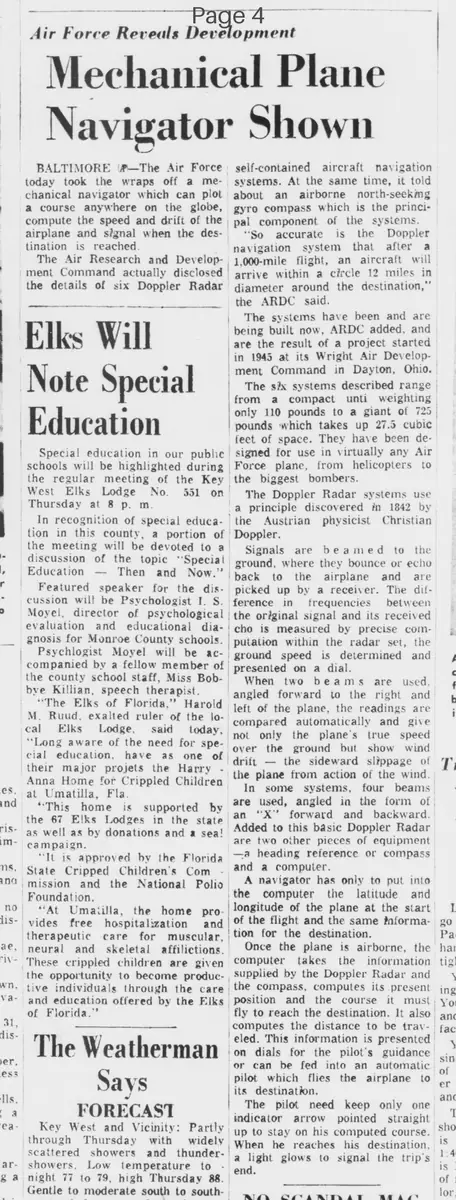
Air Force Reveals Development Mechanical Plane Navigator Shown
BALTIMORE - The Air Force today took the wraps off a mechanical navigator which can plot a course anywhere on the globe, compute the speed and drift of the airplane and signal when the destination is reached.
The Air Research and Development Command actually disclosed the details of six Doppler Radar self-contained aircraft navigation systems. At the same time, it told about an airborne north-seeking gyro compass which is the principal component of the systems.
"So accurate is the Doppler navigation system that after a 1,000-mile flight, an aircraft will arrive within a circle 12 miles in diameter around the destination," the ARDC said.
The systems have been and are being built now, ARDC added, and are the result of a project started in 1945 at its Wright Air Development Command in Dayton, Ohio.
The six systems described range from a compact unit weighing only 110 pounds to a giant of 725 pounds which takes up 27.5 cubic feet of space. They have been designed for use in virtually any Air Force plane, from helicopters to the biggest bombers.
The Doppler Radar systems use a principle discovered in 1842 by the Austrian physicist Christian Doppler.
Signals are beamed to the ground, where they bounce or echo back to the airplane and are picked up by a receiver. The difference in frequencies between the original signal and its received echo is measured by precise computation within the radar set, the ground speed is determined and presented on a dial.
When two beams are used angled forward to the right and left of the plane, the readings are compared automatically and give not only the plane's true speed over the ground but show wind drift - the sideward slippage of the plane from action of the wind.
In some systems, four beams are used, angled in the form of an "X" forward and backward.
Added to this basic Doppler Radar are two other pieces of equipment - a heading reference or compass and a computer.
A navigator has only to put into the computer the latitude and longitude of the plane at the start of the flight and the same information for the destination.
Once the plane is airborne, the computer takes the information supplied by the Doppler Radar and the compass, computes its present position and the course it must fly to reach the destination. It also computes the distance to be traveled. This information is presented on dials for the pilot's guidance or can be fed into an automatic pilot which flies the airplane to its destination.
The pilot need keep only one indicator arrow pointed straight up to stay on his computed course.
When he reaches his destination, a light glows to signal the trip's end.
BALTIMORE - The Air Force today took the wraps off a mechanical navigator which can plot a course anywhere on the globe, compute the speed and drift of the airplane and signal when the destination is reached.
The Air Research and Development Command actually disclosed the details of six Doppler Radar self-contained aircraft navigation systems. At the same time, it told about an airborne north-seeking gyro compass which is the principal component of the systems.
"So accurate is the Doppler navigation system that after a 1,000-mile flight, an aircraft will arrive within a circle 12 miles in diameter around the destination," the ARDC said.
The systems have been and are being built now, ARDC added, and are the result of a project started in 1945 at its Wright Air Development Command in Dayton, Ohio.
The six systems described range from a compact unit weighing only 110 pounds to a giant of 725 pounds which takes up 27.5 cubic feet of space. They have been designed for use in virtually any Air Force plane, from helicopters to the biggest bombers.
The Doppler Radar systems use a principle discovered in 1842 by the Austrian physicist Christian Doppler.
Signals are beamed to the ground, where they bounce or echo back to the airplane and are picked up by a receiver. The difference in frequencies between the original signal and its received echo is measured by precise computation within the radar set, the ground speed is determined and presented on a dial.
When two beams are used angled forward to the right and left of the plane, the readings are compared automatically and give not only the plane's true speed over the ground but show wind drift - the sideward slippage of the plane from action of the wind.
In some systems, four beams are used, angled in the form of an "X" forward and backward.
Added to this basic Doppler Radar are two other pieces of equipment - a heading reference or compass and a computer.
A navigator has only to put into the computer the latitude and longitude of the plane at the start of the flight and the same information for the destination.
Once the plane is airborne, the computer takes the information supplied by the Doppler Radar and the compass, computes its present position and the course it must fly to reach the destination. It also computes the distance to be traveled. This information is presented on dials for the pilot's guidance or can be fed into an automatic pilot which flies the airplane to its destination.
The pilot need keep only one indicator arrow pointed straight up to stay on his computed course.
When he reaches his destination, a light glows to signal the trip's end.
What sub-type of article is it?
Historical Event
Curiosity
What themes does it cover?
Triumph
What keywords are associated?
Doppler Radar
Aircraft Navigation
Air Force Development
Mechanical Navigator
Global Plotting
What entities or persons were involved?
Christian Doppler
Where did it happen?
Baltimore; Dayton, Ohio
Story Details
Key Persons
Christian Doppler
Location
Baltimore; Dayton, Ohio
Event Date
1945
Story Details
The Air Force discloses six Doppler Radar navigation systems for aircraft, using radar beams to compute speed, drift, and course from start to destination coordinates, accurate within 12 miles after 1,000 miles.