Thank you for visiting SNEWPapers!
Sign up free
Editorial
November 7, 1925
Worcester Democrat And The Ledger Enterprise
Pocomoke City, Worcester County, Maryland
What is this article about?
Editorial critiques the effectiveness of Prohibition, agreeing with Dr. F. Ernest Johnson's view that schools and churches should combat alcoholism through education rather than law alone. It highlights poor enforcement based on a Collier's Weekly survey and argues that Prohibition fails to elevate morals or reduce drinking.
Clipping
OCR Quality
98%
Excellent
Full Text
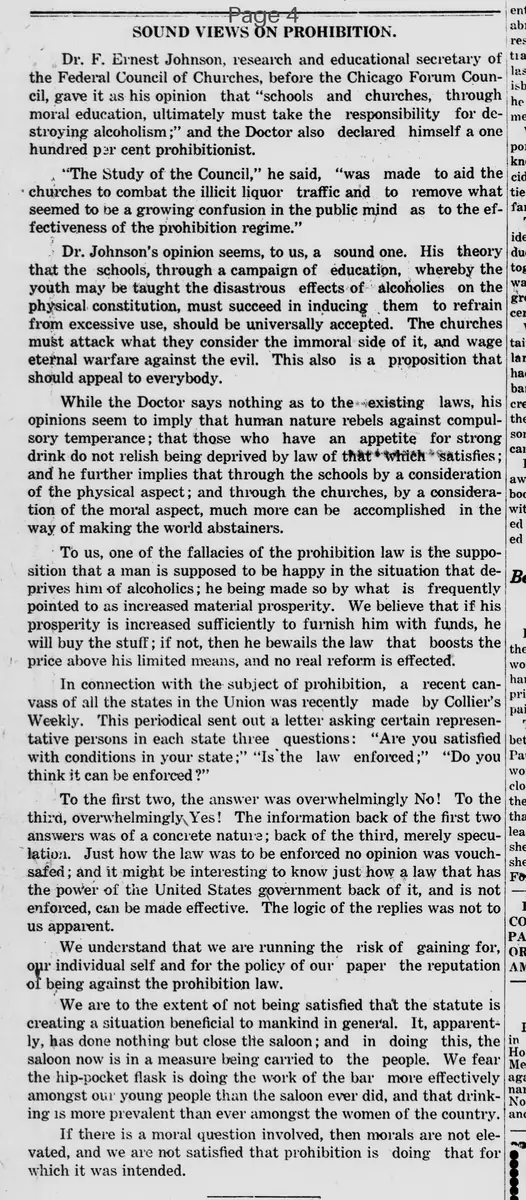
SOUND VIEWS ON PROHIBITION.
Dr. F. Ernest Johnson, research and educational secretary of the Federal Council of Churches, before the Chicago Forum Council, gave it as his opinion that "schools and churches, through moral education, ultimately must take the responsibility for destroying alcoholism;" and the Doctor also declared himself a one hundred per cent prohibitionist.
"The Study of the Council," he said, "was made to aid the churches to combat the illicit liquor traffic and to remove what seemed to be a growing confusion in the public mind as to the effectiveness of the prohibition regime."
Dr. Johnson's opinion seems to us a sound one. His theory that the schools, through a campaign of education, whereby the youth may be taught the disastrous effects of alcoholics on the physical constitution, must succeed in inducing them to refrain from excessive use, should be universally accepted. The churches must attack what they consider the immoral side of it, and wage eternal warfare against the evil. This also is a proposition that should appeal to everybody.
While the Doctor says nothing as to the existing laws, his opinions seem to imply that human nature rebels against compulsory temperance; that those who have an appetite for strong drink do not relish being deprived by law of that which satisfies; and he further implies that through the schools by a consideration of the physical aspect, and through the churches, by a consideration of the moral aspect, much more can be accomplished in the way of making the world abstainers.
To us, one of the fallacies of the prohibition law is the supposition that a man is supposed to be happy in the situation that deprives him of alcoholics; he being made so by what is frequently pointed to as increased material prosperity. We believe that if his prosperity is increased sufficiently to furnish him with funds, he will buy the stuff; if not, then he bewails the law that boosts the price above his limited means, and no real reform is effected.
In connection with the subject of prohibition, a recent canvass of all the states in the Union was recently made by Collier's Weekly. This periodical sent out a letter asking certain representative persons in each state three questions: "Are you satisfied with conditions in your state;" "Is the law enforced;" "Do you think it can be enforced?"
To the first two, the answer was overwhelmingly No! To the third, overwhelmingly Yes! The information back of the first two answers was of a concrete nature; back of the third, merely speculation. Just how the law was to be enforced no opinion was vouchsafed; and it might be interesting to know just how a law that has the power of the United States government back of it, and is not enforced, can be made effective. The logic of the replies was not to us apparent.
We understand that we are running the risk of gaining for our individual self and for the policy of our paper the reputation of being against the prohibition law.
We are to the extent of not being satisfied that the statute is creating a situation beneficial to mankind in general. It apparently has done nothing but close the saloon; and in doing this, the saloon now is in a measure being carried to the people. We fear the hip-pocket flask is doing the work of the bar more effectively amongst our young people than the saloon ever did, and that drinking is more prevalent than ever amongst the women of the country.
If there is a moral question involved, then morals are not elevated, and we are not satisfied that prohibition is doing that for which it was intended.
Dr. F. Ernest Johnson, research and educational secretary of the Federal Council of Churches, before the Chicago Forum Council, gave it as his opinion that "schools and churches, through moral education, ultimately must take the responsibility for destroying alcoholism;" and the Doctor also declared himself a one hundred per cent prohibitionist.
"The Study of the Council," he said, "was made to aid the churches to combat the illicit liquor traffic and to remove what seemed to be a growing confusion in the public mind as to the effectiveness of the prohibition regime."
Dr. Johnson's opinion seems to us a sound one. His theory that the schools, through a campaign of education, whereby the youth may be taught the disastrous effects of alcoholics on the physical constitution, must succeed in inducing them to refrain from excessive use, should be universally accepted. The churches must attack what they consider the immoral side of it, and wage eternal warfare against the evil. This also is a proposition that should appeal to everybody.
While the Doctor says nothing as to the existing laws, his opinions seem to imply that human nature rebels against compulsory temperance; that those who have an appetite for strong drink do not relish being deprived by law of that which satisfies; and he further implies that through the schools by a consideration of the physical aspect, and through the churches, by a consideration of the moral aspect, much more can be accomplished in the way of making the world abstainers.
To us, one of the fallacies of the prohibition law is the supposition that a man is supposed to be happy in the situation that deprives him of alcoholics; he being made so by what is frequently pointed to as increased material prosperity. We believe that if his prosperity is increased sufficiently to furnish him with funds, he will buy the stuff; if not, then he bewails the law that boosts the price above his limited means, and no real reform is effected.
In connection with the subject of prohibition, a recent canvass of all the states in the Union was recently made by Collier's Weekly. This periodical sent out a letter asking certain representative persons in each state three questions: "Are you satisfied with conditions in your state;" "Is the law enforced;" "Do you think it can be enforced?"
To the first two, the answer was overwhelmingly No! To the third, overwhelmingly Yes! The information back of the first two answers was of a concrete nature; back of the third, merely speculation. Just how the law was to be enforced no opinion was vouchsafed; and it might be interesting to know just how a law that has the power of the United States government back of it, and is not enforced, can be made effective. The logic of the replies was not to us apparent.
We understand that we are running the risk of gaining for our individual self and for the policy of our paper the reputation of being against the prohibition law.
We are to the extent of not being satisfied that the statute is creating a situation beneficial to mankind in general. It apparently has done nothing but close the saloon; and in doing this, the saloon now is in a measure being carried to the people. We fear the hip-pocket flask is doing the work of the bar more effectively amongst our young people than the saloon ever did, and that drinking is more prevalent than ever amongst the women of the country.
If there is a moral question involved, then morals are not elevated, and we are not satisfied that prohibition is doing that for which it was intended.
What sub-type of article is it?
Temperance
Moral Or Religious
Social Reform
What keywords are associated?
Prohibition
Temperance
Alcoholism
Moral Education
Law Enforcement
Churches
Schools
Illicit Liquor
What entities or persons were involved?
Dr. F. Ernest Johnson
Federal Council Of Churches
Chicago Forum Council
Collier's Weekly
Editorial Details
Primary Topic
Effectiveness Of Prohibition And Role Of Education In Combating Alcoholism
Stance / Tone
Critical Of Prohibition's Enforcement And Impact, Supportive Of Educational And Moral Approaches
Key Figures
Dr. F. Ernest Johnson
Federal Council Of Churches
Chicago Forum Council
Collier's Weekly
Key Arguments
Schools And Churches Must Educate On Physical And Moral Harms Of Alcohol To Destroy Alcoholism
Prohibition Fails Because Human Nature Rebels Against Compulsory Temperance
Material Prosperity Does Not Make People Happy Without Alcohol Access; They Will Seek It If Possible
Collier's Weekly Survey Shows Widespread Dissatisfaction And Non Enforcement Of Prohibition Laws
Prohibition Closes Saloons But Increases Hidden Drinking Among Youth And Women
Prohibition Does Not Elevate Morals As Intended