Thank you for visiting SNEWPapers!
Sign up free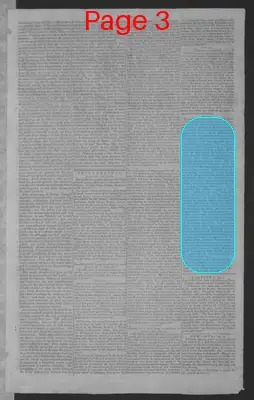
Editorial
January 12, 1792
National Gazette
Philadelphia, Philadelphia County, Pennsylvania
What is this article about?
Editorial correspondent argues Indians are better managed by treaties than war, contrasting Massachusetts Bay's violent history with Pennsylvania's peaceful prosperity under William Penn; praises federal treaty with southern Indians and hopes for similar northern approach.
Clipping
OCR Quality
95%
Excellent
Full Text
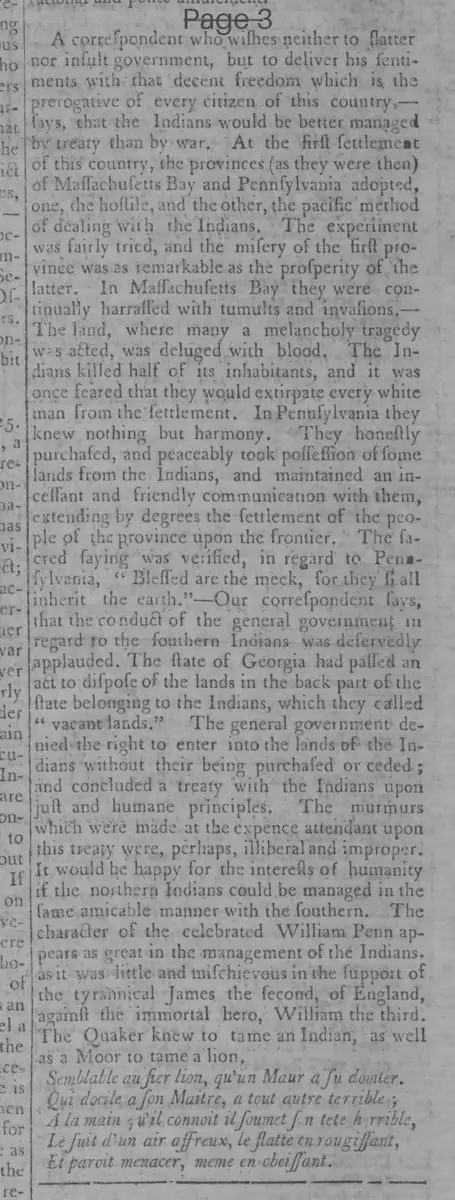
A correspondent who wishes neither to flatter nor insult government, but to deliver his sentiments with that decent freedom which is the prerogative of every citizen of this country, says, that the Indians would be better managed by treaty than by war.
At the first settlement of this country, the provinces (as they were then) of Massachusetts Bay and Pennsylvania adopted, one, the hostile, and the other, the pacific method of dealing with the Indians. The experiment was fairly tried, and the misery of the first province was as remarkable as the prosperity of the latter. In Massachusetts Bay they were continually harassed with tumults and invasions.— The land, where many a melancholy tragedy was acted, was deluged with blood. The Indians killed half of its inhabitants, and it was once feared that they would extirpate every white man from the settlement. In Pennsylvania they knew nothing but harmony. They honestly purchased, and peaceably took possession of some lands from the Indians, and maintained an incessant and friendly communication with them, extending by degrees the settlement of the people of the province upon the frontier. The sacred saying was verified, in regard to Pennsylvania, "Blessed are the meek, for they shall inherit the earth."
Our correspondent says, that the conduct of the general government in regard to the southern Indians was deservedly applauded. The state of Georgia had passed an act to dispose of the lands in the back part of the state belonging to the Indians, which they called "vacant lands." The general government denied the right to enter into the lands of the Indians without their being purchased or ceded : and concluded a treaty with the Indians upon just and humane principles. The murmurs which were made at the expense attendant upon this treaty were, perhaps, illiberal and improper. It would be happy for the interests of humanity if the northern Indians could be managed in the same amicable manner with the southern.
The character of the celebrated William Penn appears as great in the management of the Indians. as it was little and mischievous in the support of the tyrannical James the second, of England. against the immortal hero, William the third. The Quaker knew to tame an Indian, as well as a Moor to tame a lion,
Semblable au fier lion, qu'un Maur a su dompter.
Oui docile a son Maitre, a tout autre terrible;
A la main qu'il connoit il soumet une tete horrible,
Le fuit d'un air affreux, le flatte en rougissant,
Et paroit menacer, meme en obeissant.
At the first settlement of this country, the provinces (as they were then) of Massachusetts Bay and Pennsylvania adopted, one, the hostile, and the other, the pacific method of dealing with the Indians. The experiment was fairly tried, and the misery of the first province was as remarkable as the prosperity of the latter. In Massachusetts Bay they were continually harassed with tumults and invasions.— The land, where many a melancholy tragedy was acted, was deluged with blood. The Indians killed half of its inhabitants, and it was once feared that they would extirpate every white man from the settlement. In Pennsylvania they knew nothing but harmony. They honestly purchased, and peaceably took possession of some lands from the Indians, and maintained an incessant and friendly communication with them, extending by degrees the settlement of the people of the province upon the frontier. The sacred saying was verified, in regard to Pennsylvania, "Blessed are the meek, for they shall inherit the earth."
Our correspondent says, that the conduct of the general government in regard to the southern Indians was deservedly applauded. The state of Georgia had passed an act to dispose of the lands in the back part of the state belonging to the Indians, which they called "vacant lands." The general government denied the right to enter into the lands of the Indians without their being purchased or ceded : and concluded a treaty with the Indians upon just and humane principles. The murmurs which were made at the expense attendant upon this treaty were, perhaps, illiberal and improper. It would be happy for the interests of humanity if the northern Indians could be managed in the same amicable manner with the southern.
The character of the celebrated William Penn appears as great in the management of the Indians. as it was little and mischievous in the support of the tyrannical James the second, of England. against the immortal hero, William the third. The Quaker knew to tame an Indian, as well as a Moor to tame a lion,
Semblable au fier lion, qu'un Maur a su dompter.
Oui docile a son Maitre, a tout autre terrible;
A la main qu'il connoit il soumet une tete horrible,
Le fuit d'un air affreux, le flatte en rougissant,
Et paroit menacer, meme en obeissant.
What sub-type of article is it?
Indian Affairs
What keywords are associated?
Indian Treaties
Peaceful Management
William Penn
Massachusetts Bay
Pennsylvania
Southern Indians
Northern Indians
What entities or persons were involved?
Indians
Massachusetts Bay
Pennsylvania
William Penn
General Government
Georgia
Southern Indians
Northern Indians
James The Second
William The Third
Editorial Details
Primary Topic
Managing Indians By Treaty Rather Than War
Stance / Tone
Advocates Peaceful Treaties And Humane Principles
Key Figures
Indians
Massachusetts Bay
Pennsylvania
William Penn
General Government
Georgia
Southern Indians
Northern Indians
James The Second
William The Third
Key Arguments
Indians Better Managed By Treaty Than By War
Massachusetts Bay's Hostile Method Led To Tumults, Invasions, And Bloodshed
Pennsylvania's Pacific Method Resulted In Harmony And Prosperity
General Government Justly Denied Georgia's Claim To Indian Lands And Concluded Fair Treaty
Murmurs About Treaty Expenses Were Illiberal
Northern Indians Should Be Managed Amicably Like Southern Ones
William Penn Excelled In Managing Indians Despite Flaws In Supporting James Ii Against William Iii