Thank you for visiting SNEWPapers!
Sign up free
Concord Register
Concord, Merrimack County, New Hampshire
What is this article about?
Article from New-York Commercial Advertiser discusses shifting British views on American fine arts, quoting Blackwood's Magazine on neglect of arts but praise for painters like Copley, West, Trumbull, Peale, Alston, Morse, Sully, Stewart, Leslie, Newton, and Harding. Laments poor treatment of sculptor Causici in New York.
Clipping
OCR Quality
Full Text
From the New-York Commercial Advertiser.
OPINIONS ABROAD—AMERICAN PAINTERS.
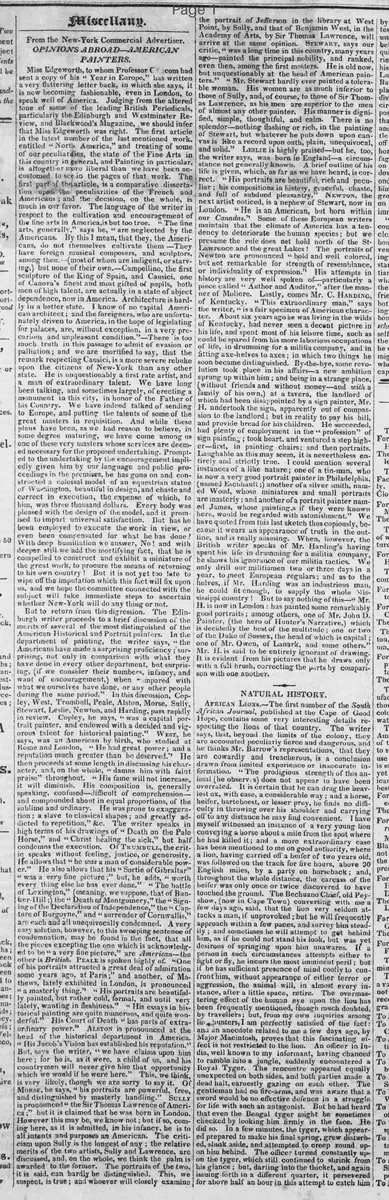
Miss Edgeworth, to whom Professor Cogswell had sent a copy of his "Year in Europe," has written a very flattering letter back, in which she says, it is now becoming fashionable, even in London, to speak well of America. Judging from the altered tone of some of the leading British Periodicals, particularly the Edinburgh and Westminster Review, and Blackwood's Magazine, we should infer that Miss Edgeworth was right. The first article in the latest number of the last mentioned work, entitled "North America," and treating of some of our peculiarities, the state of the Fine Arts in this country in general, and Painting in particular, is altogether more liberal than we have been accustomed to see in the pages of that work. The first part of the article, is a comparative dissertation upon the peculiarities of the French and Americans; and the decision, on the whole, is much in our favor. The language of the writer in respect to the cultivation and encouragement of the fine arts in America, is but too true. "The fine arts, generally," says he, "are neglected by the Americans. By this I mean, that they, the Americans, do not themselves cultivate them—They have foreign musical composers, and sculptors, among them.—(most of whom are indigent, or starving,) but none of their own.—Campellino, the first sculptor of the King of Spain, and Causici, one of Canova's finest and most gifted pupils, both men of high talent, are actually in a state of abject dependence, now in America. Architecture is hardly in a better state. I know of no capital American architect; and the foreigners, who are unfortunately driven to America, in the hope of legislating for palaces, are, without exception, in a very precarious and unpleasant condition."
There is too much truth in this passage to admit of evasion or palliation; and we are mortified to say, that the remark respecting Causici, is a more severe rebuke upon the citizens of New-York than any other state. He is unquestionably a first rate artist, and a man of extraordinary talent. We have long been talking, and sometimes largely, of erecting a monument in this city, in honor of the Father of his Country. We have indeed talked of sending to Europe, and putting the talents of some of the great masters in requisition. And while these plans have been, as we had reason to believe, in some degree maturing, we have come among us one of these very masters whose services are deemed necessary for the proposed undertaking. Prompted to the undertaking by the encouragement impliedly given him by our language and public proceedings in the premises, he has gone on and constructed a colossal model of an equestrian statue of Washington, beautiful in design, and chaste and correct in execution, the expense of which, to him, was three thousand dollars. Every body was pleased with the design of the model, and it promised to impart universal satisfaction. But has he been employed to execute the work in view, or even been compensated for what he has done? With deep humiliation we answer, No! and with deeper still we add the mortifying fact, that he is compelled to construct and exhibit a miniature of the great work, to procure the means of returning to his own country! But it is not yet too late to wipe off the imputation which this fact will fix upon us, and we hope the committee connected with the subject will take immediate steps to ascertain whether New-York will do any thing or not.
But to return from this digression. The Edinburgh writer proceeds to a brief discussion of the merits of several of the most distinguished of the American Historical and Portrait painters. In the department of painting, the writer says, "the Americans have made a surprising proficiency; surprising, not only in comparison with what they have done in every other department, but surprising, (if we consider their numbers, infancy, and want of encouragement,) when compared with what we ourselves have done, or any other people during the same period." In this discussion, Copley, West, Trumbull, Peale, Alston, Morse, Sully, Stewart, Leslie, Newton, and Harding, pass rapidly in review. Copley, he says, "was a capital portrait painter, and endowed with a decided and vigorous talent for historical painting." West, he says, was an American by birth, who studied at Rome and London, "He had great power; and a reputation much greater than he deserved." He then proceeds at some length in discussing his character, and, on the whole, "damns him with faint praise" throughout. "His fame will not increase, it will diminish. His composition is, generally speaking, confused—difficult of comprehension—and compounded about in equal proportions, of the sublime and ordinary. He was prone to exaggeration; a slave to classical shapes; and greatly addicted to repetition," &c. The writer speaks in high terms of his drawings of "Death on the Pale Horse," and "Christ healing the sick," but half condemns the execution. Of Trumbull, the critic speaks without feeling, justice, or generosity. He allows that "he was a man of considerable power." He also allows that his "Sortie of Gibraltar" "was a very fine picture;" but, he adds, "worth every thing else he has ever done."
"The battle of Lexington," (meaning, we suppose, that of Bunker-Hill) the "Death of Montgomery," the "Signing of the Declaration of Independence," the "Capture of Burgoyne," and "surrender of Cornwallis," are each and all unequivocally condemned. A very easy solution, however, to this sweeping sentence of condemnation, may be found in the fact, that all the pieces excepting the one which is acknowledged to be "a very fine picture," are American—the other is British. Peale is spoken highly of. "One of his portraits attracted a great deal of admiration some years ago, at Paris;" and another, of Matthews, lately exhibited in London, is pronounced "a masterly thing." "His portraits are beautifully painted, but rather cold, formal, and until very lately, wanting in fleshiness." "His essays in historical painting are quite numerous, and quite wonderful." His "Court of Death" "has parts of extraordinary power." Alston is pronounced at the head of the historical department in America. "His Jacob's Vision has established his reputation." But, says the writer, "we have claims upon him here; for he is, as it were, a child of us, and his countrymen will never give him that opportunity which we would if he were here." This, we think, is very likely, though we are sorry to say it. Of Morse, he says, "his portraits are powerful, free, and distinguished by masterly handling." Sully is pronounced "the Sir Thomas Lawrence of America;" but it is claimed that he was born in London. However this may be, we know not; but if so, coming here, as it is admitted, in his infancy, he is to all intents and purposes an American. The criticism upon Sully is the longest of any; the relative merits of the two artists, Sully and Lawrence, are discussed, and, on the whole, we think the palm is awarded to the former. The portraits of the two, it is said, can hardly be distinguished. This, we suspect, is true; and whoever will closely examine the portrait of Jefferson in the library at West Point, by Sully, and that of Benjamin West, in the Academy of Arts, by Sir Thomas Lawrence, will arrive at the same opinion. Stewart, says our critic, "was a long time in this country, many years ago—painted the principal nobility, and ranked, even then, among the first masters. He is old now, but unquestionably at the head of American painters." "Mr. Stewart hardly ever painted a tolerable woman. His women are as much inferior to those of Sully, and, of course, to those of Sir Thomas Lawrence, as his men are superior to the men of almost any other painter. His manner is dignified, simple, thoughtful, and calm. There is no splendor, nothing flashing or rich, in the painting of Stewart, but whatever he puts down upon canvas is like a record upon oath, plain, unequivocal, and solid." Leslie is highly praised—but he, too, the writer says, was born in England—a circumstance not generally known. A brief outline of his life is given, which, as far as we have heard, is correct. "His portraits are beautiful, rich and peculiar; his compositions in history, graceful, chaste, and full of subdued pleasantry."
Newton, the next artist noticed, is a nephew of Stewart, now in London. "He is an American, but born within our Canadas." Some of these European writers maintain that the climate of America has a tendency to deteriorate the human species; but we presume the rule does not hold north of the St. Lawrence and the great Lakes! The portraits of Newton are pronounced "bold and well colored, but not remarkable for strength of resemblance, or individuality of expression." His attempts in history are very well spoken of—particularly a piece called "Author and Auditor," after the manner of Moliere. Lastly, comes Mr. C. Harding, of Kentucky. "This extraordinary man," says the writer, "is a fair specimen of American character. About six years ago he was living in the wilds of Kentucky, had never seen a decent picture in his life, and spent most of his leisure time, such as could be spared from his more laborious occupations of life, in drumming for a militia company, and in fitting axe-helves to axes; in which two things he soon became distinguished. By-the-bye, some revolution took place in his affairs—a new ambition sprung up within him; and being in a strange place, (without friends and without money—and with a family of his own,) at a tavern, the landlord of which had been disappointed by a sign painter, Mr. H. undertook the sign, apparently out of compassion to the landlord; but in reality to pay his bill, and provide bread for his children. He succeeded, had plenty of employment in the profession of sign painting; took heart, and ventured a step higher—first, in painting chairs; and then portraits. Laughable as this may seem, it is nevertheless entirely and strictly true. I could mention several instances of a like nature; one of a tin-man, who is now a very good portrait painter in Philadelphia, (named Eschibault;) another of a silver smith, named Wood, whose miniatures and small portraits are masterly; and another of a portrait painter named James, whose paintings, if they were known here, would be regarded with astonishment." We have quoted from this last sketch thus copiously, because it wears an appearance of truth in the outline, and is really amusing. When, however, the British writer speaks of Mr. Harding's having spent his life in drumming for a militia company, he shows his ignorance of our militia tactics. We only drill our militiamen two or three days in a year, to meet European regulars; and as to the helves, if Mr. Harding was an industrious man, he could fit enough, to supply the whole Mississippi country! But to say nothing of this—"Mr. H. is now in London: has painted some remarkably good portraits; among others, one of Mr. John D. Painter, (the hero of Hunter's Narrative,) which is decidedly the best of the multitude; one or two of the Duke of Sussex, the head of which is capital; one of Mr. Owen, of Lanark, and some others." Mr. H. is said to be entirely ignorant of drawing. It is evident from his pictures that he draws only with a full brush, correcting the parts by comparison with one another.
What sub-type of article is it?
What themes does it cover?
What keywords are associated?
What entities or persons were involved?
Where did it happen?
Story Details
Key Persons
Location
America, New York, London
Story Details
The article reviews British periodical opinions on American fine arts, highlighting neglect but praising progress in painting. It discusses sculptor Causici's poor treatment in New York and profiles American painters' merits, lives, and works, from Copley to Harding's rags-to-riches story.