Thank you for visiting SNEWPapers!
Sign up free
Richmond Enquirer
Richmond, Richmond County, Virginia
What is this article about?
Detailed report on Virginia Constitutional Convention proceedings in Richmond, November 2-7, 1829, debating representation basis (white population vs. compound of population and taxation). Key speeches by Gordon, Mercer, Madison; amendment rejected 43-49; Gen. Taylor considers resignation.
Merged-components note: Merged continuation of Virginia Constitutional Convention debates and proceedings across pages 2 and 3; original labels were domestic_news and story, unified under domestic_news as political reporting on state convention.
Clippings
1 of 2
OCR Quality
Full Text
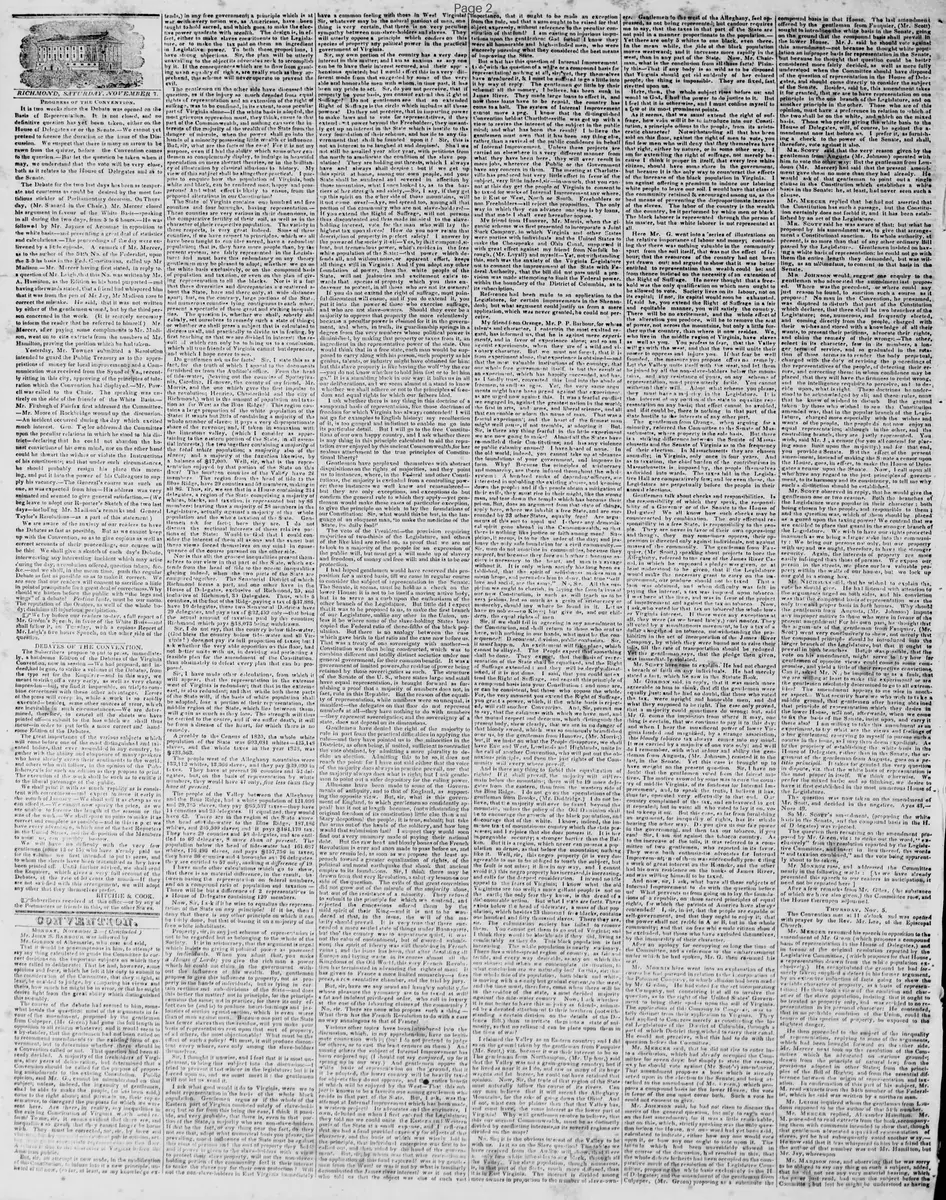
Progress of the Convention.
It is two weeks since the Debate was opened on the Basis of Representation. It is not closed, and no definitive question has yet been taken, either on the House of Delegates or on the Senate. We cannot yet pretend to foresee the duration or the issue of the Discussion. We suspect that there is many an arrow to be drawn from the quiver, before the Convention comes to the question. But let the question be taken when it may, we understand that the vote will be very close, both as it relates to the House of Delegates and as to the Senate.
The Debate for the two last days has been as temperate and courteous as could be desired by the most fastidious stickler for Parliamentary decorum. On Thursday, (Mr. Stanard in the Chair.) Mr. Mercer closed his argument in favour of the White Basis—speaking in all during the two days, from 5 to 6 hours. He was followed by Mr. Joynes of Accomac in opposition to the white basis—and presenting a great deal of statistics and calculations. The proceedings of the day were enlivened by a little episode. A remark of Mr. Mercer, as to the author of the 5th No. of the Federalist, upon the 3-5ths basis in the Fed. Constitution, called up Mr. Madison. Mr. Mercer having first stated, in reply to a question of Mr. Leigh, that this No. was written by Mr. A. Hamilton, as the Edition in his hand purported—and having afterwards stated, that a friend had whispered him that it was from the pen of Mr. Jay, Mr. Madison rose to correct the mistake. He said, that it was not written by either of the gentlemen named, but by the third person concerned in the work. (It is scarcely necessary to inform the reader that he referred to himself.) Mr. Mercer, after paying some compliments to Mr. Madison, went on to cite extracts from the numbers of Mr. Hamilton, proving the position which he had taken.
Yesterday, Mr. Townes submitted a Resolution intended to guard the Public Treasury as to the appropriations of money for local improvements; and a Communication was received from the Synod of Va., recently sitting in this city, approving of the principles of toleration which the Convention had displayed. Mr. Powell was called to the Chair. The speaking was entirely on the side of the friends of the White Basis. Mr. Fitzhugh of Fairfax first addressed the Committee. Mr. Moore of Rockbridge wound up the discussion. An incident occurred during the day which excited much interest. Gen. Taylor addressed the Committee upon the peculiar relations in which he stood to his district—declaring that he could not abandon the honest convictions of his own mind, nor on the other hand could he thwart the wishes or violate the Instructions of his constituents; and that under such circumstances, he should probably resign his place this morning, and put it into the power of his Colleagues to supply his vacancy. The General's course was such an one, as was expected from him. His address was very animated and seemed to give general satisfaction. (We beg leave to adopt our Reporter's Sketch of the two last days—including Mr. Madison's remarks and General Taylor's Resolutions—as a part of this statement.)
We are aware of the anxiety of our readers to have the Debates as fast as possible. But as we cannot keep up with the Convention, so as to give copious as well as correct accounts of their proceedings, our course will be this: We shall give a sketch of each day's Debate, interweaving any interesting incident which may arise during the day, a resolution offered, question taken, &c. &c.—and we shall, in the mean time, push the regular Debate as fast as possible so as to make it correct. We are sure that our readers will consent to sacrifice a little in point of promptitude for a great deal of correctness. Why should we hasten before the public with "the legs and wings" of a debate? Festina lente, must be our motto. The reputation of the Orators, as well of the whole body, disclaims all injurious precipitation.
We lay before our readers to-day, a full report of Mr. Gordon's Speech, in favor of the White Basis—and shall follow it, on Tuesday, with a copious Report of Mr. Leigh's five hours Speech, on the other side of the question.
CONVENTION.
MONDAY, November 2.—(Concluded.)
Mr. JOHN S. BARBOUR was followed by Mr. GORDON of Albemarle, who rose and said,
That it would be presumptuous in him, to attempt to say any thing calculated to guide the Committee to correct decisions on the important subjects on which they were called to deliberate: That he had, however, some opinions and facts, which he felt it his duty to submit to the consideration of the Committee, that they might, at least, be enabled to judge, by comparing his views and theirs, how much he might be in error, or that he might derive light from this great ability which distinguished this assembly.
The course of the debate had seemed to him, somewhat beside the question: most of the arguments in favor of the amendment, proposed by the gentleman from Culpeper, (Mr. Green) had gone the full length in opposition to all reform whatever: and it would seem to a by-stander, that the gentlemen had not been called on to recommend amendments to the existing form of government, but to determine whether there should be a Convention called or not. That question had been already decided. A majority of the freeholders of Virginia, after years of deliberation, had determined that a Convention should be called for the purpose of proposing amendments to the existing Constitution. Public opinion, said Mr. G., cannot be misunderstood on that subject; unless, indeed, the ingenuity of gentlemen, shall be able to make the people, (as was been said.) come to the right about; and persuade us, their representatives, to disregard the purposes for which we were sent here. Are there, in reality, any inequalities in the existing Constitution of Virginia which need reform? To me, sir, it seems evident that there are, and inequalities so great, that they cannot longer be borne with. They must be corrected, not, sir, by force and violence, but by the certain public opinion, acting upon the throne.
A reform due to the character of American public opinion.
Virginia before.
But, sir, an attempt is now made, in the modification of this Constitution, to infuse into it a new principle, unheard of till now, (other, at least, in my knowledge extends,) in any free government; a principle which is at war with every notion we, as Americans, have been taught to hold sacred, and which goes to make the elective power quadrate with wealth. The design is, in effect, either to make slaves constituents to the Legislature, or to make the tax paid on them an ingredient in Legislative power. To both these propositions, I have strong objections. Sir, the plan will be utterly unavailing to the objects its advocates seek to accomplish by it. If the consequences which are to flow from granting us an equality of rights, are really such as they apprehend, this scheme will never operate to prevent the evil.
The gentlemen on the other side have discussed this question, as if the injury so much dreaded from equal rights of representation and an extension of the right of suffrage, was to be confined, in its extent, to one peculiar part of Virginia alone. If the white basis is adopted, the most grievous oppression must, they think, ensue to that part of the Commonwealth, and nothing can save the interests of the majority of the wealth of the State from the danger of misrule, when the power shall go into the hands of a minority possessing little wealth or influence.
But, sir, what are the facts of the case? For it is not my purpose, even if I had the ability which some other gentlemen so conspicuously display, to indulge in beautiful speculation on mere abstract theories, or in the brilliancy of illustration by classical allusions to history. My view of this subject shall be altogether practical. I purpose to enquire how the population of Virginia, both white and black, can be rendered most happy and prosperous? And what effect is likely to ensue, from the proposed alterations in our Constitution?
The State of Virginia contains one hundred and five counties and four boroughs, having representation. These counties are very various in their dimensions, in the comparative fertility of their soil, as well as in the character of their respective population. The variety in these respects, is very great indeed. Some of these counties, if we have respect to principles, which we all have been taught to consider sacred, have a redundant population; that is, they have more people than, by the present system, are fairly represented in the Legislature: and must have this redundancy on any theory gentlemen may be pleased to adopt, whether we go on the white basis exclusively, or on the compound basis of population and taxation, or even on the plan of giving representation to all the blacks. Nor is it a fact that these diversities and discrepancies are scattered about the State, here and there only, at wide distances apart; but, on the contrary, large portions of the State, and numerous counties lying contiguous to each other, present a spectacle of these great and striking inequalities. The question is, whether we shall, soberly and calmly, set ourselves to remedy such a state of things or whether we shall press a subject that is calculated to distress us all, and practically to divide us in feeling, by first teaching us that we are divided in interest: the result of which can only be to bring us to a conclusion, which all true friends of Virginia cannot but deprecate, and which I hope never to see.
Do gentlemen ask us for facts? Sir, I state this as a fact, for the truth of which I appeal to the documents furnished us from the Auditor's office. From the head of tide-water, (leaving out the counties of Spotsylvania, Caroline, Hanover, the county of my friend, Mr. Morris, and the one which gave the first impulse to the revolution; Henrico, Chesterfield and the city of Richmond.) what is the amount of population and taxation as far West as the Blue Ridge? This region contains a large proportion of the white population of the State: it wants but little of containing a majority of the whole number of slaves: it pays a very disproportionate share of the revenue; and, if taken in connexion with the limestone valley, (which I consider as appertaining to the eastern portion of the State, in all essential interests.) the two together containing a majority of the total white population; a majority also of the slaves; and a majority of the taxation likewise, by a balance of $17,000. Well, sir, what is the representation enjoyed by that portion of the State on this floor? The fourteen counties of the Valley, have 28 members. The region from the head of tide to the Blue Ridge, have 29 counties and 59 members, making in all 88. Thus, sir, we see that in a House containing 214 delegates, a region of the State comprising a majority of whites, blacks, and taxation, is represented but by 88 members: leaving thus a majority of 126 members in the Legislature, actually against a majority of the whole population and the whole taxation of the State. Gentlemen ask for facts; here they are. I do not discuss the sectional interests of these relative portions of the State: Would to God that I could consider the interest of them all as one and the same: but these views forced themselves on my mind in consequence of the course pursued on the other side.
Nor is this all: the grossest inequalities present themselves to our view in that part of the State, which extends from the head of tide to the ocean: inequalities glaring indeed, when the two parts of the State are compared together.
The Senatorial District of which Richmond forms a part, and one other have in the House of Delegates, exclusive of Richmond, 29, and inclusive of Richmond, 30 Delegates. Thus, while 5 counties, at the foot of the Ridge, paying a tax of $37,836, have 10 delegates, these two Senatorial Districts have 29 delegates, and pay a tax of $32,159 only—that being the actual amount of taxation paid by the counties; Richmond which pays $18,078 being withdrawn.
Sir, I do not say, that the country below tide-water, (God bless the country below tide-water and all Virginia!) does not pay its full proportion of taxes; but I ask whether the very able opposition on this floor, had not better unite with us, in devising and perfecting a feasible plan for the amendment of the Constitution, than obstinately to defeat every plan that can be proposed.
Sir, I have made other calculations, from which it will appear, that the representation in the extreme west of Virginia is redundant; that that in the extreme east, is also redundant; and that while both these parts of the State will, if the basis of white population shall be adopted, lose a portion of their representation, the middle region of the State, which lies between them, will gain as much as they lose. The strength will thus be carried to the centre, and if we suffer death, it will be from a disease of the heart, for which there is no remedy.
Agreeably to the Census of 1820, the whole white population of the State was 603,031 whites—425,148 slaves, and the whole taxes in the year 1828, was $423,563.
The people west of the Alleghany mountains were 133,112 whites, 13,366 slaves, and they pay $39,099 in taxes. They have at present 26 counties and 52 delegates, but, on the basis of representation by white numbers, they would have 47 only, five less than they have at present.
The people of the Valley between the Alleghany and the Blue Ridge, had a white population of 121,096 and 29,785 slaves, they pay $65,537 taxes—they have 14 counties and 28 delegates. If equalized, they would have 42. There are in the region of the State above the head of tide-water to the Blue Ridge, 187,186 whites, and 205,500 slaves; and it pays $161,170 tax. They have 29 counties and 59 delegates, and are entitled to 68 delegates, 9 more than at present. The population below the head of tide-water had 161,687 whites, 176,496 slaves, and pays $157,756 in taxes; they have 36 counties and 4 boroughs and 76 delegates. They are entitled to 57 only, making a difference of 19.
I have made other calculations which go to shew, that there is no material difference, in the result, between basing the representation on federal numbers, and on a compound ratio of population and taxation. There will be but a difference of 2 representatives in a House of Delegates containing 120 members.
Now, Sir, I ask if it be wise to equalize the representation of the State on any principle? If it be, then I deny that there is any other principle on which it can be fitly done, but that of basing it on a majority of the free white inhabitants.
Property, sir, in any just scheme of representation is not to be regarded but as belonging to the whole of the Society. It is in aristocracy, that the argument is urged which insists on giving it political power as possessed by individuals. When you admit that, you make a House of Lords; you give the rich man a power which he could not claim in the government without the influence of his wealth. But, gentlemen propose to give this influence to property, not as property in the hands of individuals, but as lying in certain sections and sub-divisions of the State—and does this better the matter? not in principle, for the principle remains the same; not in practice, for there its only effect can be (and is) to produce heart-burnings and jealousies of section against section, which is even worse than of man against man. Because one part of the State has fewer slaves than the residue, will you make your basis of representation rest upon that sort of property, of all others, the most objectionable? What must be the effect of such a policy? It must, it will produce discontent every where, save only among the slave-holders themselves.
Sir, I thought it unwise, and I feel that it is most unpleasant, to bring this subject into the discussion: I tried to prevent it last winter in the legislature: but it is forced upon us, and we must meet it: the gentlemen will not let us avoid it.
I ask what good would it do to Virginia, were we to admit representation in the basis of the whole black population. Gentlemen argue as if the whole of the Eastern part of Virginia consisted solely of slave-holders; but so far from this being the case, I think it possible, and very probable, that there is, even in that portion of the State, a majority who are non-slave-holders. If that be the fact, or any thing near the fact, do they not see that, adopt what numerical basis you please, the prevailing, moral influence of the State must be against this class of persons in the got of property they hold? and if power is given to the slave-holders with a view to protect their slave property, will not the non-slave-holding portion of the community feel it their interest to make the slaves pay for their own protection? Will not the non-slave-holders in East Virginia immediately have a common feeling with those in West Virginia?
Sir, whatever may be the natural passions of men, one thing is very certain, that there is no very peculiar sympathy between non-slave-holders and slaves. They will utterly oppose a principle which confers on this species of property any political power in the practical government of Virginia.
Sir, my own portion of the country has a very deep interest in this matter; and I am as anxious as any one can be to have their interest secured, and their apprehensions quieted; but I would effect this in a very different mode from that suggested by some of the very able and honorable men with whom, in time past, it has been my pride to act. Sir, do you not perceive, that if property be your basis, you cannot extend the right of Suffrage? Do not gentlemen see that an extended Right of Suffrage is the circle which includes all these powers? Do they not perceive, that in imparting power to make laws and to vote for representatives, if they extend out power beyond the Freeholders, they instantly get up an interest in the State which is hostile to the very foundation of their scheme, and hostile to any Government that shall be founded upon it? Sir, this is not an interest to be laughed at and despised. Shall we not still be assailed year after year, with petitions from the north to ameliorate the condition of the slave population? They are holding out threats, which I always have and always shall despise: but if we get up this spirit at home, among our own people, and your State shall be sundered and severed "in affection by those mountains, what I once looked to, as to the barriers of her strength and safety,—Sir, I say, if they get up this spirit on the other side of those mountains, will it not come over?—Aye, and spread too, among all that portion of the community who are not slave-holders?— If you extend the Right of Suffrage, will not persons thus discontented and thus made hostile to the slave-holding interest, vote for the man who will lay the highest tax upon slaves? How do you now retain that description of property in perfect safety? I answer by the power of the society itself—Yes, by that composed, silent, but tremendous power, which resides in the free white population of the State:—that power which defends all, and without noise, or apparent effort, keeps all things still in Virginia: And if you adopt any other foundation of power, then the white people of the State, will not jealousies and excitement exist towards that species of property which you thus endeavour to protect, in all those who are not its owners?
If you do not extend the right of suffrage, most painful discontent will ensue, and if you do extend it, you put it into the power of those who exercise suffrage, and who are not slave-owners. Should they ever be a majority to oppress that property the more relentlessly because a peculiar power is claimed for it in the government, and when, in truth, its guardianship springs in a degree from the very numbers whose political power is diminished, by making that property or taxes from it, an ingredient in the representative power of the state. One would think that in a free state, each man would be supposed to carry along with his person, such property as his genius, talents, or industry might have obtained for him: but this slave property is like having the wolf "by the ear—you do not know whether to hold him fast or to let him go." It is a stumbling block in our way: it balks us in all our deliberations, and we seem almost at a stand to know whether we shall adhere or not to the principles of freedom and equal rights for which our fathers bled.
I ask whether there is any thing in this doctrine of a compound basis of representation, like those doctrines of freedom for which Virginia has always contended? I will not go for examples to English history: my recollection of it, is too general and indistinct to enable me go into its particular detail. But I will go to the free Constitutions of our own happy country, and I ask whether there is any thing in this principle calculated to aid the reputation ever enjoyed by this ancient Commonwealth, for her zealous attachment to the true principles of Constitutional liberty?
Gentlemen have perplexed themselves with abstract disquisitions on the rights of majorities, and they point us to instances, where, in the Federal and other Constitutions, the majority is excluded from a controlling power: these instances we well knew and remembered—but they are only exceptions, and exceptions do but confirm the general rule to which they apply—yet gentlemen would make these cases of particular exception, to give the principle on which to lay the foundations of our Constitution: Sir, what would this be but, in the language of an eloquent man, 'to make the medicine of the State, its daily food?'
The veto of the President—the provision requiring majorities of two-thirds of the Legislature, and others of the like kind are relied on, as proof that we are not to look to a majority of the people for an expression of the public will, but must get a will made up of slavery and freedom, of money and free will: and this is to be our protection.
I had hoped gentlemen would have reserved this proposition for a mixed basis, till we came in regular course to consider the subject of representation in the Senate. The Senate, it seems, must be held as a check on the lower House: it is not to be itself a moving active body, but is to serve as a curb upon the enthusiasm of the other branch of the Legislature. But little did I expect that it was to be proposed to us, to make the first branch of our Legislature, unlike any other in the Union, unless it be where some of the slave-holding States have copied the Federal ratio of three-fifths of the black population. But there is no analogy between the case which gave birth to that ratio and the case now before us. That was a treaty of one sovereignty with another—a Constitution was then being constructed, which was to combine different and totally distinct societies under one general government, for their common benefit. It was a government of limited powers, the residue of power being retained by those sovereignties as such. The structure of the Senate of the U. S., where states large and small have equal representation, is brought forward as furnishing a proof that a majority of numbers does not, in fact, rule in this Republic. But the reason of the equality of representation, while numbers were so unequal, is manifest—the delegates on that floor do not represent numbers at all—they have nothing to do with numbers—they represent sovereignties; and the sovereignty of a state, does not depend on its dimensions.
Gentlemen have denied the right of the majority to rule in part from the practical difficulties in applying the rule—and they have pointed us to the minorities in the Districts, as often being, if united, sufficient to contradict the vote obtained, by admitting a mere plurality to decide an election. Admitting this to be so, it does not reach the point: for I have not said either that the voice of the majority does always in practice prevail, nor that the majority always does what is right; but I ask gentlemen to point out a safer depository for the ruling power.
Allusions have been made to some of the Governments of antiquity, and to that of England, as supporting the opposite view. But, sir, what is this government of England, to which gentlemen so confidently appeal? has it not at length become, (notwithstanding the original freedom of its constitution) little else than a military despotism? the people, it is true, submit; but take the arms out of the hands of the soldiery, and how long would that submission last? I suspect they would soon find out a very summary mode of paying their national debt. But the raw head and bloody bones of the French Revolution is ever and anon made to pass before us, and we are reminded, as soon as we propose the least approach toward a greater equalization of rights, of the political and moral earthquake that shook that ancient empire to its foundations. Sir, I think there may be drawn from that very Revolution, a salutary lesson on our side of the question. The evils of that great convulsion did not grow out of the misrule of the majority alone, but out of the resistance of a minority. They refused to submit to the principle for which we contend, and rejected the concessions offered them by the mild spirit of their King—and it is not to be wondered at that, in the issue, the will of the majority should prevail. It is very true that there succeeded a more settled state of things under Bonaparte, but tho' the country was to appearance quiet, it was not the calm of contentment, but of coerced submission; the spirit of liberty was still throbbing in French veins; and the issue has been, that after desolating all Europe and laying waste in its course almost all the Kingdoms of the Old World, this very French Revolution has terminated in advancing the rights of man: It has given to France a more limited monarchy—a free press, a representative chamber, and the trial by jury.
But, sir, have we any proud and haughty nobility, for whose pleasure the yeomanry are to be taxed at will? a fat and indolent privileged order, who roll in luxury at the cost of the labouring classes of the community? No, sir. There are none who propose such a thing. What then has the French Revolution to do with a case no way analogous to that of France?
Various other topics have been introduced into the discussion, which, in my apprehension, have no legitimate connexion with it; (but I do not pretend to judge for others, or to cast the least censure on them.) And among others the subject of Internal Improvement has been conjured up; (I should not say conjured up for it sprang up in our way) And gentlemen oppose the white basis of representation on the ground, that if it be adopted, the lower country will be heavily taxed for objects they do not approve, and the entire benefit of which will be enjoyed by the West. That this subject is known to be a favorite one among gentlemen who reside in that part of the State. But, I ask, was that attempt at Internal Improvement which has been made, a western project? Its advocates and the engineers, I own, deluded me when I first entered the Legislature: they told me we could unite the Eastern and Western parts of the State at a small expense, and I reflected that we had a fund provided expressly for objects of that character, and the basis of which was wisely laid in the principle, that individual enterprise was first to be called out, and then aided by the hand of the government. But, sir, by whom was that wise restriction on the application of this fund ruptured? was it by gentlemen from the West? or was it not by what is familiarly denominated the James river interest? was it not they who tell us that the object was one of such vast importance, that it ought to be made an exception from the rule, and that a sum ought to be raised for that object expressly, without reference to the peculiar constitution of that fund? I am casting no injurious imputations upon the gentlemen: God forbid! I know they were all honourable and high-minded men, who were sincerely pursuing what they considered the best means of improving the State.
But what has this question of Internal Improvement to do with the question of a white or a compound basis for representation? nothing at all, sir: yet, they themselves have introduced it, & I must be suffered to go a little into it by way of reply. The gentlemen got little by their scheme: all the money, I believe, has been sunk in James River. They made large loans to effect it, and now those loans have to be repaid, the country has come to a halt. The system of Internal Improvement cannot move a peg. I know that the distinguished Convention held at Charlottesville was got up with a view to revive the interest of the subject in the public mind; and what has been the result? I believe the gentlemen must own that it has been any thing else, rather than a revival of the public confidence in behalf of Internal Improvement. Unless these projects are carried on elsewhere in a very different manner from what they have been here, they will ever result in more jobs, wherever the Public or the Government have any concern in them. The meeting at Charlottesville has produced but very little effect in favor of the subject. very little indeed, sir—insomuch, that you cannot at this day get the people of Virginia to consent to be taxed for works of Internal Improvement any where, be it East or West, North or South. Freeholders or non Freeholders—all reject the proposition. The only way in which they can advance one step is by loans, and that mode I shall ever hereafter oppose.
My friend from Hanover, Mr. Morris, when the gigantic scheme was first presented to incorporate a Joint Stock Company, in which Virginia and other States were parties with individuals and the United States to make the Chesapeake and Ohio Canal, supported it with great effect against my friend from Norfolk borough, (Mr. Loyall) and myself. Yet, notwithstanding this, such was the anxiety of the Virginia Legislature not to connect the improvement of the State with Federal Authority, that the bill did not pass until a provision was made attempting to limit the Federal power, within the boundary of the District of Columbia, as to its subscription.
Reference had been made to an application to the Legislature, for certain improvements in the Shenandoah; but what argument could justify us from a mere application, which was never granted, he could not perceive.
My friend from Orange, Mr. P. P. Barbour, for whose talents and character, I entertain the most exalted regard, has informed us, that he is against mere experiments, and in favor of experience alone; and so am I against experiments, when they are of a wild and visionary character. But we must not forget, that it is from experiment alone, that experience is obtained—and that the most valuable institutions of the country, that our whole free government itself, is but the result of an experiment, which has happily succeeded, and has, as I fondly trust, converted this Land into the abode of freemen, to endless ages. Yet, the very same arguments might have been urged against that experiment as are urged now against this. It was a fearful conflict we engaged in, against the greatest nation in the world: the first in arts, and arms, and liberal science, and all that can ennoble or adorn the name of man. That was a fearful experiment; and the heart of the firmest man might well pause, if not tremble, at adopting it. But, Sir, is there any thing fearful in the little experiment we are now going to make? Almost all the States have re-modelled their Constitutions; and has any violence or public calamity ensued? I have heard of none. In the old world, indeed, you cannot take up at pleasure the foundations of your government, and improve its form. Why? Because the principles of aristocracy and monarchy, are there infused throughout the whole system: A hundred ranks of dependent officers, are interested in upholding the existing abuses, and keeping down the people: and if the people obtain a mitigation of their evils, they must rise in their might, like the strong man, and tear down the temple which has become their prison. But, does an argument from that state of things, apply here, where we inhabit a free State, and are surrounded by 23 other States, equally free? Are arguments of this sort to appal us? Is there any demoniacal spirit gone abroad in the Commonwealth, so that there is nothing like justice or faith among men? Suspicion, it seems, is to be the order of the day; and jealousy the only safe foundation for a civil community. Sir, men do not associate in communities, because they suspect, but because they love each other: because society is necessary to the heart, and man is a savage without it. It is only when society has long been established, that the spirit of selfishness makes man a misanthrope, and persuades him to deny, that true "self love and social, are the same." No, Sir. All the suspicion we ought to cherish, in laying the foundations of our new Constitution, is such as will teach us to be very jealous, lest so much as a grain of aristocracy or monarchy, should any where be found in it. Let us have no nobles—no Kings; but give us, and our children, three equal rights of men.
Sir, if we shall fail in agreeing to any amendment to the Constitution, and shall return to those who sent us here, with nothing in our hands, what must be the consequence? Discontent, division, public confusion. Sir, it must happen. An excitement will take place, which cannot be allayed. The People expect that something shall be done. They expect, that the basis of representation of the State shall be equalized, and the Right of Suffrage extended: and they will be deeply dissatisfied, if it is not done. I said, that you could not extend the Right of Suffrage, and engraft this principle of a compound basis into your Constitution: and none are, or can be consistent, but those who oppose the whole. For, the very moment you extend the Right of Suffrage, you grant a power, which, if the white basis is rejected, will call another Convention. And, Sir, permit me to say, that the calmness with which we have met, and the mutual respect and decorum, which distinguish the present body, shew clearly, that we are in no danger of that bloody sword, which was so ominously brandished over us, by the gentleman from Hanover, (Mr. Morris;) but, if we insist on what the People disapprove, we shall have East and West, Lowlands and Highlands, unite in the call of another Convention, who will put out the obnoxious principle, and then the just rights of the Community will every where prevail.
And is there any thing to forbid this equalization of rights? If it shall prevail, the majority will still remain below the mountains; there will be 19 more delegates from the eastern, than from the western side of the Blue Ridge. I do not go on the speculations of the gentleman from Brooke, (Mr. Doddridge.) I do not believe, that the majority will ever be found beyond the mountain, unless the policy of the Old Dominion shall be to encourage the growth of the black population, and discourage that of the white. I know, indeed, the immense tract of mountainous country which the state possesses; and I rejoice that she does possess it. It is her impregnable security; a stronger barrier than the Baltic. But it is a region, which never can possess a population so dense, as that below the mountains; nothing like it. Well, sir, this negro property (it is very disagreeable to me to be obliged to touch the subject, but the fault is not mine; it lies in my way, and I cannot avoid it.) this negro property has increased, is increasing, and calls for the deepest consideration. I intend no idle appeal to the fears of Virginia; I know what the old Virginians are too well; a more gallant people is not on the earth; the only fear they know, is the dread of a dishonourable action. But what I state are facts. There exists below the head of tidewater, a mass of that population, which besides 23 thousand free blacks, contains one hundred and fifty thousand slaves. There they are, sir. The colonization society has failed to remove them. You cannot get them to go out of Virginia; and I think they would be blockheads if they did, living as comfortably as they do. This black population is fast increasing. The white population is nearly stationary. There lies a wide-spread region of country, as fair and fertile, and every way desirable, as any on which the sun shines: and when we contemplate its situation, to what conclusion are we naturally led? To this, sir: that the whole tide of its population, both black and white, is moving with a steady but gradual current, to the west, and the time must, therefore, come when there will be in the residue of the state, a most decided majority against the tide-water country. Now, I ask whether it is not better to have this majority as friends, animated by a devoted attachment to their brethren (notwithstanding a certain division on the details of the Defence Bill.) than to irritate them into a state of animosity, so that no reliance can be placed upon them in the time of war?
I claimed the Valley as an Eastern country; and I did so on the ground taken by the gentleman from Fauquier (Mr. Scott.) viz. because it was their interest to be so. The gentleman from Northampton, (Mr. Upshur) said that the Valley was not a grain-growing country; but if he lived as near it as I do, and saw as many of its huge wagons and fat horses, he could not have retained that opinion. Now, Sir, the trade of that region of the State must naturally follow the course of its rivers. Can any man believe that it will ascend the Alleghany Mountains, for the sake of going down the Ohio? And if not, what can be plainer than that that Valley has, and must have, the same interest as the lower part of Virginia? Why will gentlemen resolve to believe, that this our ancient Commonwealth, must be as distinctly divided by conflicting interests, as its several regions are divided on the maps?
No. Sir; it is the obvious interest of the Valley to be with us. Is it so on the Slave question? The tables we have received from the Auditor, will show, that there are only two slaves to one black, through all the Valley. The slave population, though numerous, is, in that part of the State, much more diffused, than it is in East Virginia. The interest is divided among more owners in proportion to the number of slave-owners.
Gentlemen to the west of the Alleghany, feel oppressed, as not being represented; but candour requires me to say, that the taxes in that part of the State are not paid in a manner proportionate to the population. Yet there are only 5 whites to one black, even there. In the mean while, the tide of the black population moves westward; and it increases more rapidly in the west, than in any part of the State. Now, Mr. Chairman, what is the conclusion from all these facts? Plainly this—That if any body is so wild as to be disposed that Virginia should get rid suddenly of her colored people, the thing is impossible. They are fixed, fast rivetted upon us.
Here, then, the whole subject rises before us: and would to God, I had the power to do justice to it. But I feel that it is otherwise, and I must confine myself to a few of its most prominent points.
As it seems, that we must extend the right of suffrage, how vain will it be to introduce into our Constitution, a principle odious to the people, from its aristocratic character? Notwithstanding all that has been said on this floor, against the right of men to vote, you find few men who will deny that they themselves have that right, either by nature, or in some other way. I am for extending the right of suffrage, not merely because I think it proper in itself, that every free white citizen, should have some share in the government, but because it is the only way to counteract the effects of the increase of the black population in Virginia. I am against offering a premium to induce our laboring white people to leave our soil. I would have that class of the community retained & encouraged among us, as the best means of preventing the disproportionate increase of the slaves. The labor of the country is the wealth of the country, be it performed by white men or black. The black laborer is represented through the person of his master, but the white laborer is not represented at all.
Here Mr. G. went into a series of illustrations on the relative importance of labour and money; contending that there was nothing valuable in the community apart from the soil itself, that was not the effect of labour; that the resources of the country had not been yet drawn out: and argued to show that it was better entitled to representation than wealth could be: and from thence insisted on the necessity of an extension of the Right of Suffrage. He never thought that a freehold was the only qualification on which men ought to be allowed to vote. Society lives on its labour, not on its capital; if not, its capital would soon be exhausted. If, said he, you extend the Right of Suffrage in a fair and equitable manner, you will satisfy the country. There will be no excitement, and the whole effect of the alteration you produce, will be to remove the seat of power, not across the mountains, but only a little further up the country, than where it now resides. We, who live in the middle region of Virginia, have slaves as well as you. You profess to fear, that the Valley will go with the west, and that the two will unite their power to oppress and injure you. If that fear be well founded, the measure you propose offers no remedy. Let the Valley unite itself with the west, and let them be joined by all the non-slave-holders below the mountains, and any resistance of yours, on any scheme of representation, must prove utterly futile. You cannot withstand their will. Adopt what scheme you please, they must have a majority in the Legislature. It is the interest of my portion of the state to equalize representation on any basis; that effect cannot be avoided, and if it could be, there is nothing in that part of the state hostile to the interests of any other part.
The gentleman from Orange, when arguing for a minority, referred the Committee to the Senate of Massachusetts, where property is the sole basis. But there is a striking difference between the Senate of Massachusetts and the Senate of Virginia as to the frequency of their election. In Massachusetts they are chosen annually; in Virginia, only once in four years. And as to taxation, the chief burden of the contributions in Massachusetts is imposed by, the people themselves as divided into wards. The taxes laid in the Legislative Hall are comparatively few; and for even these, the Legislators are perpetually before the people in their annual elections.
Gentlemen talk about checks and responsibilities. Is the responsibility of which they speak, the responsibility of a Governor or of the Senate to the House of Delegates? We all know how such checks may be counteracted by combination. The only effectual responsibility in a free State, is responsibility to the people. They are never in favor of their own oppression: and though, they may sometimes oppress, their oppression is directed only against individuals, not against masses of the community. The gentleman from Fauquier, (Mr. Scott,) speaking about projects to bore the Kanhaway, referred to the case of the James River Canal, in which he supposed a pledge was given, or at least understood to be given, that if the Legislature would make the necessary grant to carry on the improvement, our produce should not be taxed. That a loan was obtained, and when difficulty was felt in paying the interest, a tax was imposed upon tobacco (I was here at the time, and was in favor of the project of improvement and against the tax on tobacco. 'Now, I ask, who voted for that tax on tobacco? the whole lower Virginia interest. If there were any exceptions at all, they were (as we heard lately.) rara nantes. They all voted by a simultaneous movement, to lay a tax of a dollar a hogshead on tobacco, notwithstanding the prohibition in the act of incorporation of the James River Company, by which they were bound not to raise their tolls, till the rate of transportation should be reduced. Yet the gentleman says, that the pledge then given, was immediately violated.
Mr. SCOTT here rose to explain. He had not charged a breach of faith on any individuals. He had merely stated a fact, which he saw in the Statute Book.
Mr. GORDON said, in reply, that it was much more agreeable to him to think, that all the gentlemen were equally just: and he had no doubt, that those who voted the tax, were upright and honorable men, and did what they supposed to be right. The case only proved, that a majority could sometimes do wrong: but, said Mr. G. come the imposition from where it may, one thing is certain, that we continue to pay it to this day: and when I hear the omnipotent power of lower Virginia lauded and magnified, by a strange association, this bloody tobacco tax always comes into my mind. It was carried by a majority of one vote only: and well do I remember, with what ardour and ability the gentleman from Augusta, (Mr. Johnson,) resisted it to the last, in the Senate. Yet this case is brought up to have weight on the present question. Sir, I have no doubt that the gentlemen voted from the fairest motives. The motive avowed by some was to cure the country of middle Virginia, of its fondness for Internal Improvement, and, to speak the truth, I believe it has, thus far, operated very effectually to that end. Our country complained of the tax, and endeavored to get it repealed; but in vain: all who voted to lay it on, voted to keep it on. But this case, so far from furnishing an argument, for inequality of rights, has its whole bearing the other way. Do you give us our fair power in the government, and then tax our tobacco, if you can? Sir, I am not against the tobacco country. As to the increase of the tolls, it was referred to a committee of two gentlemen, who reported in its favor. They were both enthusiastic advocates for Internal Improvement; one of them was successfully prosecuting a work of great interest on the Roanoke, and the other had his own residence on the banks of James River, and was willing himself to be taxed.
And now, sir, I ask, what have all these subjects of Internal Improvement to do with the question before us? What prevents us from going on to lay the foundations of a republic, on those sacred principles of equal rights, for which the patriots of America have always contended? I, sir, insist, that the people are capable of self-government, and that they ought to enjoy it; that the power shall not reside in A or B, but in the whole community; and that no free white male citizen should be excluded, but those who have excluded themselves, by the immorality of their character.
After an apology, for occupying so long the time of the Committee, and a reference to the embarrassment under which he had spoken, Mr. G. then closed his seat.
Mr. MORRIS here went into an explanation of the course he had pursued in relation to the incorporation of the Potomac Company, to which allusion had been made, by Mr. Gordon. He had voted for the act incorporating the Company, not conceiving it at all to involve the question, as to the right of the United States' Government to bring their spades upon the soil of Virginia. The application of this Company to Congress, was totally distinct from their application to Virginia. They had applied to Congress merely as constituting the local Legislature of the District of Columbia, through a part of which District they wished to carry their canal. He could not perceive, what this had to do with the question before the Committee.
Mr. MERCER said, that he did not rise to enter into a discussion, which had already occupied the Committee for seven days: but simply to state the reason, why he should vote against (Mr. Scott's) amendment. That amendment proposes a basis which is already acted upon in the election to the Senate; and being attached to the amendment (of Mr. Green.) which proposes a compound basis for the lower House, the vote in favor of the one must cover both. Such a vote he could not consent to give.
Mr. JOHNSON said, he had not risen to discuss the merits of the general question, but only to say a word on the last amendment; for it was a little remarkable, that on this, which, strictly speaking was the only question before the House, not one word had yet been said, calculated to indicate, either how any one would vote upon it, or how any one ought to vote upon it. The latitude which had been unavoidably allowed in the course of the discussion, had resulted in this, that the whole debate hitherto had been occupied on the comparative merit of the resolution of the Legislative Committee, proposing the white basis exclusively in the H. of Delegates; and the amendment of the gentleman from Culpeper, (Mr. Green) proposing as a substitute the compound basis in that House. The last amendment offered by the gentleman from Fauquier, (Mr. Scott) sought to introduce the white basis in the Senate, going on the ground that the compound basis shall prevail in the lower House. Mr. J. said he should vote against this amendment—not because he thought white population an improper basis for representation in the Senate, but because he thought that question could be better considered more fairly decided, as well as more fully understood when the Committee should have disposed of the question of representation in the House of Delegates, and should come directly to consider the subject of the Senate. Besides, said he, this amendment takes it for granted, that we are to have representation on one principle in the one branch of the Legislature, and on another principle in the other. Those who are of this opinion, must have a preference in relation to which of the two shall be on the white, and which on the mixed basis. Those who prefer giving the white basis to the House of Delegates, will, of course, be against the amendment now last before us. I prefer it, as furnishing a check to the power of the Senate, and shall, therefore, vote against it also.
Mr. SCOTT said that the very reason given by the gentleman from Augusta (Mr. Johnson) operated with him to vote the other way: But the gentleman from London (Mr. Mercer) had said that the present amendment gave them no more than they had already. He would ask of that gentleman to point out a single clause in the Constitution which establishes a white basis in the Senate: he, at least, had never seen such a clause.
Mr. MERCER replied that he had not asserted that the Constitution has such a passage, but the Constitution certainly does not forbid it, and it has been established by an act of the Legislature.
Mr. SCOTT said he was aware of that: but what he proposed by his amendment was, to give that arrangement a Constitutional sanction. Its whole authority, at present, is no more than that of any other ordinary Bill passed by the Legislature. Gentlemen insisted on having a white basis of representation: he could not go with them the entire length they demanded, but was willing, as an ultimatum, to consent to that basis in the Senate.
Mr. JOHNSON would suggest one enquiry to the gentleman who advocated the amendment last proposed. Where was the precedent, or where could any just reason be found, to sanction such a course as it proposed? No man in the Convention, he presumed, was disposed to disturb that part of the Constitution which declares, that there shall be two branches of the Legislature; one, numerous, and frequently elected, and coming directly from the people, charged with their wishes and stored with a knowledge of all their wants, to present their petitions, advocate their rights, and claim the remedy of their wrongs: —The other, select in its character, few in its numbers, a longer term of service, and so graduated in the rotation of those terms as to render the body perpetual, charged with the duty of revising the proceedings of the representatives of the people, of detecting their errors, and correcting them: in which confidence may be placed, that they will have the firmness to resist wrong, and the intelligence requisite to perceive, and to decide upon, what is right. These doctrines he understood to be acknowledged by all; and these rules, none that he knew of wished to disturb. But the ground taken by those who wished to see the Constitution amended was, that in the popular branch of the Legislature, charged more especially with the wishes and wants of the people, the people do not now enjoy an equal representation; although in the other, and the controlling branch, they are justly represented. You wish, said Mr. J, a censor (for you all contend for placing some limit upon the majority:) and for that end, you provide a Senate. But the effect of the present amendment, instead of making the Senate a censor upon the House, goes, in effect, to make the House of Delegates a censor upon the Senate. Now, I call upon all who have any regard to the just principles of government, to its harmony and its consistency, to tell me why such a distinction should be established.
Mr. SCOTT observed in reply, that he would give the gentleman one or two reasons. Both the branches of the Legislature were popular in their character: both being chosen by the people, and responsible to them and the question was, which of them should be placed as a guard upon the taxing power? We contend that we are entitled to place that guard in the stronger branch of the Legislature, We wish to have our rights protected inasmuch as we bring a larger stake into the community: We bring our persons not only, but our property with us; and we ought, therefore, to have the stronger security. Again, the interests of property are more easily infringed than those of persons. We expose our person in the streets, we place our less valuable property within the walls of our houses, but we lock up our gold in a strong box.
Mr. NICHOLAS said, that he wished to explain the vote he should give. He had listened with attention to the arguments urged on both sides, and his conviction was that the compound basis of representation was the only true and proper basis in both houses. Why should the gentleman from Augusta, (Mr. Johnson) impute any improper motive to those who were in favour of the present amendment? For his own part, he thought that the arguments of the gentleman from Fauquier, (Mr. Scott) went very conclusively to shew, not merely that the compound principle should be introduced into the larger branch of the Legislature, but that it ought to prevail in both branches. But, it was possible, that the vote on his amendment, might serve to try how far gentlemen of opposite views could come to some compromise, and yield a little of their respective convictions. Can it, asked Mr. N., be imputed to us as a fault, that we are willing at least to make the experiment? or are the gentlemen resolutely determined to go to all extremities? The amendment appears to me wise in another aspect.— What security have we who wish to take a middle ground, that gentlemen after having obtained that principle of representation which they desire in the lower House, will not, afterwards, when we come to fix the basis of the Senate, insist upon, and carry it there also? I am willing to take this amendment as an experiment, to try what are the views and feelings of other gentlemen: reserving to myself to pursue such a course in the issue, as I may then deem expedient. As to the propriety of establishing the white basis in the House of Delegates, rather than in the Senate, the argument of the gentleman from Augusta, goes on a petitio principii. It takes for granted the very question in dispute, viz. that the white basis of representation is the most proper in itself. We think otherwise. We prefer the mixed basis: and so thinking, we desire to have it first established in the most numerous House of the Legislature.
The question was now taken on the amendment of Mr. Scott, and decided in the negative. Ayes 43, Noes 49.
So Mr. SCOTT's amendment, (proposing the white basis in the Senate, and the compound basis in the H. of Delegates) was rejected.
The question then recurring on the amendment proposed by Mr. GREEN, viz: to strike out the word, "exclusively" from the resolution reported by the Legislative Committee, and insert in lieu thereof, the words "and taxation combined," and the vote being apparently about to be taken,
Mr. MONROE rose, and addressed the Committee nearly in the following words: [As we have already presented this speech to our readers in anticipation, it need not be repeated here.]
After a few remarks from Mr. GILES, (the substance of which we have also given,) the Committee rose, and the House thereupon adjourned.
THURSDAY, NOV. 5.
The Convention met at 11 o'clock and was opened with prayer by the Rev. Mr. Lee, of the Episcopal Church.
Mr. MERCER resumed his speech in opposition to the amendment of Mr. GREEN (which proposes a compound basis of representation in the House of Delegates,) and in favour of the original resolution reported by the Legislative Committee, (which proposes for that House, a representation drawn from the white population exclusively.) He recapitulated the ground he had formerly taken; supplied a defect in his former argument, by an extensive induction of facts going to shew the variable character of property, as a basis of representation: He then took a view of the condition and character of the slave population, insisting that it ought to be treated as property only, and was entitled to no representation in its personal character: He contended, that in no probable condition of the Union, could the tenure of this species of property, be exposed to the slightest danger.
He then proceeded to the subject of the inequality of representation, replying to some of the arguments, which had been brought forward on the other side.
Mr. MERCER next took up the resolution of the Committee which he advocated on various grounds; drawn from the principle of natural law; from the provisions adopted in other States; from the principles of the Bill of Rights; and from the essential difference between the origin of representation and taxation. In confirmation of this part of his subject, Mr. M. read extracts from the 54th number of the Federalist, which he said was written by a northern man.
Mr. LEIGH inquired whom the gentleman from London supposed to be the author of that 54th number.
Mr. MERCER replied, Alexander Hamilton. Mr. M. proceeded to read extracts from the book, accompanying them with comments intended to show that, though that gentleman advocated a qualified representation of slaves, yet he had subsequently voted another way.— He now said that it was whispered to him by a friend that the author of that number was not Mr. Hamilton, but Mr. Jay, whereupon
Mr. MADISON rose, and observing that he was sorry to be obliged to say any thing on such a subject, added, that he did not see any very material bearing, which the paper just read, had upon the subject before the Committee; but lest he might be understood as having written that by Mr. Hamilton, or by Mr. Jay, but, by a third person concerned in that work. (Madison expressed his regret at having been mistaken; and explained how his "mistake had "arisen, (that it was attributed to Mr. Hamilton in the copy which he had used, and which had passed (through a variety of editions ): He proceeded to quote other parts of the Federalist, in confirmation of the views which he had taken, and then after a very respectful reference to Mr. Madison's virtues and public services, went on to consider the subject of the relative taxation in different parts of the State, and the security against the abuse "of the taxing power. He adverted to the generosity and patriotism displayed by the people of the 'West, during the late war, their sufferings at Norfolk, and the inertness of North Carolina in reference to the defence of that town; in which part of his speech, he passed a high encomium on the character of General Taylor, He touched briefly on the subject of the Education Fund, and concluded his speech by declaring his unalterable attachment to the union of the States, "apostrophizing both Virginia and the Union, in the language of Father Paul; O America! Mater omnium! &c.: Mr. J. S. Barbour and Mr. Doddridge, respectively explained, in 'reply to some of the remarks of Mr. M. Mr. Johnson of Accomac next addressed the Committee, in a speech abounding in statistical details, going to illustrate the interest of different parts of the State in slave property, and the necessity of adopting the plan of a mixed basis of representation for its security, 'But Mr. J. contended, that if there was not a slave in Virginia, the right of property to representation would remain the same, let the property consist of what it might. (These speeches will be given in extenso hereafter.) Mr. Joynes having resumed his seat, the Committee rose, and thereupon the House adjourned.
FRIDAY, Nov.6. The Convention met at 11 o'clock. and its sitting was opened with prayer by the Rev. Mr. Lea of the Episcopal Church. Mr. Townes of Pittsylvania submitted a Resolution, which, if the Convention thought worthy of its attention, he hoped would be referred to the Committee of the Whole. This resolution, read by the Clerk, is as follows: " Resolved. That all propositions for laying the Taxes, or appropriating the public money, or for the loan of money upon the credit of the State, the votes of the members of both branches of the General Assembly, representing the divisions of the State hereafter mentioned, shall avail, in proportion to the amount of public revenue collected in each division of the preceding year. A majority of the members from each division, shall give the vote of the division; to which end, that part of the State which is composed of the counties of shall be one division; that part which is composed of the counties of , shall be another division; that part which is composed of the counties of shall be another division; and that part which is composed of the counties ---, shall be another division." Mr. Townes moved, that the Resolution be referred to the Committee of the whole, which was agreed to. The President then submitted a Letter from the Presbyterian Synod of Virginia (which had just had its meeting in this City.) expressing their cordial concurrence in the Principles of Toleration, which had marked the Proceedings of the Convention. This letter was read as follows : " At the Sessions of the Synod of Virginia, held in the First Presbyterian Church in the City of Richmond on the 31st of October, A. D. 1829, the following Resolution was unanimously adopted: " Resolved, unanimously, That the Synod of Virginia have observed with great satisfaction, that the Convention now assembled to form a new Constitution for the People of this Commonwealth, are proposing and doubtless intending to preserve and perpetuate the sacred principle-Liberty of Conscience-declared in the Bill of Rights and developed in the Act establishing Religious Freedom, as a part of the Fundamental Law of the Land; and they do hereby solemnly proclaim that they continue to esteem and cherish that principle for which the Presbyterian Church in this State, and throughout the United States, have ever zealously and heartily contended, as the clearest right and the most precious privilege that freemen can exert. Resolved. That John H. Rice, D. D. Conrad Speece, D. D. and Wm. Maxwell, be a Committee to communicate a copy of the foregoing resolution to the President of the Convention, to be very respectfully submitted to that body at such time as he shall deem most proper and convenient. WM. HILL. Moderator. FRANCIS M'FARLAND, Clerk of Synod. On Mr. Naylor's motion, this paper was laid on the table-Mr. N moved also to have it printed, & on taking the question, the voices seemed to be against it; on Mr. Naylor's saying, that he would be content with the spreading of it on the Journals of the Convention, no count was taken. The Convention having gone into Committee of the whole, Mr. Powell in the Chair, Mr Fitzhugh addressed the Committee, expressing his preference for the resolution of the Committee to the amendment of Mr. Green. He contended for the principle of equal right, not as drawn from the law of nature, but as being conventional in its character, and expressly recognized in the Bill of Rights: But acknowledging that these principles were in some degree to be modified, by the circumstances of the case to which they were applied. He considered the amendment, as at war with all the principles of equal right, and as placing the supreme power of the state in the hands of a minority. and went into a statistical calculation to shew, that it would enable the will of 16 persons in the lower part of the state to control that of 23 in the upper. He denied that it was necessary to the protection of slave-property. He professed himself in favour of a limited Right of Suffrage so arranged that no man should have the power of taxing property, who did not himself own a portion of it. The slave-property had a security in the fact that it was owned by three-fourths of the inhabitants of the State. He avowed himself to be a friend of Internal Improvements, and of some check on the action of mere majority of numbers, when directed to the subject of property. After some further remarks on the precedents quoted on the other side, from the general and state Governments, and a protest against self-interest being acknowledged as the sole ruling principle of human action, Mr. F. resumed his seat, and a long pause ensued. The Chair having twice enquired, whether the Committee were ready for the question, it was about to be put when, Mr. Tazewell of Norfolk, rose, and said that he had not had the slightest suspicion that the question would be taken at this time; but as it seemed that no gentleman intended to address the Committee, he would move that the Committee do now rise, and he owed it to himself to explain why he made such a motion. I received, said Mr. T., the honour of a seat here, with a distinct knowledge, on the part of my constituents, of the sentiments I held in regard to the reforms contemplated in the government of the State. I had given to them no pledges, express or implied. I had made a distinct avowal of my opinions in respect to most of the matters in controversy, and an open promulgation of them, on the last day of the election. On the immediate subject now before us, I had formed no definite opinion: nor had any such opinion been formed, or expressed, by the people of my district. If there had. I was ignorant of it. The opinions I hold with regard to this resolution, have already been indicated, to this body by the Resolutions I had the honor to submit to it, some days since: which resolutions were considered in part, and now sleep on your table.' When I offered them, I did believe, and I do still believe, that the amendment is inconsistent with our free institutions, that it is hostile in principle, to equal right among qualified voters, and tends directly, in its practical effect to introduce an oligarchy, fatal to the continuance of free government. If the present amendment had been rejected, it was my purpose to have moved another, the object of which would have been to strike out the words "white population," and to insert in lieu thereof "qualified voters, without regard to disparity of fortune:" and I meant to do this, not only because I considered it more philosophical to commence with presenting principles, rather than facts; but also, because I considered it important not only to myself, but to the friends who agree with me in opinion, and to the interests of the whole state, that the public should understand the subjects which are in discussion here. that they should understand, that this Convention is debating whether a majority of the qualified voters of the State, shall have the control of the State, or whether a minority shall possess that control on account of their superior wealth. I am willing to stand or fall on this question, when it shall be rightly understood by the people. I do not now intend to enter into the debate. Peculiar circumstances render it improper for me to do so at present, and it is in reference to these circumstances that I am induced to ask the Committee to rise. I have learned, recently, that although no opinion had existed among my Constituents when I came here, on the subject of the amendment, there does now exist among them a very decided opinion on that subject. insomuch that I have received direct instructions as to the course they wish me pursue. I have some reason to believe that a vast majority of my people (I call them so. as they have honored me with an appointment to this body.) concur in the sentiment expressed in these instructions. It has been the sentiment of my life, that representation is only the means by which the opinions of the constituent body are to be expressed and effectuated. No act of mine shall ever impair that principle. But, Sir, there are limits to obedience. Had my constituents instructed me in some matter of expediency. or asked me to do what was possible to me, I should have taken pleasure in showing with what cheerful submission I would give effect to their opinions rather than my own. But they ask what is impossible:-To obey them I must violate my conscience, and the sacred obligation I owe to my country. I must do that which would dishonor me as a man and cover me with shame as a patriot. I cannot do it without being guilty of moral treason to the free institutions of my country. If I fall. I will meet the blow with dignity and firmness, and I shall only regret that the victim is not more worthy of the God."But, Sir, a man of integrity knows how to reconcile all his duties: and I am constrained to ask a postponement of this question, because it is my fixed purpose not to give a vote upon it, but to resign my seat in this body. I have had a communication with the member first chosen in the delegation from Norfolk. and I have asked him to Consult with his colleagues as to the selection of some other person who may be more fortunate than I am, and agreed in sentiment with my Constituents, and to do so with as much expedition as propriety may allow in order that they may not remain unrepresented on this question - He informed me that there was no need of acting yesterday, as there was no probability whatever that the question would be taken for some days to come. Under these circumstances, I throw myself on the generosity of this body, that I may not be compelled to act against either my own conscience or the will of my constituents, and that time may be given for the selection of another delegate in my room: I shall, therefore, move that the Committee rise, hoping that before it is again called to deliberate, some gentleman may occupy my seat who shall be more fortunate than myself, in harmony of opinion, though none can be more devoted to what I conceive to be the best interests of my constituents. Before I take my seat, I hope it will not be deemed criminal in me to profess, that I brought to this House the sentiments so well expressed by the gentleman from Northampton. (Mr. Upshur.) I came here, sir. as a Virginian; prepared to promote the interest of Virginia: fully believing that the petty and temporary interests of my district are as nothing. in comparison to the interest it has, in the general prosperity of the State. Permit me, sir, to state. the comparative effect which will be produced in my District, by the adoption of the resolution and of the amendment'; in other words, by the white, and by the compound basis of representation. My District consists of the counties of Norfolk, Princess Anne, Nansemond, and the borough of Norfolk In the county of Norfolk, (I state from memory.) the white population is about nine thousand: in Princess Anne. 5,400; in Nansemond more than 5000; and in Norfolk Borough, 7400. Now, if the resolution reported by the Committee shall prevail, and the white basis be adopted, what will be the result? Go by numbers, and the county of Norfolk having twice the population of the Borough, will be entitled to twice the number of representatives. Princess Anne will have its representation in proportion to that of Norfolk 1 and 16-100 to 1. Nansemond also will have a larger representation than Norfolk Borough. I speak now of qualified voters; and I refer to the census, only as a means of ascertaining them. , should the amendment prevail, and the mixed basis of population and taxation be adopted, see what will be the result :$10,280 are paid in taxes by Norfolk borough. Add its population, and the compound ratio for that borough will be within a fraction of 15,000. In the county of Norfolk, the taxes amount to $5,528: Add the 9,000 people, and the sum is less than 15,000. So that the whole county, with a double population, will have a less representation than the borough. The county of Princess Anne, which pays $1,716 in taxes, will, on the same plan, be surpassed by the borough of Norfolk, in the proportion of 1 and 17-100 to 1. And, in like manner, the county of Nansemond will be surpassed, in the proportion of 1 and 94-100 to 1.-Thus, with greater population, each of these counties will have less representation than the Norfolk Borough. Mr. Tazewell concluded, by renewing his request, that the question might be postponed, and that the Committee would rise. He did not feel at liberty to enter upon its discussion; but he afterwards consented to withdraw the motion at the request of. Mr. Moore of Rockbridge, who then took the floor in support of the resolution, and in a general reply to the arguments which had been adduced in favor of the amendment. Having concluded his remarks. (which we hope to present hereafter,) he moved for the rising of the Committee; when Mr. Doddridge enquired of Mr. Tazewell; whether it was probable the difficulty to which he adverted, would be removed!, in time for the meeting of the Convention to morrow? Mr. Tazewell answered, that he presumed it would. He had intimated his purpose to the senior Member of the delegation; and he should to-morrow send in to the President, his letter of resignation. He hoped his colleague would be able, by to-morrow, to have the vacancy supplied. The Committee then rose, and the House adjourned.
What sub-type of article is it?
What keywords are associated?
What entities or persons were involved?
Where did it happen?
Domestic News Details
Primary Location
Richmond, Virginia
Event Date
November 2 To November 7, 1829
Key Persons
Outcome
mr. scott's amendment rejected (ayes 43, noes 49); ongoing debate on representation basis; gen. taylor announces intent to resign due to conflict with constituents; resolution from synod of virginia approving toleration principles received.
Event Details
Proceedings of the Virginia Constitutional Convention debating the basis of representation in the House of Delegates and Senate, focusing on white population exclusively versus compound basis of population and taxation. Includes full speech by Mr. Gordon in favor of white basis, summaries of speeches by Mercer, Madison's correction on Federalist authorship, statistical arguments on population and taxation disparities across regions, discussions on slavery's role in representation, internal improvements, and suffrage extension. Mr. Townes submits resolution on proportional voting for taxes; letter from Presbyterian Synod commends religious toleration.