Thank you for visiting SNEWPapers!
Sign up free
Poem
September 29, 1880
New Ulm Weekly Review
New Ulm, Brown County, Minnesota
What is this article about?
Humorous narrative poem about a perpetually grumbling old woman who complains despite her comfortable life with cottage, animals, and provisions. She envies the rich, ignores the poor, and is ultimately swept away by wind while wishing ill on a neighbor's barn. Ends with a moral on finding contentment.
Clipping
OCR Quality
88%
Good
Full Text
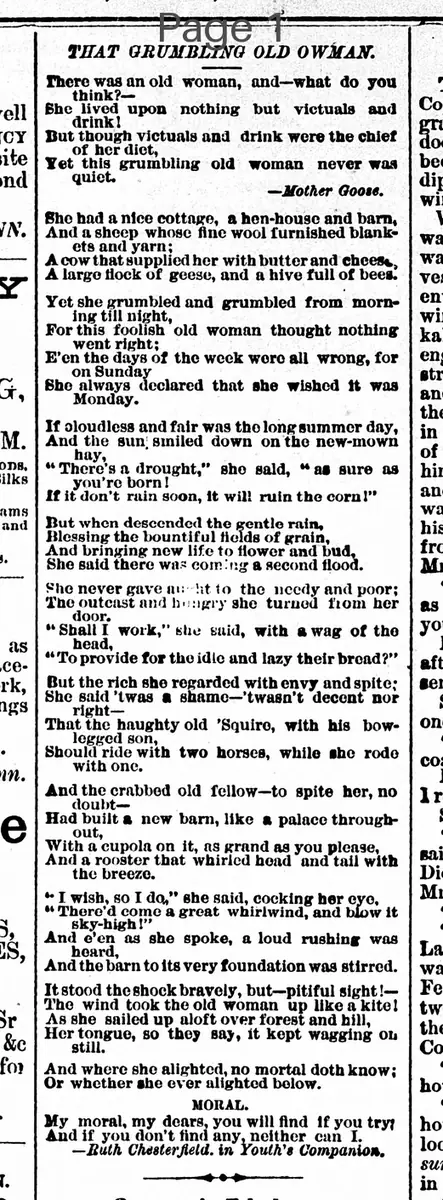
That Grumbling Old Woman
There was an old woman, and—what do you
think?
She lived upon nothing but victuals
and
drink!
But though victuals and drink were the chief
of her diet,
Yet this grumbling
old
woman
never was
quiet.
Mother Goose
She had a nice cottage, a hen-house and broom
And a sheep whose fine wool furnished blankets
and yarn;
A cow that supplied her with butter and cheese.
A large flock of geese and a hive full of bees.
Yet, she grumbled and
grumbled from morning
till night,
For this foolish
old
woman
thought nothing
went right;
Even the days of the week
were all
wrong, for
on Sunday
She always declared
That
it was
Monday.
If cloudless and fair was the long summer day,
And the sun, smiled down on the now-mown
hay,
"There's a drought,"
she'd cry.
"a sure as
you're born
If it don't rain soon, it will ruin the corn!"
But when descended the gentle rain,
Healing the bountiful fields of grain.
And bringing new life to flower and field,
She said there was coming a second flood.
She never gave aid to the needy and poor:
The outcast and hungry she turned from her
door.
"Shall I work," she said, with a wag of the
head,
"To provide for the idle and lazy their bread?"
But the rich she regarded with envy and spite;
She said 'twas a shame—'twasn't decent nor
right-
That the haughty old Squire, with his bow-
legged son
Should ride with two horses, while she rode
with one.
And the crabbed old fellow—to spite her, no
doubt
Had built a new barn, like a palace through-
out,
With a cupola on it, as grand as you please,
And a rooster that whirled head and tail with
the breeze.
"I wish, so I do." she said, cocking her eye,
"There'd come a great whirlwind, and blow it
sky-high!
And e'en as she
spoke
loud
rushing wind
was
heard,
And the barn to its very foundation was stirred.
It stood the shock bravely, but—pitiful sight!-
The wind took the old woman up like a kite!
As she sailed up aloft over forest and hill,
Her tongue, so they say, it kept wagging on
still.
And where she alighted, no mortal doth know:
Or whether she ever alighted below.
MORAL.
My moral, my dears, you will find if you try it;
And if you don't find any, neither can I.
—Ruth Chesterfield, in Youth's Companion.
There was an old woman, and—what do you
think?
She lived upon nothing but victuals
and
drink!
But though victuals and drink were the chief
of her diet,
Yet this grumbling
old
woman
never was
quiet.
Mother Goose
She had a nice cottage, a hen-house and broom
And a sheep whose fine wool furnished blankets
and yarn;
A cow that supplied her with butter and cheese.
A large flock of geese and a hive full of bees.
Yet, she grumbled and
grumbled from morning
till night,
For this foolish
old
woman
thought nothing
went right;
Even the days of the week
were all
wrong, for
on Sunday
She always declared
That
it was
Monday.
If cloudless and fair was the long summer day,
And the sun, smiled down on the now-mown
hay,
"There's a drought,"
she'd cry.
"a sure as
you're born
If it don't rain soon, it will ruin the corn!"
But when descended the gentle rain,
Healing the bountiful fields of grain.
And bringing new life to flower and field,
She said there was coming a second flood.
She never gave aid to the needy and poor:
The outcast and hungry she turned from her
door.
"Shall I work," she said, with a wag of the
head,
"To provide for the idle and lazy their bread?"
But the rich she regarded with envy and spite;
She said 'twas a shame—'twasn't decent nor
right-
That the haughty old Squire, with his bow-
legged son
Should ride with two horses, while she rode
with one.
And the crabbed old fellow—to spite her, no
doubt
Had built a new barn, like a palace through-
out,
With a cupola on it, as grand as you please,
And a rooster that whirled head and tail with
the breeze.
"I wish, so I do." she said, cocking her eye,
"There'd come a great whirlwind, and blow it
sky-high!
And e'en as she
spoke
loud
rushing wind
was
heard,
And the barn to its very foundation was stirred.
It stood the shock bravely, but—pitiful sight!-
The wind took the old woman up like a kite!
As she sailed up aloft over forest and hill,
Her tongue, so they say, it kept wagging on
still.
And where she alighted, no mortal doth know:
Or whether she ever alighted below.
MORAL.
My moral, my dears, you will find if you try it;
And if you don't find any, neither can I.
—Ruth Chesterfield, in Youth's Companion.
What sub-type of article is it?
Ballad
Satire
What themes does it cover?
Moral Virtue
Satire Society
What keywords are associated?
Grumbling Woman
Mother Goose
Complaining
Envy
Moral
Windstorm
Contentment
What entities or persons were involved?
Mother Goose; —Ruth Chesterfield, In Youth's Companion
Poem Details
Title
That Grumbling Old Woman
Author
Mother Goose; —Ruth Chesterfield, In Youth's Companion
Form / Style
Rhymed Stanzas
Key Lines
Yet, She Grumbled And Grumbled From Morning Till Night, For This Foolish Old Woman Thought Nothing Went Right;
My Moral, My Dears, You Will Find If You Try It; And If You Don't Find Any, Neither Can I.