Thank you for visiting SNEWPapers!
Sign up free
Letter to Editor
June 2, 1774
The Virginia Gazette
Williamsburg, Virginia
What is this article about?
A letter to Lord North argues against enforcing the American tea duty, highlighting colonial loyalty, rights to self-taxation, and risks of military coercion leading to rebellion. The author, having lived in America, appeals to North's moral and political sense to avoid conflict.
Clipping
OCR Quality
95%
Excellent
Full Text
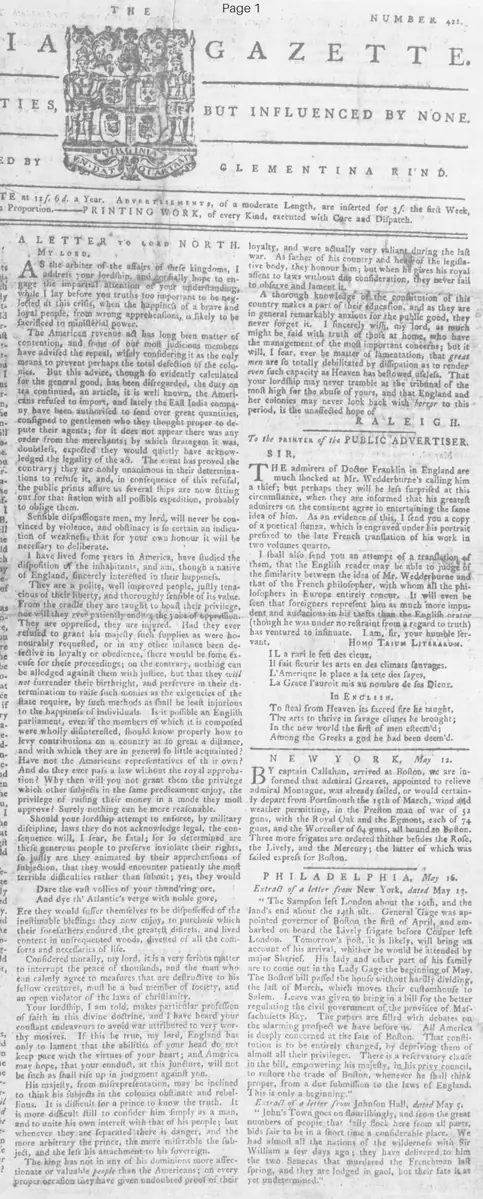
A LETTER TO LORD NORTH.
MY LORD,
AS the arbiter of the affairs of these kingdoms, I address your lordship, and cordially hope to engage the impartial attention of your understandings while I lay before you truths too important to be neglected at this crisis, when the happiness of a brave and loyal people; from wrong apprehensions, is likely to be sacrificed to ministerial power.
The American revenue act has long been matter of contention, and some of our most judicious members have advised the repeal, wisely considering it as the only means to prevent perhaps the total defection of the colonies. But this advice, though so evidently calculated for the general good, has been disregarded, the duty on tea continued, an article, it is well known, the Americans refused to import, and lately the East India company have been authorised to send over great quantities, consigned to gentlemen who they thought proper to depute their agents; for it does not appear there was any order from the merchants; by which stratagem it was, doubtless, expected they would quietly have acknowledged the legality of the act. The event has proved the contrary; they are nobly unanimous in their determinations to refuse it, and, in consequence of this refusal, the public prints assure us several ships are now fitting out at that station with all possible expedition, probably to oblige them.
Sensible dispassionate men, my lord, will never be convinced by violence, and obstinacy is so certain an indication of weakness, that for your own honour it will be necessary to deliberate.
I have lived some years in America, have studied the disposition of the inhabitants, and am, though a native of England, sincerely interested in their happiness. They are a polite, well improved people, justly tenacious of their liberty, and thoroughly sensible of its value. From the cradle they are taught to boast their privilege, nor will they ever patiently endure the yoke of oppression. They are oppressed, they are injured. Had they ever refused to grant his majesty such supplies as were honourably requested, or in any other instance been defective in loyalty or obedience, there would be some excuse for these proceedings; on the contrary, nothing can be alledged against them with justice, but that they will not surrender their birthright, and persevere in their determination to raise such monies as the exigencies of the state require, by such methods as shall be least injurious to the happiness of individuals. Is it possible an English parliament, even if the members of which it is composed were wholly disinterested, should know properly how to levy contributions on a country at so great a distance, and with which they are in general so little acquainted? Have not the Americans representatives of their own? And do they ever pass a law without the royal approbation? Why then will you not grant them the privilege which other subjects in the same predicament enjoy, the privilege of raising their money in a mode they most approve? Surely nothing can be more reasonable.
Should your lordship attempt to enforce, by military discipline, laws they do not acknowledge legal, the consequence will, I fear, be fatal: or so determined are these generous people to preserve inviolate their rights, so justly are they animated by their apprehensions of subjection, that they would encounter patiently the most terrible difficulties rather than submit; yes, they would
Dare the vast vollies of your thund'ring ore,
And dye th' Atlantic's verge with noble gore,
Ere they would suffer themselves to be dispossessed of the inestimable blessings they now enjoy, to purchase which their forefathers endured the greatest distress, and lived content in unfrequented woods, divested of all the comforts and necessaries of life.
Considered morally, my lord, it is a very serious matter to interrupt the peace of thousands, and the man who can calmly agree to measures that are destructive to his fellow creatures, must be a bad member of society, and an open violator of the laws of christianity.
Your lordship, I am told, makes particular profession of faith in this divine doctrine, and I have heard your constant endeavours to avoid war attributed to very worthy motives. If this be true, my lord, England has only to lament that the abilities of your head do not keep pace with the virtues of your heart: and America may hope, that your conduct, at this juncture, will not be such as shall rise up in judgment against you.
His majesty, from misrepresentation, may be inclined to think his subjects in the colonies obstinate and rebellious. It is difficult for a prince to know the truth. It is more difficult still to consider him simply as a man, and to unite his own interest with that of his people; but whenever they are separated there is danger, and the more arbitrary the prince, the more miserable the subject, and the less his attachment to his sovereign.
The king has not in any of his dominions more affectionate or valuable people than the Americans; on every proper occasion they have given undoubted proof of their loyalty, and were actually very valiant during the last war. As father of his country and head of the legislative body, they honour him; but when he gives his royal assent to laws without due consideration, they never fail to observe and lament it.
A thorough knowledge of the constitution of this country makes a part of their education, and as they are in general remarkably anxious for the public good, they never forget it. I sincerely wish, my lord, as much might be said with truth of those at home, who have the management of the most important concerns; but it will, I fear, ever be matter of lamentation, that great men are so totally debilitated by dissipation as to render even such capacity as Heaven has bestowed useless. That your lordship may never tremble at the tribunal of the most high for the abuse of yours, and that England and her colonies may never look back with horror to this period, is the unaffected hope of
RALEIGH.
MY LORD,
AS the arbiter of the affairs of these kingdoms, I address your lordship, and cordially hope to engage the impartial attention of your understandings while I lay before you truths too important to be neglected at this crisis, when the happiness of a brave and loyal people; from wrong apprehensions, is likely to be sacrificed to ministerial power.
The American revenue act has long been matter of contention, and some of our most judicious members have advised the repeal, wisely considering it as the only means to prevent perhaps the total defection of the colonies. But this advice, though so evidently calculated for the general good, has been disregarded, the duty on tea continued, an article, it is well known, the Americans refused to import, and lately the East India company have been authorised to send over great quantities, consigned to gentlemen who they thought proper to depute their agents; for it does not appear there was any order from the merchants; by which stratagem it was, doubtless, expected they would quietly have acknowledged the legality of the act. The event has proved the contrary; they are nobly unanimous in their determinations to refuse it, and, in consequence of this refusal, the public prints assure us several ships are now fitting out at that station with all possible expedition, probably to oblige them.
Sensible dispassionate men, my lord, will never be convinced by violence, and obstinacy is so certain an indication of weakness, that for your own honour it will be necessary to deliberate.
I have lived some years in America, have studied the disposition of the inhabitants, and am, though a native of England, sincerely interested in their happiness. They are a polite, well improved people, justly tenacious of their liberty, and thoroughly sensible of its value. From the cradle they are taught to boast their privilege, nor will they ever patiently endure the yoke of oppression. They are oppressed, they are injured. Had they ever refused to grant his majesty such supplies as were honourably requested, or in any other instance been defective in loyalty or obedience, there would be some excuse for these proceedings; on the contrary, nothing can be alledged against them with justice, but that they will not surrender their birthright, and persevere in their determination to raise such monies as the exigencies of the state require, by such methods as shall be least injurious to the happiness of individuals. Is it possible an English parliament, even if the members of which it is composed were wholly disinterested, should know properly how to levy contributions on a country at so great a distance, and with which they are in general so little acquainted? Have not the Americans representatives of their own? And do they ever pass a law without the royal approbation? Why then will you not grant them the privilege which other subjects in the same predicament enjoy, the privilege of raising their money in a mode they most approve? Surely nothing can be more reasonable.
Should your lordship attempt to enforce, by military discipline, laws they do not acknowledge legal, the consequence will, I fear, be fatal: or so determined are these generous people to preserve inviolate their rights, so justly are they animated by their apprehensions of subjection, that they would encounter patiently the most terrible difficulties rather than submit; yes, they would
Dare the vast vollies of your thund'ring ore,
And dye th' Atlantic's verge with noble gore,
Ere they would suffer themselves to be dispossessed of the inestimable blessings they now enjoy, to purchase which their forefathers endured the greatest distress, and lived content in unfrequented woods, divested of all the comforts and necessaries of life.
Considered morally, my lord, it is a very serious matter to interrupt the peace of thousands, and the man who can calmly agree to measures that are destructive to his fellow creatures, must be a bad member of society, and an open violator of the laws of christianity.
Your lordship, I am told, makes particular profession of faith in this divine doctrine, and I have heard your constant endeavours to avoid war attributed to very worthy motives. If this be true, my lord, England has only to lament that the abilities of your head do not keep pace with the virtues of your heart: and America may hope, that your conduct, at this juncture, will not be such as shall rise up in judgment against you.
His majesty, from misrepresentation, may be inclined to think his subjects in the colonies obstinate and rebellious. It is difficult for a prince to know the truth. It is more difficult still to consider him simply as a man, and to unite his own interest with that of his people; but whenever they are separated there is danger, and the more arbitrary the prince, the more miserable the subject, and the less his attachment to his sovereign.
The king has not in any of his dominions more affectionate or valuable people than the Americans; on every proper occasion they have given undoubted proof of their loyalty, and were actually very valiant during the last war. As father of his country and head of the legislative body, they honour him; but when he gives his royal assent to laws without due consideration, they never fail to observe and lament it.
A thorough knowledge of the constitution of this country makes a part of their education, and as they are in general remarkably anxious for the public good, they never forget it. I sincerely wish, my lord, as much might be said with truth of those at home, who have the management of the most important concerns; but it will, I fear, ever be matter of lamentation, that great men are so totally debilitated by dissipation as to render even such capacity as Heaven has bestowed useless. That your lordship may never tremble at the tribunal of the most high for the abuse of yours, and that England and her colonies may never look back with horror to this period, is the unaffected hope of
RALEIGH.
What sub-type of article is it?
Persuasive
Political
Ethical Moral
What themes does it cover?
Constitutional Rights
Taxation
Politics
What keywords are associated?
American Colonies
Tea Duty
Lord North
Colonial Rights
Taxation
British Parliament
East India Company
Military Enforcement
What entities or persons were involved?
Raleigh
Lord North
Letter to Editor Details
Author
Raleigh
Recipient
Lord North
Main Argument
the american revenue act, particularly the tea duty, should be repealed to avoid colonial defection and conflict; americans are loyal but tenacious of their rights to self-taxation, and enforcement by military means would be disastrous.
Notable Details
Author Lived In America And Studied Inhabitants
Quotes Poetry On Resistance: 'Dare The Vast Vollies Of Your Thund'ring Ore, And Dye Th' Atlantic's Verge With Noble Gore'
Appeals To North's Christian Faith And Aversion To War
Emphasizes Colonial Loyalty And Valor In Last War