Thank you for visiting SNEWPapers!
Sign up free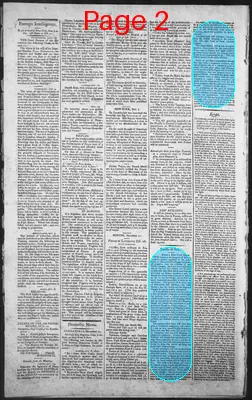
Story
December 15, 1801
The New Hampshire Gazette
Portsmouth, Rockingham County, New Hampshire
What is this article about?
Article from New-York paper discusses economic repercussions of peace after prolonged war on American society, particularly merchants: loss of freighting, shifts in trade to West Indies and Mediterranean, revival of fisheries, price reductions in staples and labor by 25-50%, providing relief despite changes.
Clipping
OCR Quality
98%
Excellent
Full Text
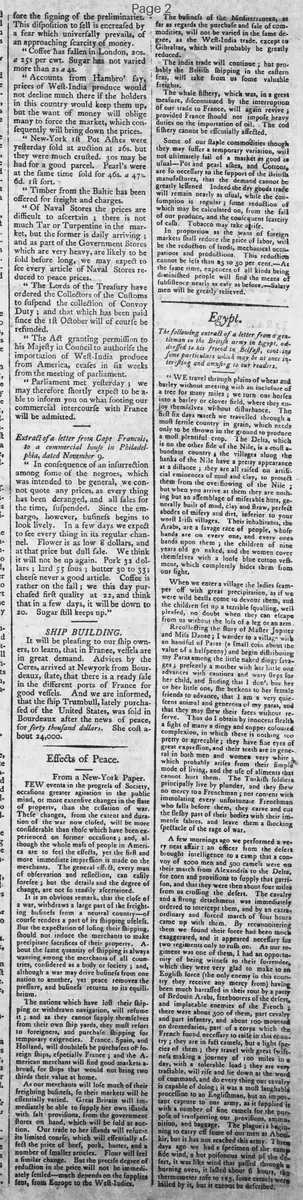
Effects of Peace.
From a New-York Paper.
FEW events in the progress of Society, occasions greater agitation in the public mind, or more extensive changes in the state of property, than the cessation of war. These changes, from the extent and duration of the war now closed, will be more considerable than those which have been experienced on former occasions; and, although the whole mass of people in America are to feel the effects, yet the first and more immediate impression is made on the merchants. The general effect, every man of observation and reflection, can easily foresee; but the details and the degree of change, are not so readily ascertained.
It is an obvious remark, that the close of a war, withdraws a large part of the freighting business from a neutral country—of course renders a part of its shipping useless. But the expectation of losing their shipping, should not induce the merchants to make precipitate sacrifices of their property. About the same quantity of shipping is always wanting among the merchants of all countries, considered as a body or society; and, although a war may drive business from one nation to another, yet peace removes the pressure, and business returns to its equilibrium.
The nations which have lost their shipping or withdrawn navigation, will resume it; and as they cannot supply themselves from their own ship yards, they must resort to foreigners, and purchase shipping for temporary exigencies. France, Spain, and Holland, will doubtless be purchasers of foreign ships, especially France; and the American merchant will find good markets abroad, for ships that would not bring two thirds their value at home.
As our merchants will lose much of their freighting business, so their markets will be essentially varied. Great Britain will immediately be able to supply her own islands with salt provisions, from the government stores on hand, which will be sold at auction. Our trade to her islands will resume its limited course, which will essentially affect the price of beef, pork, butter, and a number of smaller articles. Flour will feel a similar change. But the precise degree of reduction in the price will not be immediately settled—much depends on the supplies sent, from Europe to the West-Indies.
The business of the Mediterranean, so far as regards the purchase and sale of commodities, will not be varied in the same degree, as the West-India trade, except to Gibraltar, which will probably be greatly reduced.
The India trade will continue; but probably the British shipping in the eastern seas, will take from us some valuable freights.
The whale fishery, which was, in a great measure, discontinued by the interruption of our trade to France, will again revive; provided France should not impose heavy duties on the importation of oil. The cod fishery cannot be essentially affected.
Some of our staple commodities though they may suffer a temporary variation, will not ultimately fail of a market as good as usual—Pot and pearl ashes, and Cottons, are so necessary to the support of the British manufactures, that the demand cannot be greatly lessened Indeed the dry goods trade will remain nearly as usual, while the consumption is regular; some reduction of which may be calculated on, from the fall of our produce, and the consequent scarcity of cash. Tobacco may take a rise.
In proportion as the want of foreign markets shall reduce the price of labor, will be the reduction of lands, mechanical occupations and productions. This reduction cannot be less than 25 to 50 per cent.—At the same time, expences of all kinds being diminished people will find the means of subsistence nearly as easy as before.—Salary men will be greatly relieved.
From a New-York Paper.
FEW events in the progress of Society, occasions greater agitation in the public mind, or more extensive changes in the state of property, than the cessation of war. These changes, from the extent and duration of the war now closed, will be more considerable than those which have been experienced on former occasions; and, although the whole mass of people in America are to feel the effects, yet the first and more immediate impression is made on the merchants. The general effect, every man of observation and reflection, can easily foresee; but the details and the degree of change, are not so readily ascertained.
It is an obvious remark, that the close of a war, withdraws a large part of the freighting business from a neutral country—of course renders a part of its shipping useless. But the expectation of losing their shipping, should not induce the merchants to make precipitate sacrifices of their property. About the same quantity of shipping is always wanting among the merchants of all countries, considered as a body or society; and, although a war may drive business from one nation to another, yet peace removes the pressure, and business returns to its equilibrium.
The nations which have lost their shipping or withdrawn navigation, will resume it; and as they cannot supply themselves from their own ship yards, they must resort to foreigners, and purchase shipping for temporary exigencies. France, Spain, and Holland, will doubtless be purchasers of foreign ships, especially France; and the American merchant will find good markets abroad, for ships that would not bring two thirds their value at home.
As our merchants will lose much of their freighting business, so their markets will be essentially varied. Great Britain will immediately be able to supply her own islands with salt provisions, from the government stores on hand, which will be sold at auction. Our trade to her islands will resume its limited course, which will essentially affect the price of beef, pork, butter, and a number of smaller articles. Flour will feel a similar change. But the precise degree of reduction in the price will not be immediately settled—much depends on the supplies sent, from Europe to the West-Indies.
The business of the Mediterranean, so far as regards the purchase and sale of commodities, will not be varied in the same degree, as the West-India trade, except to Gibraltar, which will probably be greatly reduced.
The India trade will continue; but probably the British shipping in the eastern seas, will take from us some valuable freights.
The whale fishery, which was, in a great measure, discontinued by the interruption of our trade to France, will again revive; provided France should not impose heavy duties on the importation of oil. The cod fishery cannot be essentially affected.
Some of our staple commodities though they may suffer a temporary variation, will not ultimately fail of a market as good as usual—Pot and pearl ashes, and Cottons, are so necessary to the support of the British manufactures, that the demand cannot be greatly lessened Indeed the dry goods trade will remain nearly as usual, while the consumption is regular; some reduction of which may be calculated on, from the fall of our produce, and the consequent scarcity of cash. Tobacco may take a rise.
In proportion as the want of foreign markets shall reduce the price of labor, will be the reduction of lands, mechanical occupations and productions. This reduction cannot be less than 25 to 50 per cent.—At the same time, expences of all kinds being diminished people will find the means of subsistence nearly as easy as before.—Salary men will be greatly relieved.
What sub-type of article is it?
Economic Analysis
Trade Commentary
What themes does it cover?
Fortune Reversal
Misfortune
What keywords are associated?
Peace Effects
Shipping Trade
American Merchants
West India Trade
Commodity Prices
Whale Fishery
Labor Reduction
Where did it happen?
America
Story Details
Location
America
Story Details
Analysis of economic changes following the end of war, focusing on impacts to American merchants including reduced freighting business, variations in trade markets, effects on commodity prices, revival of fisheries, and overall reduction in prices of labor, lands, and occupations.